 KnowThis
Key Takeaways
Key Takeaways
- 1Mixtures are physical combinations, not chemical reactions — the substances inside keep their own identities and can, in principle, always be separated back out.
- 2A solution is a special, uniform (homogeneous) mixture where the solute breaks down to the molecular level and stays dissolved indefinitely, unlike a suspension that eventually settles.
- 3Which separation method works — filtration, evaporation, distillation, or chromatography — depends entirely on which physical property actually differs between the components: particle size, boiling point, or solubility.
The concept
Understanding that dissolving is physical, not chemical, is the key that unlocks the whole topic of separation — because if nothing chemically new was formed, everything that went in can, with the right technique, be gotten back out.
You stir a spoonful of salt into a glass of water and it seems to disappear completely. What actually happened to the salt?
Worked examples
Example 1: Is a glass of salt water saturated? (baseline case)
Example 2: Why warm soda goes flat faster than cold soda (edge case / variation)
A can of soda goes flat noticeably faster when left in a warm room than when kept in the fridge. Why?
Example 3: Separating salt from seawater by distillation (real-world / applied case)
Seawater is a solution of dissolved salts in water. Because salt has an extremely high boiling point compared to water (water boils at 100°C at sea level; salt itself has to be heated to over 1,400°C to boil), heating seawater lets the water evaporate away as vapor while the dissolved salt stays behind as a solid residue — this is simple distillation. Cooling and collecting that water vapor gives fresh, salt-free water. Large-scale desalination plants use essentially this same evaporation-and-recondensation principle (often combined with other methods like reverse osmosis) to turn seawater into drinking water, exploiting the enormous gap between water's boiling point and salt's.
How it works (visual)
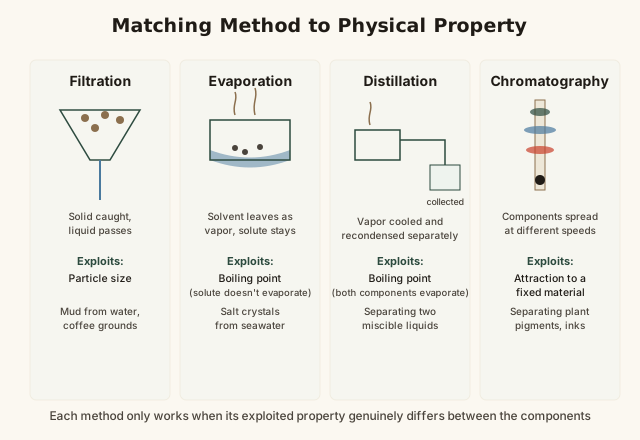
Pick the wrong tool and separation simply fails — filtration can't separate dissolved salt from water because the salt ions are far too small to be caught by any filter paper, and plain evaporation can't separate two liquids that both boil away together. Matching the technique to the actual physical property that differs between the components is the entire logic of separation chemistry.
Evaporation is distillation's simpler cousin: instead of collecting the vapor, you just let it escape and keep the solid residue that's left behind. Salt farmers use exactly this — seawater is channeled into shallow ponds and left in the sun until the water evaporates away, leaving crystallized salt behind to be harvested. It only works when you want the dissolved solid, not the liquid that boiled off; if you needed drinkable water instead, you'd have to switch to distillation to capture the vapor.
Chromatography separates components that are all dissolved together and don't differ in boiling point at all — it relies on a third property instead: how strongly each component clings to a fixed material versus how readily it travels with a moving liquid. A classic classroom version: dot a small blob of black felt-tip ink near the bottom of a strip of filter paper, then stand the strip upright with just its tip touching water. As the water climbs up the paper by capillary action, it drags the ink's dissolved dyes along with it — but not all at the same speed. Dyes that cling more weakly to the paper fibers travel farther and faster, while dyes that cling more strongly lag behind, so the single black dot fans out into separate bands of blue, red, and yellow. The same principle, scaled up, is what forensic labs use to identify unknown chemical samples and what quality-control labs use to check that a drug or food product doesn't contain unexpected contaminants.
Common mistakes
Common Mistakes
Thinking dissolving is a chemical reaction, so the dissolved substance is 'gone for good.'
→ Dissolving is a physical change. Evaporating the solvent (like boiling away water from salt water) recovers the original solute completely unchanged.
Assuming every mixture must look uniform to count as a mixture.
→ Heterogeneous mixtures like sand in water, or a salad, are still mixtures even though you can visibly see the separate parts — 'mixture' just means a physical combination, not necessarily a uniform one.
Believing a solution can dissolve an unlimited amount of solute no matter how much you add.
→ Every solvent has a solubility limit at a given temperature. Past that saturation point, extra solute simply won't dissolve and settles out as a visible solid.
Common misconception
“Muddy water can't be made clean again because the dirt has permanently mixed into the water.”
Mud in water is a heterogeneous mixture (often closer to a suspension) — the dirt particles haven't chemically bonded with the water at all, they're just physically suspended in it. Given enough time, gravity alone will settle most of the particles out; filtration removes the rest almost immediately by trapping particles too large to pass through the filter's openings, while the water itself passes straight through. Because no chemical reaction occurred, full physical separation is always possible in principle — it just needs the right technique and, for water treatment at scale, often several combined techniques.
Why can filtration completely separate mud from water, but not salt from water?
Try it yourself
What to do next
What to do next
- Next time you sweeten iced tea, notice how much easier sugar dissolves in the hot version — that's solubility rising with temperature in action.
- Watch a can of soda go flat over a warm afternoon and connect it to gas solubility dropping as temperature rises.
- Try the mass percent calculator above with your own kitchen numbers, like a saltwater brine recipe, to see the actual concentration.
- Read the related entry on Acids, Bases & pH to see how dissolved hydrogen ions in a solution connect to this same solute-and-solvent framework.