Common Household Chemistry: The Real Chemistry Behind Cleaning Products
Household cleaning products work through real, predictable chemistry — soap bridges water and oil, and certain combinations like bleach and ammonia react dangerously, not just as a warning label.
Reading time
— 5 min
Updated
— Aug 16, 2026
Fact-reviewed
— Aug 16, 2026
Key Takeaways
Key Takeaways
1Soap works because its molecules have two different ends — one that bonds with water, one that bonds with oil and grease — physically bridging the two so grease can be rinsed away with water.
2Bleach and ammonia-based cleaners must never be mixed: the reaction produces toxic chloramine vapors that can cause serious respiratory injury, and this is real, documented chemistry, not an exaggerated warning.
3Most cleaning chemistry boils down to a handful of principles — surfactants, oxidizers, and acid-base reactions — repeated across dozens of different product formulations.
The concept
Water alone doesn't wash away grease and oil, because water and oil don't mix — that's why a greasy pan rinsed with plain water still feels slick. Soap solves this by having one end of its molecule that likes water and one end that likes oil, letting it grab onto grease and carry it into the water to be rinsed away. Bleach works differently, breaking down stains and killing germs through a strong chemical reaction — and that reactive strength is exactly why bleach becomes dangerous if combined with the wrong other chemical, like ammonia.
Understanding surfactants explains why soap works at all — but the more urgent, practical chemistry to internalize is exactly which combinations of ordinary cleaning products turn a safe routine into a genuine hazard.
Quick check
Why doesn't rinsing a greasy pan with plain water alone remove the grease?
Worked examples
Example 1: Washing a greasy plate with soap (baseline case)
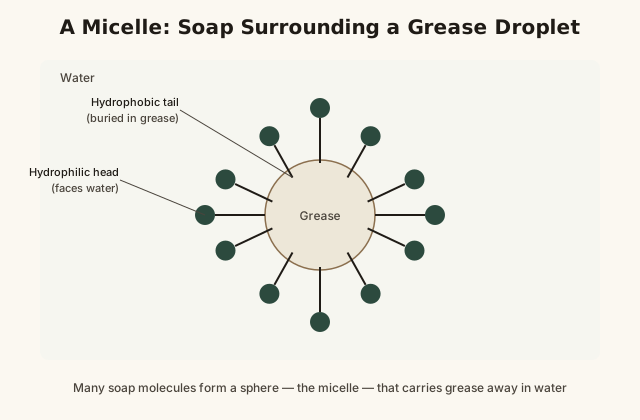
Rub soap onto a greasy plate under running water, and surfactant molecules immediately begin surrounding grease droplets with their oily tails burrowing into the fat and their water-loving heads facing outward into the surrounding water. This forms micelles — microscopic grease-carrying spheres that stay suspended in the water rather than re-sticking to the plate — which is why the water runs cloudy rather than the grease simply spreading thinner across the surface. Rinsing then carries those suspended micelles away entirely.
Example 2: Why bleach and ammonia must never be combined (edge case / variation)
Bleach (sodium hypochlorite solution) reacting with ammonia produces a cascade of reactions generating chloramine gases — compounds that are respiratory irritants at low exposure and can cause serious lung injury at higher concentrations. This danger applies even when neither product is labeled with the word "ammonia" explicitly: some glass cleaners, some multi-purpose cleaners, and even urine (which breaks down into ammonia-related compounds) can trigger the same reaction if combined with bleach in an enclosed space like a bathroom. This is exactly why cleaning product labels warn against mixing different cleaning chemicals in general, rather than just naming bleach and ammonia specifically — the safest default is never combining two different cleaning products at all.
Quick check
A bathroom cleaner doesn't have 'ammonia' printed on its label, but a person mixes it with bleach anyway and experiences coughing and eye irritation. What's the most likely explanation?
Example 3: How dishwasher detergent handles hard water minerals (real-world / applied case)
Hard water contains dissolved calcium and magnesium ions that react with ordinary soap to form a sticky, insoluble residue — soap scum — instead of rinsing cleanly. Dishwasher and laundry detergents address this with added water softeners (often compounds that bind to calcium and magnesium ions, effectively removing them from solution before they can interfere) alongside the primary surfactants. This is why a detergent formulated for hard water regions performs noticeably better there than plain bar soap would, and why some regions see more scale buildup and cleaning difficulty than others purely due to their local water mineral content.
How it works (visual)
How a surfactant molecule surrounds a grease droplet
Each soap molecule orients itself at the boundary between water and grease, tail-first into the fat. Enough molecules surrounding a single grease droplet form a stable sphere — a micelle — small enough to stay suspended in water rather than settling back onto a surface, which is the entire physical mechanism that makes rinsing effective.
Common mistakes
Common Mistakes
✕
Assuming 'natural' or 'homemade' cleaning mixtures are automatically safe to combine.
→ Danger comes from chemical composition, not from whether a product is store-bought or homemade — vinegar mixed with bleach, for example, releases toxic chlorine gas, regardless of how natural either ingredient sounds.
✕
Thinking hotter water alone can substitute for soap when washing greasy dishes.
→ Heat can loosen grease somewhat, but water and oil remain fundamentally immiscible at any reasonable temperature — a surfactant is still needed to actually lift grease away rather than just spread it.
✕
Believing a cleaning product is safe to mix with anything as long as it doesn't say 'ammonia' or 'bleach' on the front label.
→ Check full ingredient lists, not just prominent labels — many multi-purpose cleaners contain ammonia-related or bleach-related compounds without those exact words being the headline term.
Common misconception
“Using more cleaning product, or combining several different cleaners at once, always cleans better.”
Combining cleaning chemicals is far more likely to create a hazardous reaction (like bleach and ammonia producing toxic chloramine gas) than to clean more effectively — most cleaning products are formulated to work best alone, and layering them can even leave more residue or damage surfaces. Using significantly more than the recommended amount of a single product also rarely improves results past a certain point, since surfactants and other active ingredients work by a fixed, saturating chemical mechanism, not an unlimited scaling one.
Quick check
A person combines two different bathroom cleaning sprays hoping for extra cleaning power. What is the actual, well-documented risk of this habit?
What to do next
What to do next
Check the ingredient labels of your household cleaners for ammonia or bleach (sodium hypochlorite), and store them separately, never combining them.
Next time you wash greasy dishes, notice how the water turns cloudy rather than the grease simply spreading — that's micelles forming and carrying grease away.
Ventilate any space well when using bleach-based products, and never use them in an already-cleaned space that may still have ammonia-based residue.
Read the related entry on Acids, Bases & pH to see how the acid-base chemistry in some cleaners connects to this same reactive framework.
FAQ
FAQ
Related terms
Related terms
Surfactant
A compound (like soap) that reduces water's surface tension and bridges water and oil-based substances, letting them mix and be rinsed away together.
Hydrophilic
'Water-loving' — a molecular part that is attracted to and dissolves in water.
Hydrophobic
'Water-fearing' — a molecular part that repels water and instead is attracted to oils and fats.
Oxidizer
A substance (like bleach) that reacts by taking electrons from other substances, often used to break down stains and kill microorganisms.
Toxic gas reaction
A chemical reaction between household products that produces a harmful gas, such as chloramine vapors from mixing bleach and ammonia-based cleaners.
 KnowThis