 KnowThis
Key Takeaways
Key Takeaways
- 1The pH scale runs from 0 (strongly acidic) to 14 (strongly basic), with 7 as neutral — pure water is the standard neutral reference point.
- 2pH is logarithmic, not linear: each single-point drop means the solution is 10 times more acidic, not just 'a bit more'. A pH of 4 is 1,000 times more acidic than a pH of 7.
- 3Acids and bases neutralize each other in a predictable chemical reaction, which is the working principle behind antacids, soap, and treating an acidic sting or spill.
The concept
That logarithmic structure is the single most important — and most commonly misunderstood — thing about the pH scale, and it only clicks once you compare real numbers directly.
Solution A has a pH of 3. Solution B has a pH of 5. How much more acidic (higher hydrogen ion concentration) is Solution A compared to Solution B?
Worked examples
Example 1: Calculating pH from hydrogen ion concentration (baseline case)
Example 2: Why stomach acid doesn't dissolve the stomach itself (edge case / variation)
Stomach acid is strong enough to dissolve metal over time, yet it doesn't normally damage the stomach itself. Why?
Example 3: How antacids neutralize excess stomach acid (real-world / applied case)
How it works (visual)
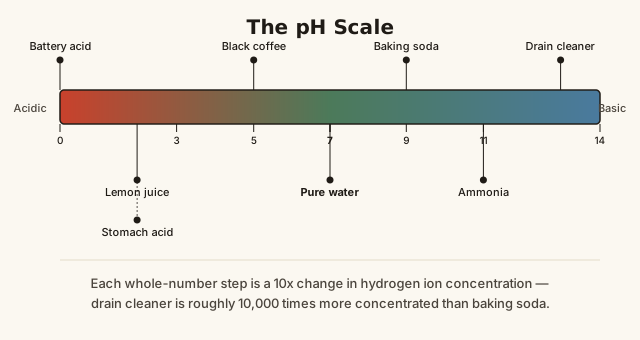
Notice how tightly clustered many familiar substances are near the neutral middle, while a small number of extreme substances (battery acid, drain cleaner) sit far out at either end. Because the scale is logarithmic, that visual distance corresponds to an enormous real difference in hydrogen ion concentration — pH 13 drain cleaner isn't "a bit more basic" than pH 9 baking soda, it's roughly 10,000 times more concentrated in its basic strength.
Common mistakes
Common Mistakes
Treating the pH scale as linear, assuming a pH of 4 is 'twice as acidic' as a pH of 8.
→ pH is logarithmic — each single-point difference is a 10x change in hydrogen ion concentration. A pH of 4 versus 8 is a 10,000-fold difference, not a 2x difference.
Assuming 'basic' or 'alkaline' automatically means safer or gentler than 'acidic.'
→ Strength matters independent of direction. Concentrated bases like drain cleaner (pH ~13-14) are just as capable of causing severe chemical burns as concentrated acids — both extremes of the scale can be hazardous.
Thinking neutral (pH 7) means 'contains no chemicals' or is automatically the safest possible value.
→ Neutral simply means balanced hydrogen and hydroxide ion concentrations — it says nothing about what else is dissolved in a solution, or whether that solution is safe to touch or ingest.
Common misconception
“A lower pH number always means a more dangerous or corrosive substance.”
Danger depends on both how far a substance sits from neutral and its concentration — not the pH number alone in isolation. Lemon juice sits around pH 2, similar to some stomach acid, and is perfectly safe to drink in normal amounts; concentrated sulfuric acid, also very low pH, causes severe chemical burns. Meanwhile, a strong base like drain cleaner at the opposite end of the scale (pH ~13-14) can be just as hazardous as a strong acid. The number alone, without context on concentration and exposure, doesn't tell the whole safety story.
Lemon juice (pH ~2) is safe to drink, but concentrated battery acid (also very low pH) causes severe burns. What explains the difference?
Try it yourself
What to do next
What to do next
- Try the calculator above with a hydrogen ion concentration of 0.00000001 (10⁻⁸ M) to see how a slightly basic solution comes out — it should land just above pH 7.
- Next time you use an antacid, connect the relief to a genuine acid-base neutralization reaction happening in your stomach.
- Check the pH of common household liquids (coffee, soap, tap water) with pH test strips to see how tightly most familiar substances cluster near neutral.
- Read the related entry on Chemical Reactions & Everyday Chemistry to see how neutralization fits into the broader picture of reactions.