 KnowThis
Key Takeaways
Key Takeaways
- 1A chemical reaction rearranges atoms into new substances with genuinely different properties — this is what separates it from a physical change like melting or cutting.
- 2Mass is always conserved in a chemical reaction: the total mass of everything you start with exactly equals the total mass of everything you end with, even if a gas escapes and it looks like mass 'disappeared'.
- 3Reactions either release energy (exothermic, like combustion or rusting) or absorb it (endothermic, like a cold pack activating), and this energy direction explains why some reactions feel hot and others feel cold.
The concept
Conservation of mass sounds like a rule for a chemistry classroom until you apply it to something that seems to violate it at first glance — like an object that appears to lose mass simply by burning.
A piece of wood is weighed, then burned completely, and the leftover ash weighs far less than the original wood. Has mass been destroyed?
Worked examples
Example 1: Baking soda and vinegar (baseline case)
Example 2: Rusting iron — a slow reaction with the same rules (edge case / variation)
Rusting happens over weeks while an explosive reaction happens in milliseconds. What does this difference in speed tell you about whether both are 'real' chemical reactions?
Example 3: Instant cold packs and hot packs (real-world / applied case)
One more variable changes how fast any of these reactions run without changing what they produce: a catalyst. A catalyst provides an alternative reaction pathway that needs less activation energy to get started, so the same reaction happens faster at the same temperature — without the catalyst itself being consumed or showing up in the final products. The catalytic converter under a car is an everyday example: exhaust gases pass over a honeycomb coated in platinum, palladium, and rhodium, and those metals speed up the conversion of toxic carbon monoxide and unburned fuel into carbon dioxide and water vapor, without the metals themselves being used up — the same small amount of catalyst keeps working for the life of the car. The human body runs on the same principle at a much smaller scale: enzymes are biological catalysts that speed up digestion and metabolism by factors of millions, which is the only reason reactions that would otherwise take hours in a lab happen fast enough inside you to sustain life.
How it works (visual)
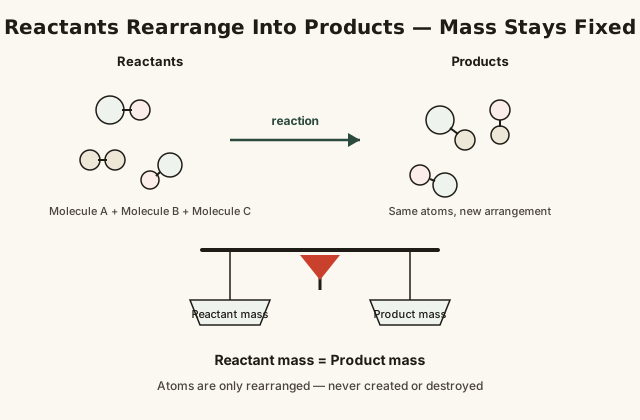
The atoms present before the arrow are the exact same atoms present after it — none are added or removed, only rearranged into new bonding patterns. This is why chemical equations must always be "balanced": the same number of each type of atom has to appear on both sides, a direct bookkeeping consequence of conservation of mass.
Common mistakes
Common Mistakes
Confusing a physical change (melting, dissolving, cutting) with a chemical reaction.
→ Ask whether a genuinely new substance formed with different properties. Melting ice is still H₂O — a physical change. Rusting iron becomes iron oxide, a different substance — a chemical reaction.
Thinking mass disappears when a reaction produces a gas or a visible flame.
→ Mass is always conserved — gases and heat carry mass and energy away in ways that are easy to miss on a simple kitchen scale, but nothing is actually destroyed.
Assuming a fast, dramatic reaction is more 'chemical' than a slow one.
→ Reaction speed depends on conditions like concentration and temperature, not on whether a genuine chemical reaction is occurring. Rusting and explosions are both real chemical reactions at very different speeds.
Common misconception
“Mixing chemicals that fizz, bubble, or change color always means something dangerous or unnatural is happening.”
Fizzing, color changes, and heat release are simply visible signs that bonds are breaking and reforming — they happen constantly in safe, everyday contexts: bread rising uses a biological reaction producing carbon dioxide bubbles, and antacid tablets fizzing in water use the same acid-base chemistry as baking soda and vinegar. The visible drama of a reaction says nothing about whether it's dangerous — that depends entirely on the specific substances and products involved, which is why reading labels and following safety guidance matters more than judging a reaction by how dramatic it looks.
An antacid tablet fizzes vigorously when dropped in water. Does the visible fizzing alone tell you whether this reaction is dangerous?
What to do next
What to do next
- Next time you see rust, bread rising, or a fizzing tablet, identify what new substance is actually forming — that's the signature of a genuine chemical reaction.
- Try the baking soda and vinegar reaction in a sealed balloon-topped bottle at home and notice the balloon inflate — that's the escaping gas mass made visible.
- Notice whether a reaction feels warm (exothermic) or cool (endothermic) to the touch, and connect it to whether bond-forming or bond-breaking is winning out energetically.
- Read the related entry on Atoms & Elements to see what's actually being rearranged during a chemical reaction at the atomic level.