 KnowThis
Key Takeaways
Key Takeaways
- 1An atom is built from protons and neutrons packed into a tiny nucleus, surrounded by electrons — and it's the proton count alone that determines which element you have.
- 2The periodic table isn't an arbitrary list — it's arranged so elements with similar chemical behavior line up in the same column, because that behavior comes from electron patterns that repeat predictably.
- 3Atoms of the same element can still differ in mass (isotopes) if they have different numbers of neutrons, without changing what element they are.
The concept
That predictive power is exactly what made the periodic table more than just a list — it's an organizing principle you can actually use.
An atom has 6 protons and 8 neutrons. A second atom has 6 protons and 6 neutrons. Are they the same element?
Worked examples
Example 1: Identifying an element from its proton count (baseline case)
Example 2: Why carbon dating works on isotopes, not elements (edge case / variation)
Example 3: Why sodium and chlorine bond so readily (real-world / applied case)
Sodium (1 outer electron) and chlorine (7 outer electrons, needing 1 more for a full shell) react to form table salt. What actually happens between them?
How it works (visual)
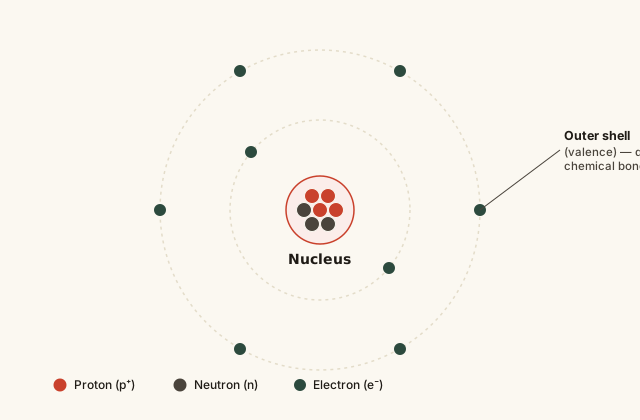
Nearly all of an atom's mass sits in the tiny, dense nucleus at the center, while the electrons — which take up almost all the atom's actual volume — orbit at proportionally much greater distances. The outermost shell is what interacts with other atoms during chemical reactions.
Common mistakes
Common Mistakes
Thinking atomic mass and atomic number are the same thing.
→ Atomic number is the proton count (defines the element); atomic mass reflects protons plus neutrons combined, and varies slightly between isotopes of the same element.
Assuming electrons orbit the nucleus like planets orbit the sun, in neat fixed circular paths.
→ Electrons actually exist in fuzzy probability regions called orbitals — the neat circular-orbit picture is a simplified teaching model, not physically accurate at the quantum scale.
Believing isotopes of an element are essentially 'different elements.'
→ Isotopes are chemically almost identical — same proton count, same electron behavior, same element — they differ only in mass and sometimes radioactive stability.
Common misconception
“Atoms are the smallest possible particles of matter, indivisible as the Greek word 'atomos' suggests.”
Atoms are actually made of smaller particles — protons, neutrons, and electrons — and protons and neutrons themselves are made of even smaller particles called quarks. The ancient Greek concept of an indivisible smallest unit was a philosophical guess later borrowed as a name; 20th-century physics discovered atoms very much can be split, which is literally how nuclear power and nuclear weapons work.
Try it yourself
What to do next
What to do next
- Look up your favorite element's position on the periodic table and notice which column it's in — that column shares its bonding behavior.
- Try the calculator above with a few real isotopes (carbon-12 vs carbon-14, both 6 protons) to see how mass number changes without the element changing.
- Next time carbon dating comes up in the news, remember it's measuring an isotope ratio, not detecting 'carbon' itself.