 KnowThis
Key Takeaways
Key Takeaways
- 1Electric current is charge in motion, driven by voltage and limited by resistance — related by Ohm's law: V = IR.
- 2Electricity and magnetism aren't separate forces — moving electric charge always creates a magnetic field, which is how electromagnets and motors work.
- 3Higher resistance for the same voltage means less current flows — this is exactly how a dimmer switch or a thinner wire changes brightness or heat output.
The concept
Set electromagnets aside for a moment and look at an ordinary bar magnet, the kind stuck to a fridge. Every magnet has two magnetic poles, labeled north and south, and the rule governing them is simple and absolute: like poles repel, opposite poles attract. That force comes from the same underlying cause as an electromagnet's field — inside the magnet's atoms, electrons behave like countless tiny current loops, and in a magnetized material enough of them line up in the same direction that their fields add together instead of canceling out, producing one net field with a north and south end. A compass needle is just a small, freely spinning magnet: its north pole is pulled toward Earth's magnetic south pole (which sits near the geographic North Pole), which is why it points north. Cut a bar magnet in half and you don't get an isolated north pole and an isolated south pole — you get two smaller magnets, each with its own north and south end, because the alignment (not some physical "north chunk") is what creates a pole in the first place.
Ohm's law is simple to state, but it explains a surprising range of everyday electrical behavior once you run real numbers through it.
A circuit's resistance doubles while the voltage stays the same. What happens to the current?
Worked examples
Example 1: A simple flashlight circuit (baseline case)
Example 2: Why thin wires overheat (edge case / variation)
Example 3: How an electric motor turns current into motion (real-world / applied case)
An electric generator and an electric motor both involve a coil of wire and a magnet. What's the key difference in how they work?
Example 4: Why one dead bulb kills an old string of Christmas lights but not your kitchen outlet (real-world / applied case)
Why does unplugging one lamp in your living room not turn off the other lamps and appliances in the same room?
How it works (visual)
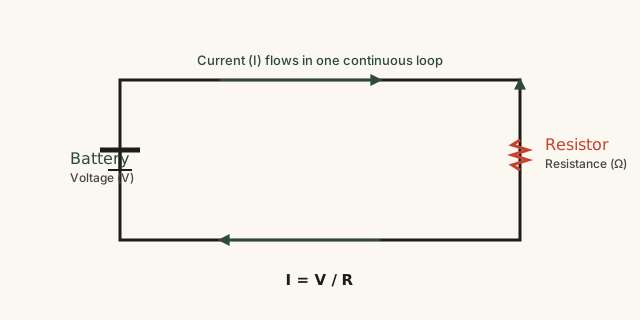
Current flows in one continuous loop — from the battery's positive terminal, through the resistor (anything that uses the electricity, like a bulb or motor), and back to the battery's negative terminal. Break the loop anywhere and current stops flowing entirely, which is exactly what a switch does on purpose.
Common mistakes
Common Mistakes
Thinking current 'gets used up' as it flows around a circuit.
→ The same current flows through every point of a simple series circuit — energy is used up (converted to light, heat, or motion), but the charge itself isn't consumed.
Confusing voltage and current as the same thing.
→ Voltage is the driving 'pressure,' current is the actual flow rate — a 9V battery and a car battery can produce very different currents depending on the circuit's resistance, despite different voltages.
Assuming all magnets are permanent and unrelated to electricity.
→ Every magnetic field is ultimately caused by moving electric charge, whether that's current in a wire (electromagnet) or electrons spinning within atoms (permanent magnet).
Assuming all circuits behave like a single loop, so one broken link always kills everything downstream.
→ That's only true for a series circuit. In a parallel circuit — how household wiring is done — each branch has its own independent path, so one dead component doesn't cut power to the rest.
Common misconception
“Electric current flows through a wire almost instantly, at close to the speed the electrons themselves are moving.”
Individual electrons in a wire actually drift extremely slowly — often just millimeters per second. What travels fast (close to the speed of light in the wire) is the electric field that pushes all the electrons in the circuit to start moving at nearly the same time, like a long line of train cars all jolting forward together the instant the engine pulls, even though no single car moves quickly. That's why a light switch seems to work instantly, even though the electrons themselves are barely crawling.
Try it yourself
What to do next
What to do next
- Check the wattage rating on an extension cord before plugging in a high-draw appliance — it exists to prevent the overheating problem in Example 2.
- Next time you see a dimmer switch, remember it's literally adding resistance to reduce current and dim the bulb.
- Look for the electromagnet inside a doorbell or a relay click — it's one of the simplest visible examples of current creating magnetism.
- Look at your home's breaker panel and notice it's split into multiple circuits — that's the parallel-wiring principle in action, isolating problems to one branch instead of the whole house.