 KnowThis
Key Takeaways
Key Takeaways
- 1A force is any push or pull — without a net force, a moving object keeps moving and a still object stays still (Newton's first law).
- 2How much an object accelerates under a force depends on its mass: F = ma. Same force, more mass, less acceleration.
- 3Every force has an equal and opposite reaction — a rocket doesn't push against air, it pushes against its own exhaust.
The concept
Those three laws sound abstract until you run real numbers through them — which is where F = ma stops being a formula to memorize and starts being a tool you can actually use.
You push a shopping cart and a loaded moving truck with the exact same force. What happens?
Worked examples
Example 1: Pushing a shopping cart (baseline case)
Example 2: The same push, a stalled car (edge case / variation)
Example 3: Why seatbelts and airbags exist (real-world / applied case)
Two cars going the same speed crash into a wall — one has crumple zones that fold and take a full second to stop, the other is rigid and stops in a tenth of a second. Which passenger experiences more force?
How it works (visual)
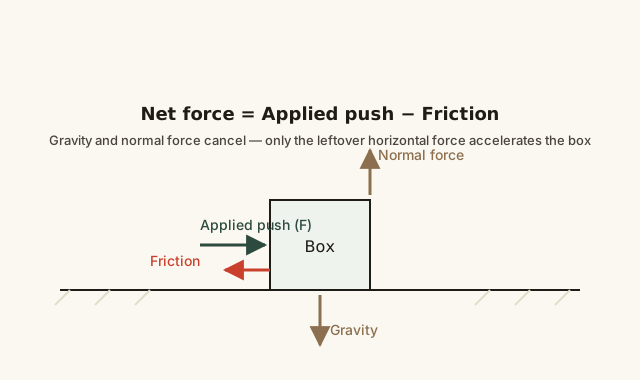
Notice that four forces act on the box at once — gravity down, the floor pushing back up (normal force), your push forward, and friction resisting that push. Gravity and the normal force cancel out exactly (the box doesn't sink or float), so the box's actual acceleration only depends on the leftover, unbalanced part: your push minus friction. That leftover is the net force that F = ma actually describes.
Common mistakes
Common Mistakes
Thinking a constant force is needed just to keep something moving at a steady speed.
→ Constant velocity needs zero net force (Newton's first law) — the only reason cars and bikes need continuous engine force is to cancel out friction and air resistance, not to 'maintain' motion itself.
Using weight and mass interchangeably.
→ Mass is how much matter an object has (kg) and never changes; weight is the force of gravity on that mass (newtons) and changes depending on where you are — your mass on the Moon is identical to on Earth, but your weight is about one-sixth.
Assuming a bigger object always needs a bigger force to move it.
→ It depends entirely on the acceleration you want. A huge, nearly frictionless object (a ship drifting in water) can be moved by a small force — it'll just accelerate very slowly.
Common misconception
“Heavier objects fall faster than lighter ones.”
Ignoring air resistance, every object accelerates due to gravity at the same rate — about 9.8 m/s² near Earth's surface — regardless of mass. A heavier object does experience more gravitational force, but it also has proportionally more mass resisting that force (from F = ma), and the two effects exactly cancel. Galileo is credited with demonstrating this; astronauts repeated it dramatically on the Moon in 1971, dropping a hammer and a feather that hit the ground at the same instant in the airless vacuum.
Try it yourself
What to do next
What to do next
- Next time you push something heavy, notice how much harder the first instant is — that's overcoming static friction before F = ma even applies.
- Try the calculator above with a bicycle's mass (~12 kg) versus a car's (~1,500 kg) at the same acceleration to feel the scale difference in force.
- Watch for Newton's third law in ordinary life — walking, swimming, and rockets all work by pushing something backward to go forward.