 KnowThis
Key Takeaways
Key Takeaways
- 1Matter changes state based on how much energy its particles carry — 'cold' isn't a substance being added, it's heat energy being removed.
- 2During a phase change, energy goes into breaking or forming particle bonds instead of raising temperature — this is why melting ice stays at 0°C the entire time it's melting.
- 3This one mechanism — latent heat — is the working principle behind refrigerators, air conditioners, pressure cookers, sweating, and fog formation.
The concept
The particle picture explains what a state is. The next question — and the one with the real payoff — is what happens during the switch from one state to another, because that switch is where most of the energy movement (and most of the useful engineering) happens.
You put an ice cube in a warm room and it melts into a puddle of water. What is happening to the water molecules during this process?
Worked examples
Two drinks start at the same temperature. One is cooled with 30g of ice at 0°C, the other with 30g of liquid water chilled to 0°C. Which cools the drink more, and why?
Example 1: Ice melting into water — with real numbers (baseline case)
Example 2: Water boiling at different altitudes (edge case / variation)
A pressure cooker seals in steam and cooks food faster than an open pot. What is the main physical reason for this?
Example 3: How your fridge and AC use phase changes to move heat (real-world / applied case)
A refrigerator or air conditioner doesn't "make cold" — it moves heat from inside to outside using a repeating cycle of phase changes in a refrigerant fluid. The refrigerant is compressed into a hot, high-pressure liquid, then allowed to expand and evaporate inside the fridge's interior coils. Because evaporation absorbs large amounts of latent heat (just like melting ice, but liquid-to-gas instead of solid-to-liquid), the evaporating refrigerant pulls heat out of the air inside the fridge, cooling it. The now-gaseous refrigerant is pumped back to a compressor, turned back into a hot liquid, and releases that absorbed heat to the outside air through the coils on the back of the fridge — which is why the back of a fridge feels warm. The entire appliance is essentially an engineered loop of evaporation and condensation, repeated continuously.
How it works (visual)
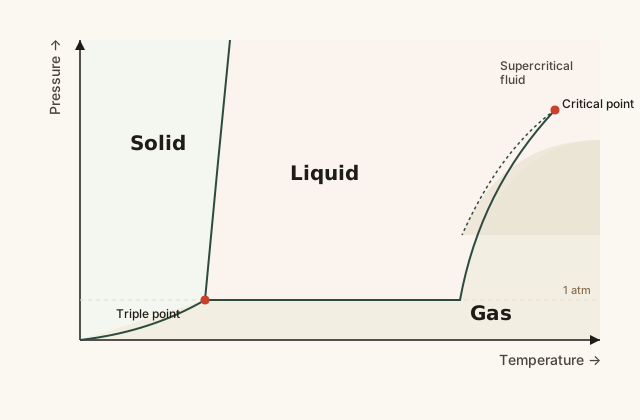
Trace a horizontal line across the diagram at normal atmospheric pressure (1 atm) — as you move left to right (increasing temperature), you cross the solid-liquid boundary at water's melting point (0°C) and the liquid-gas boundary at its boiling point (100°C). Now trace a vertical line at a fixed temperature and slide it up or down — that's what happens inside a pressure cooker (pressure rising pushes you further right along the liquid-gas boundary, raising the effective boiling point) or on a mountaintop (pressure falling pushes the boiling point down). The single point where all three regions meet is the triple point; above the point marked "critical point" at the top of the liquid-gas line, liquid and gas stop being physically distinguishable at all — this is called a supercritical fluid, used industrially in decaffeinating coffee with supercritical CO₂.
Common mistakes
Common Mistakes
Thinking 'cold' is something that gets added to a substance, rather than heat being removed.
→ Reframe it: cold is the absence or reduction of heat energy, not a substance flowing in on its own — a fridge removes heat, it doesn't inject cold.
Assuming a substance's temperature keeps rising steadily while it's changing state (e.g., while ice is melting or water is boiling).
→ Remember temperature holds steady at the melting or boiling point until the entire state change finishes — the energy is going into latent heat, not raising temperature.
Believing all solids are denser than their liquid form.
→ Water/ice is a well-known exception — ice is about 9% less dense than liquid water, which is why it floats. Most other substances are denser as solids than as liquids.
Thinking boiling point is a fixed property that never changes.
→ Boiling point shifts with pressure — lower at altitude, higher inside a sealed pressure cooker. Only at a specified standard pressure (usually 1 atm) is '100°C' the correct number for water.
Common misconception
“Sweating cools you down because the sweat itself feels cold on your skin.”
Sweat cools you through evaporation, not through the liquid's temperature. As sweat evaporates off your skin, it pulls latent heat directly from your body to power that phase change — the same 2,260 joules-per-gram of latent heat of vaporization involved in boiling water applies here at body temperature, just at a slower rate. That's why sweating in a humid environment cools you far less effectively: the surrounding air is already saturated with water vapor, so evaporation slows down and the heat-removal mechanism stalls.
You feel much less cooling relief from sweating on a humid day than on a dry day, even though you're sweating just as much. Why?
Try it yourself
What to do next
What to do next
- Time how long it takes an equal mass of ice versus very cold water to cool a drink to the same temperature — the ice will win, and now you know exactly why (latent heat, not just temperature difference).
- Next time you use a pressure cooker, connect the faster cooking time to a higher boiling point caused by higher internal pressure, not just 'more heat.'
- On a humid day, notice how much less effective sweating feels compared to a dry day — that's the evaporation mechanism being slowed by already-saturated air.
- Read the related entry on Heat & Temperature to go deeper on what temperature actually measures at the particle level, and Pressure for how it governs phase changes.