Pressure: Why a Sharp Knife Cuts and a Snowshoe Doesn't Sink
Pressure is force spread over an area — the same force concentrated on a small area creates far more pressure than spread across a large one.
Reading time
— 4 min
Updated
— Aug 16, 2026
Fact-reviewed
— Aug 16, 2026
Key Takeaways
Key Takeaways
1Pressure is force divided by the area it's spread over — the same force concentrated on a tiny area (a knife edge) creates dramatically more pressure than spread across a large one (the flat side of the blade).
2This is why snowshoes, wide tires, and flat feet on soft ground prevent sinking: spreading the same body weight over a larger area lowers pressure below the threshold that would cause sinking.
3Air itself has weight, and atmospheric pressure — about 101,325 pascals at sea level — drops with altitude, which is the direct reason water boils at a lower temperature on a mountain.
The concept
Pressure is what you get when a force is squeezed into a smaller space. Push on something with your palm flat, and the force spreads out, feeling gentle. Push with the same force through one finger, and it feels far more intense — same force, smaller area, more pressure. A sharp knife cuts easily not because it applies more force than a dull one, but because its thin edge concentrates that force onto a tiny area, creating enough pressure to slice through material a wider blade couldn't.
That balance between force and area is easiest to see with real numbers — the same force behaves completely differently depending on how much area it's spread across.
Quick check
Pressing a thumbtack into a board takes much less effort than pressing a coin of the same force into the same board. Why?
Worked examples
Example 1: A person standing versus balancing on one heel (baseline case)
A 700-newton person (about 71 kg) standing with both feet flat, contact area roughly 0.04 m² per foot (0.08 m² total), experiences pressure of 700 ÷ 0.08 = 8,750 pascals on the ground. Balance on just one heel with a contact area of roughly 0.002 m², and the same 700 newtons of weight now produces 700 ÷ 0.002 = 350,000 pascals — a 40x increase in pressure from the exact same body weight, purely from shrinking the contact area. This is why standing on one heel in soft ground or on someone's foot hurts far more than standing flat.
Example 2: Why snowshoes prevent sinking into snow (edge case / variation)
Snow can typically support a certain maximum pressure — often in the range of a few thousand pascals — before it compresses and gives way underfoot. A hiker's boot alone, with a contact area around 0.02 m², concentrates their body weight enough to exceed that threshold and sink with every step. A snowshoe roughly 0.25 m² spreads the exact same body weight over more than 10 times the area, dropping pressure below snow's compression threshold — the person's weight hasn't changed at all, only how thinly it's spread. The identical principle explains wide tractor tires on soft farmland and flat-bottomed camel feet on desert sand.
Quick check
Two hikers weigh the same, but one wears snowshoes and the other wears regular boots on the same soft snow. Why does only the boot-wearer sink?
Example 3: How a drinking straw works using atmospheric pressure (real-world / applied case)
A straw doesn't "suck" liquid up through some pulling force — it works because atmospheric pressure pushes the liquid up once you lower the pressure inside the straw. Sipping reduces the air pressure inside the straw below normal atmospheric pressure; outside the straw, the full weight of the atmosphere (about 101,325 pascals at sea level) keeps pushing down on the liquid's surface in the glass, and that imbalance forces liquid up into the lower-pressure straw to fill the gap. This is also why a straw stops working in a near-vacuum, and why astronauts drink from sealed pouches instead — there's no meaningful atmospheric pressure in space to push liquid anywhere.
How it works (visual)
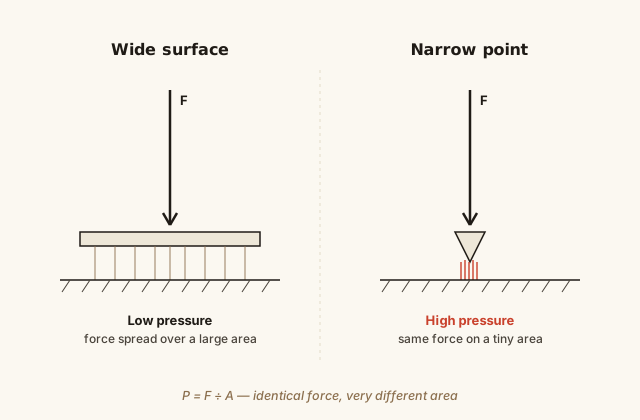
Same force, different area, different pressure
Both objects in the diagram experience the exact same downward force. The wide surface spreads that force thin, producing low pressure; the narrow point concentrates the identical force into a small area, producing high pressure — this single relationship, P = F/A, is the entire working principle behind knives, needles, nails, snowshoes, skis, and wide vehicle tires.
Common mistakes
Common Mistakes
✕
Assuming a sharper knife cuts because it applies more force.
→ A sharp blade concentrates the same force onto a much smaller edge area, producing far higher pressure at the cutting edge — force doesn't need to increase for pressure to increase dramatically.
✕
Thinking air has no weight and therefore exerts no real pressure.
→ Air has real mass and weight — atmospheric pressure at sea level is about 101,325 pascals, equivalent to roughly 10 tonnes of air pressing on each square meter, balanced by pressure from inside objects and bodies.
✕
Believing pressure and force are the same thing.
→ Force is a push or pull measured in newtons; pressure is that force divided by the area it's spread over, measured in pascals. The same force can produce wildly different pressures depending on area alone.
Common misconception
“A drinking straw works by 'sucking' liquid up through some pulling force.”
No pulling force reaches into the glass. Sipping lowers the air pressure inside the straw; the unchanged, higher atmospheric pressure pushing down on the liquid's surface outside the straw is what forces liquid upward to fill that lower-pressure region. The same principle explains why you can't drink through a straw in a vacuum, and why a barometric-style suction cup grips a smooth surface — it's always atmospheric pressure doing the pushing, from outside, never a pull from inside.
Quick check
Why can't a drinking straw work in the vacuum of space, even if you could seal your mouth around one?
Try it yourself
Pressure (force ÷ area)
Pressure (pascals)8,750
What to do next
What to do next
Try the calculator above with your own approximate weight and shoe area versus a much smaller area (like a heel) to see the pressure jump.
Next time you use a knife, notice that sharpening it doesn't add force — it shrinks the contact area, raising pressure at the edge.
Watch what happens to a sealed empty water bottle when you drive up a mountain — it puffs out as lower outside atmospheric pressure lets the air inside expand.
Read the related entry on Density & Buoyancy to see how fluid pressure connects to buoyant force underwater.
FAQ
FAQ
Related terms
Related terms
Pressure
Force applied per unit area, measured in pascals (Pa) or pounds per square inch (psi) — the same force spread over a smaller area creates higher pressure.
Pascal
The SI unit of pressure, equal to one newton of force per square meter of area.
Atmospheric pressure
The pressure exerted by the weight of the air above a given point, roughly 101,325 pascals at sea level.
Fluid pressure
Pressure exerted by a liquid or gas, which increases with depth in a liquid due to the weight of fluid above.
Vacuum
A space with little or no matter, and therefore little or no pressure.
 KnowThis