Microorganisms: Bacteria, Viruses, and the Invisible Majority of Life
Microorganisms are living things too small to see without a microscope, and the vast majority — including most bacteria in and on your body — are harmless or actively beneficial, not disease-causing.
Reading time
— 7 min
Updated
— Aug 19, 2026
Fact-reviewed
— Aug 19, 2026
Key Takeaways
Key Takeaways
1Most bacteria reproduce through binary fission — one cell splitting into two — and under ideal conditions, some species can double their population every 20 minutes, producing exponential growth.
2The overwhelming majority of microorganisms are harmless or actively beneficial; the human gut alone hosts trillions of mostly helpful bacteria that aid digestion and support immune function.
3Bacteria and viruses are fundamentally different: bacteria are living, single-celled organisms that can reproduce on their own, while viruses can't reproduce without hijacking a host cell's machinery.
The concept
Microorganisms are living things too small to see without a microscope — mainly bacteria, along with archaea, protozoa, fungi, and algae. They're everywhere: in soil, water, air, food, and all over and inside your own body. Most people associate microbes mainly with illness, but the vast majority are completely harmless, and many are actively essential — bacteria in your gut help digest food, bacteria in soil recycle nutrients for plants, and bacteria in fermented foods like yogurt and sauerkraut are what make the fermentation happen at all.
That doubling-based growth pattern is precise enough to calculate directly, and running real numbers through it shows exactly how a tiny starting population can explode in size within hours.
Quick check
A bacterial population doubles every 20 minutes under ideal conditions. Starting from a single cell, roughly how many cells would exist after 2 hours (6 doubling periods), assuming unlimited nutrients and no other constraints?
Beyond bacteria and viruses: the rest of the microbial world
Bacteria and viruses get most of the attention, but "microorganism" is a wider category with at least three other genuinely distinct groups. Protozoans are single-celled but, unlike bacteria, have a nucleus and often behave like microscopic animals — an amoeba actively hunts and engulfs food particles, and Plasmodium, the parasite that causes malaria, is a protozoan that spends part of its life cycle inside a mosquito and part inside a human bloodstream. Microscopic fungi — yeasts and molds — also have a nucleus, but get energy by absorbing nutrients from their surroundings rather than hunting: brewer's and baker's yeast (Saccharomyces cerevisiae) is a single-celled fungus that ferments sugar into carbon dioxide and alcohol, which is simultaneously why bread rises and why beer contains alcohol; other fungi, like the mold that causes athlete's foot, cause infection instead. Algae, many of which are single-celled, are photosynthetic like plants — microscopic marine algae called phytoplankton are the base of essentially every ocean food chain and are estimated to produce roughly half of the oxygen in Earth's atmosphere. Archaea look superficially like bacteria under a microscope but are genetically distinct enough to be classified in their own separate domain of life; many are extremophiles, surviving in conditions that would kill nearly everything else, including boiling deep-sea hydrothermal vents and highly acidic hot springs.
Quick check
Baker's yeast (used to make bread rise) and the mold that can grow on old bread are both classified in the same broad microbial group. Which group, and what sets it apart from bacteria?
Worked examples
Example 1: E. coli growth over a full workday, with real numbers (baseline case)
Starting with 100 E. coli cells in a nutrient-rich culture with a 20-minute doubling time, after 1 hour (3 doublings) the population reaches 100 × 2³ = 800 cells. After 4 hours (12 doublings), it reaches 100 × 2¹² = 409,600 cells. After 8 hours (24 doublings), the math produces roughly 1.68 billion cells from that same starting 100 — a number that looks implausible until you remember that exponential growth is genuinely explosive by nature, not a rounding trick. In practice, real bacterial cultures eventually slow down and plateau as nutrients run low and waste products accumulate, a pattern microbiologists call a growth curve, but the initial exponential phase really does follow this doubling math closely under favorable lab conditions.
Example 2: Why most bacteria never reach anywhere near their theoretical maximum growth (edge case / variation)
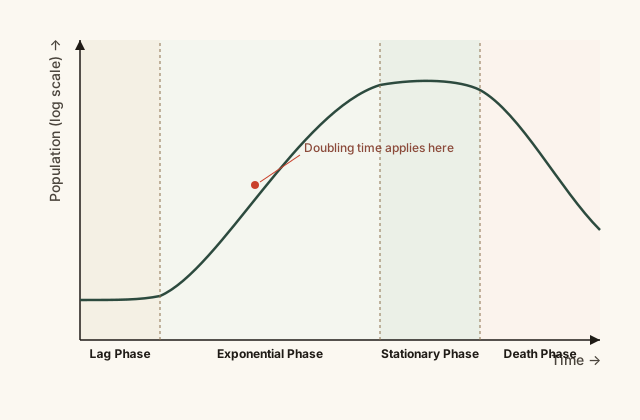
The explosive doubling math in Example 1 assumes ideal, unlimited conditions — nutrients, space, and no toxic waste buildup — which almost never persist for long outside a carefully maintained lab culture. In a real environment, bacterial growth follows a more complex curve: an initial lag phase while cells adjust to their surroundings, a genuine exponential growth phase while resources remain abundant, then a stationary phase where growth rate roughly matches die-off rate as nutrients become scarce and waste accumulates, and eventually a decline phase. This is a genuine, important edge case to the simple doubling formula: it correctly predicts short-term exponential bursts, but real bacterial populations are constantly constrained by their environment, which is exactly why food doesn't spoil into an infinite, ever-accelerating bacterial mass — growth self-limits once resources run out.
Quick check
A simple doubling-time calculation predicts a bacterial population would keep growing exponentially forever. Why don't real-world bacterial populations actually do this indefinitely?
Example 3: Why food safety guidelines are built around bacterial doubling math (real-world / applied case)
Food safety agencies commonly cite a "danger zone" temperature range (roughly 4°C to 60°C / 40°F to 140°F) where bacterial growth on perishable food accelerates fastest, and recommend limiting how long food sits in that range — often citing a 2-hour general guideline (or as little as 1 hour above roughly 32°C / 90°F). This guidance exists precisely because of exponential doubling math: a small, initially harmless bacterial population on food left at room temperature can multiply into a genuinely hazardous quantity within just a few hours, exactly as the doubling calculation predicts. This is a direct, practical application of microbiology most people encounter regularly without necessarily connecting it to the underlying exponential growth mechanism — refrigeration works specifically because cold temperatures dramatically slow bacterial reproduction, extending the effective doubling time from minutes to many hours or days.
How it works (visual)
Bacterial growth curve: lag, exponential, stationary, and decline phases
The curve's shape tells the whole growth story at a glance: the flat lag phase is cells adjusting to a new environment before multiplying, the steep exponential phase is where the doubling-time math from the examples above applies most cleanly, the stationary phase is where birth rate and death rate roughly balance as resources run low, and the final decline phase is population dropping as conditions become unsustainable. Nearly every practical use of bacterial growth math — food safety timing, lab culture planning, understanding how fast an infection can establish itself — is really about identifying where on this curve a given population currently sits.
Common mistakes
Common Mistakes
✕
Assuming all bacteria are harmful germs that cause disease.
→ The large majority of bacteria are harmless or actively beneficial — the human gut alone hosts trillions of mostly helpful bacteria, and only a small fraction of known bacterial species are disease-causing pathogens.
✕
Treating 'bacteria' and 'virus' as interchangeable terms for the same kind of germ.
→ Bacteria are complete, independently reproducing living cells; viruses are not cells at all and cannot reproduce without hijacking a host cell — different enough that treatments like antibiotics work on one but not the other.
✕
Assuming refrigeration kills bacteria on food.
→ Refrigeration mainly slows bacterial reproduction by dramatically extending doubling time — it doesn't kill most bacteria outright, which is why refrigerated food still eventually spoils and why cooking (not just cold storage) is what actually kills most bacteria present.
Common misconception
“All bacteria are harmful and the goal should be to eliminate as many as possible from your body and environment.”
The overwhelming majority of bacterial species are harmless, and a substantial number are directly beneficial or even essential. The human gut microbiome hosts trillions of bacteria that aid digestion, help synthesize certain vitamins, and support immune system function — disrupting this community (for example, through overuse of antibiotics) can cause real health problems, not improvements. Soil bacteria recycle nutrients essential for plant growth; bacteria in fermented foods like yogurt, cheese, and sauerkraut are what produce those foods in the first place. According to NIH research on the microbiome, only a small fraction of known bacterial species are pathogenic (disease-causing) at all — treating "bacteria" as a single harmful category ignores an enormous, mostly beneficial or neutral majority.
Quick check
Someone argues that using strong antibacterial products constantly, everywhere, must be good for health since it kills more bacteria. What is the most accurate response based on microbiology?
Try it yourself
Bacterial population growth by doubling time
Estimated population after elapsed time409,600
What to do next
What to do next
Try the calculator above with a longer doubling time (like 60 minutes, closer to many real-world bacteria outside ideal lab conditions) to see how much slower realistic growth looks compared to the lab-optimal 20-minute E. coli figure.
Next time you follow a food safety guideline about not leaving perishables out too long, connect it directly to exponential bacterial doubling math, not just a vague 'better safe than sorry' rule.
Look up what's actually in a probiotic yogurt or fermented food label — it's naming specific beneficial bacterial species, a direct, everyday encounter with helpful microbes.
Read the related entry on Diseases, Immunity & How the Body Fights Illness to see how the immune system distinguishes harmful microbes from the beneficial majority.
FAQ
FAQ
Related terms
Related terms
Microorganism
A living organism too small to see with the naked eye, requiring a microscope to observe — includes bacteria, archaea, protozoa, fungi, and algae.
Bacterium
A single-celled microorganism lacking a nucleus, found in nearly every environment on Earth, including inside the human body — the overwhelming majority are harmless or beneficial.
Virus
A microscopic infectious particle that cannot reproduce on its own; it must hijack a living host cell's machinery to make copies of itself. Most scientists don't classify viruses as fully 'alive' by standard biological definitions.
Binary fission
The way most bacteria reproduce — a single cell splits into two identical daughter cells, allowing exponential population growth over time.
Doubling time
The time it takes a growing bacterial population to double in size; under ideal lab conditions, some bacteria like E. coli can double in as little as 20 minutes.
Microbiome
The full community of microorganisms living in and on a particular environment, such as the human gut microbiome, which includes trillions of mostly beneficial bacteria.
Germ theory
The scientific principle, established in the 19th century, that many diseases are caused by specific microorganisms — a foundational concept in modern medicine and public health.
Protozoan
A single-celled microorganism with a nucleus (unlike bacteria) that typically behaves like a microscopic animal — moving and consuming food particles or other microbes. Amoebas and the malaria parasite Plasmodium are protozoans.
Microscopic fungus
A fungal microorganism such as yeast or mold — distinct from bacteria in having a nucleus and a different cell wall structure; some are decomposers, some cause infections, and some (like brewer's yeast) are put to direct human use.
Archaea
A domain of single-celled microorganisms that superficially resemble bacteria but are genetically and biochemically distinct — many are extremophiles, thriving in conditions lethal to most life, like deep-sea hydrothermal vents or highly acidic hot springs.
 KnowThis