 KnowThis
Key Takeaways
Key Takeaways
- 1The immune system defends the body in layers: physical barriers (skin, mucus) first, a fast general-purpose 'innate' response second, and a slower but highly targeted 'adaptive' response that remembers specific pathogens third.
- 2Adaptive immunity creates memory cells after an infection or vaccination, which is why catching or being vaccinated against a disease once often prevents severe reinfection later.
- 3Herd immunity — the point where a population has enough immunity to sharply slow a pathogen's spread — depends mathematically on how contagious that specific disease is, not one fixed percentage that applies to every disease.
The concept
Innate and adaptive immunity together explain how the body fights off a single infection — but they also explain something that seems, at first, like a contradiction: why people can catch "the same" illness, like a cold, again and again despite having immune memory.
A pathogen enters the body for the first time. Which immune response typically activates first, and which is more specific to that exact pathogen?
Worked examples
Example 1: The immune timeline for a common cold virus (baseline case)
Example 2: Why you can catch "a cold" repeatedly despite immune memory (edge case / variation)
A person who has already had several colds in their life still catches a new cold this winter. Does this mean their adaptive immune memory isn't working?
Example 3: Calculating herd immunity threshold from a disease's contagiousness (real-world / applied case)
Herd immunity threshold can be estimated with the formula 1 − 1/R₀, where R₀ ("R-naught") is the average number of new infections one case produces in a fully susceptible population. Measles, one of the most contagious known diseases, has an estimated R₀ of roughly 12-18; using R₀ = 15 as a midpoint: 1 − 1/15 ≈ 93% of a population needing immunity to sharply slow its spread. A far less contagious disease with an R₀ of 2 would need only 1 − 1/2 = 50% immunity to reach the same effect. This is why public health targets for population immunity differ significantly by disease — they're driven by each pathogen's actual measured contagiousness, not an arbitrary shared number.
How it works (visual)
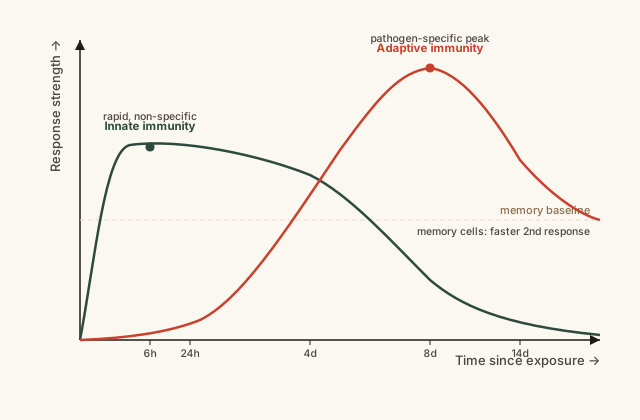
Compare the two curves: innate immunity's quick, moderate rise buys time while the much larger, slower adaptive response builds up. The key detail is what's left after the infection clears — a lingering baseline of memory cells that isn't present after the very first exposure. That memory baseline is exactly what makes a hypothetical second exposure produce a faster, stronger, often symptom-free response, which is the same underlying mechanism whether that memory came from natural infection or from vaccination.
Common mistakes
Common Mistakes
Treating a fever itself as the illness or as inherently dangerous.
→ A fever is usually a controlled, deliberate immune response, not a malfunction — the brain intentionally raises the body's temperature set point to make conditions less favorable for many pathogens.
Taking or requesting antibiotics for a cold or the flu.
→ Antibiotics only work against bacteria — colds and flu are caused by viruses, so antibiotics have no effect on them, and using them unnecessarily contributes to antibiotic resistance, per CDC guidance.
Assuming a disease with a similar name or symptoms to one you've already had will be blocked by the same immune memory.
→ Immune memory is specific to the exact pathogen encountered — as with the 200+ distinct viruses that all cause 'cold' symptoms, similar symptoms don't mean the same underlying pathogen or shared immunity.
Common misconception
“Antibiotics are an effective treatment for the common cold or the flu.”
Colds and the flu are caused by viruses, and antibiotics only work against bacteria — they have no effect on viral infections. Per CDC guidance, taking antibiotics for a viral illness doesn't speed recovery and provides no benefit against the virus itself, while unnecessary antibiotic use contributes to a well-documented public health problem: antibiotic-resistant bacteria. Antibiotics remain appropriate and effective for bacterial infections, but the common cold and seasonal flu are not among them.
Someone with a viral cold asks their doctor for antibiotics, believing it will help them recover faster. What does current medical guidance say about this?
Try it yourself
This is a simplified estimate used for general education, not an epidemiological model — real-world thresholds also depend on factors like population mixing patterns and vaccine effectiveness. For guidance on vaccination or a specific illness, consult a healthcare provider or your local public health authority.
What to do next
What to do next
- Use the calculator above to compare herd immunity thresholds for a highly contagious disease (high R₀) versus a less contagious one (low R₀).
- Next time you or someone around you has a fever, recognize it as a regulated immune response rather than assuming something has gone wrong.
- Check the CDC or WHO recommended vaccination schedule and stay current, since vaccines work by building the same adaptive memory natural infection does, without the risks of the disease itself.
- Follow your healthcare provider's or local public health authority's guidance for diagnosis and treatment of any specific illness rather than self-diagnosing from general information.