 KnowThis
Key Takeaways
Key Takeaways
- 1Nearly every cell in your body contains a full copy of your DNA, but different genes are switched on or off in different cell types, which is how identical instructions build very different tissues.
- 2Genes come in pairs — one allele inherited from each parent — and dominant/recessive inheritance follows predictable probability patterns like the Punnett square, not a 'blending' of traits.
- 3Any two humans are roughly 99.9% genetically identical; the remaining fraction of DNA accounts for essentially all inherited human variation, from eye color to disease risk.
The concept
Knowing that genes come in pairs explains a lot, but the real payoff is being able to predict the odds of a specific trait showing up in offspring — which is exactly what a Punnett square is built to do.
A person has one allele for brown eyes (dominant, B) and one allele for blue eyes (recessive, b). What eye color will actually show up, and what's happening to the blue-eye allele?
Worked examples
Example 1: A monohybrid cross with a Punnett square (baseline case)
Example 2: When traits don't follow simple dominance (edge case / variation)
A person inherits one blood-type allele for A and one for B, and their blood type tests as AB — showing both traits at once rather than one masking the other. What inheritance pattern does this demonstrate?
Example 3: Carrier probability for a recessive genetic condition (real-world / applied case)
Some inherited conditions, like cystic fibrosis, are recessive — a person needs two copies of the recessive allele to be affected, while someone with only one copy is an unaffected "carrier." If both parents are carriers (heterozygous, Aa), the same Punnett square logic from Example 1 applies: each child has a 25% chance of inheriting two recessive alleles and being affected, a 50% chance of being an unaffected carrier like their parents (Aa), and a 25% chance of inheriting two dominant alleles and being neither affected nor a carrier. This is exactly why genetic counselors can give parents specific, numeric odds — not vague reassurance — once carrier status for a specific condition is known through genetic testing.
How it works (visual)
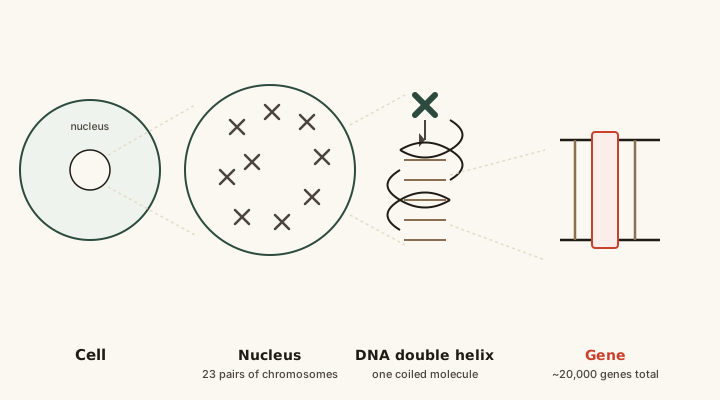
Reading the diagram from the outside in shows the actual scale relationship: a cell contains a nucleus, the nucleus contains chromosomes, each chromosome is one extremely long, tightly coiled DNA molecule, and a gene is just one functional segment along that molecule — of which there are roughly 20,000 spread across all 23 chromosome pairs. This nested structure is why a single skin cell and a single liver cell, despite looking and behaving completely differently, contain the exact same full set of genes; the difference between cell types comes from which genes are switched on, not which genes are present.
Common mistakes
Common Mistakes
Using 'gene,' 'chromosome,' and 'DNA' interchangeably, as if they're the same thing.
→ Keep the scale straight: DNA is the molecule, a chromosome is a tightly packaged strand of DNA, and a gene is one specific functional segment within that DNA — nested inside each other, not synonyms.
Assuming inherited traits blend evenly, like mixing paint, rather than following allele-pairing rules.
→ Classical dominant/recessive traits don't blend — one allele's trait shows (dominant) while the other stays hidden but inheritable (recessive). Only specific cases like incomplete dominance produce a true in-between result.
Believing a 25% recessive-trait probability guarantees exactly 1 in 4 children will be affected in any specific family.
→ The 25% is a per-child probability, recalculated independently each pregnancy — like a coin flip, past outcomes don't change the odds for the next child, so a family of four children could see 0, 1, 2, 3, or all 4 affected.
Common misconception
“A dominant trait is automatically more common in a population than a recessive one.”
Dominance describes how a trait is expressed when two different alleles are paired together in one individual — it says nothing about how frequently that allele appears across a whole population. Huntington's disease and achondroplasia (a common cause of dwarfism) are both dominant conditions, yet both are rare in the general population. Red hair, by contrast, is a recessive trait, yet it persists at meaningful frequency in some populations because enough people carry two copies of the recessive allele. Population frequency depends on the history and distribution of alleles in a group, not on whether a trait happens to be dominant or recessive.
Huntington's disease is caused by a dominant allele but is rare in the general population, while red hair is caused by a recessive combination of alleles and is far more common in some populations. What does this show?
What to do next
What to do next
- Practice a Punnett square with a trait of your choice (two heterozygous parents), and confirm you land on the classic 3:1 phenotype ratio from Example 1.
- Next time you hear a blood type mentioned (like AB), connect it to codominance — both alleles being expressed at once — rather than a blend.
- If a family history of a specific genetic condition is a concern, ask a healthcare provider about genetic counseling and carrier testing rather than estimating risk informally.
- Read the related entry on Diseases, Immunity & How the Body Fights Illness to see how genetic differences can influence disease risk.