Ecosystems & Food Chains: How Energy Moves Through Nature
A food chain is a sequence of who-eats-whom that moves energy through an ecosystem, and at each step roughly 90% of that energy is lost as heat rather than passed on.
Reading time
— 7 min
Updated
— Aug 19, 2026
Fact-reviewed
— Aug 19, 2026
Key Takeaways
Key Takeaways
1A food chain traces energy from producers (usually plants) through a series of consumers, and at each step roughly 90% of the energy is lost, mostly as metabolic heat — only about 10% transfers to the next level.
2Real ecosystems are food webs, not single chains — most animals eat, and are eaten by, more than one species, so removing one species can ripple through many connected food chains at once.
3The 10% rule is why apex predators are always rare compared to producers: each trophic level up supports a far smaller total mass of organisms than the level below it.
What actually makes something an ecosystem
An ecosystem is every living thing in a given area (its biotic factors — plants, animals, fungi, bacteria) interacting with the non-living conditions around them (its abiotic factors — sunlight, temperature, water, soil chemistry, rainfall). Neither half works alone as a definition: a desert is a desert because of low rainfall and heat (abiotic), but it's specifically a desert ecosystem because of the cacti, reptiles, and insects (biotic) adapted to survive those exact conditions. Change the abiotic conditions enough — drain a wetland, clear-cut a forest — and the biotic community that depends on them collapses even if no organism was directly killed.
Ecosystems are grouped at a larger scale into biomes — categories defined mainly by climate. Forest biomes (tropical rainforest, temperate forest, boreal/taiga) are set apart mostly by rainfall and temperature range, which determines whether trees are broadleaf, evergreen, or coniferous. Grassland biomes (savanna, prairie) get enough rain for grasses but not enough, or with the wrong seasonal timing, to sustain dense forest. Desert biomes are defined by low precipitation (under about 25 cm/year) regardless of temperature — cold deserts like parts of Antarctica and Mongolia qualify just as much as hot ones like the Sahara. Tundra biomes have short growing seasons and permafrost (permanently frozen subsoil) that limits root depth, which is why tundra vegetation is mostly low shrubs, moss, and lichen rather than trees. Aquatic ecosystems split into freshwater (rivers, lakes — low salt content) and marine (oceans, coral reefs — high salt content), plus wetlands, which sit at the boundary and combine traits of both.
Nutrients don't just flow through an ecosystem once and disappear — decomposers (mainly fungi and bacteria) close the loop by breaking down dead organisms and waste into simple compounds like nitrogen and phosphorus that producers can absorb and reuse. Without decomposers, nutrients would stay permanently locked inside dead plant and animal matter, and every ecosystem on Earth would run out of usable nutrients within a few generations no matter how much sunlight was available — decomposition is what makes an ecosystem a genuine cycle rather than a one-way flow.
Quick check
A wetland is drained for farmland, but none of its plants or animals are directly killed in the process. Ecologists still classify this as ecosystem destruction. Why?
How energy moves through it: food chains
A food chain shows who eats whom, starting with a plant and moving up: grass is eaten by a rabbit, the rabbit is eaten by a fox. Each step passes energy along the chain, but not all of it — a lot of the energy an animal eats gets used up just staying alive (moving, staying warm, digesting) rather than being stored in a form the next predator can eat. That's why food chains are usually short, rarely more than four or five links, and why there are always far fewer predators than prey in a healthy ecosystem.
That 10% figure isn't a rough guess — it's precise enough to run real numbers through, and doing so is the fastest way to see why big predators are always rare.
Quick check
A pasture ecosystem has grass, grasshoppers that eat grass, and birds that eat grasshoppers. Based on the 10% rule, roughly how much of the grass's original energy is available to the birds?
Worked examples
Example 1: A four-level grassland chain with real energy numbers (baseline case)
Suppose grass in a field captures 10,000 kilocalories of energy from sunlight through photosynthesis in a season. Grasshoppers eating that grass gain roughly 10% of it — about 1,000 kilocalories. A shrew eating those grasshoppers gains roughly 10% of that — about 100 kilocalories. An owl eating shrews gains roughly 10% of that — about 10 kilocalories. Starting from 10,000 kilocalories of captured sunlight, the owl at the top of this four-level chain ultimately has access to only about 10 kilocalories worth of that original energy — a 1,000-fold reduction across three transfers, which is exactly why a single field can support enormous numbers of grasshoppers but only a handful of owls.
Example 2: Why ocean food chains can support giants despite the 10% rule (edge case / variation)
Blue whales, the largest animals ever known to exist, feed on tiny shrimp-like krill — seemingly a contradiction, since the 10% rule suggests a large predator should sit atop a long, energy-depleted chain. The resolution is that a blue whale's food chain is actually short: phytoplankton (producers) are eaten directly by krill (primary consumers), and whales eat krill directly, skipping the many intermediate predator levels a chain on land would typically need to reach a large body size. By feeding one trophic level closer to the producers, filter-feeding giants like blue whales access a far larger total energy pool than a predator sitting several levels higher up would — this is also why the ocean's most efficient food chains (in terms of total biomass supported) tend to be short and built on enormous producer populations of phytoplankton.
Quick check
Blue whales are enormous, yet they feed on tiny krill rather than large prey. How does this fit with the 10% rule?
Example 3: Why eating lower on the food chain feeds more people (real-world / applied case)
The 10% rule has a direct, practical human application: producing a kilogram of plant-based food for direct human consumption requires far less land, water, and energy than producing a kilogram of meat from an animal that was itself fed on plants, because raising livestock adds an extra trophic-level energy loss into the chain. Roughly 90% of the energy in the grain or grass fed to cattle is lost to the animal's own metabolism before any of it becomes meat available to eat. This is a core piece of the reasoning behind global food-security and land-use research, and it's a direct, real-world consequence of the same ecological energy math that governs why owls are rarer than grasshoppers.
How it works (visual)
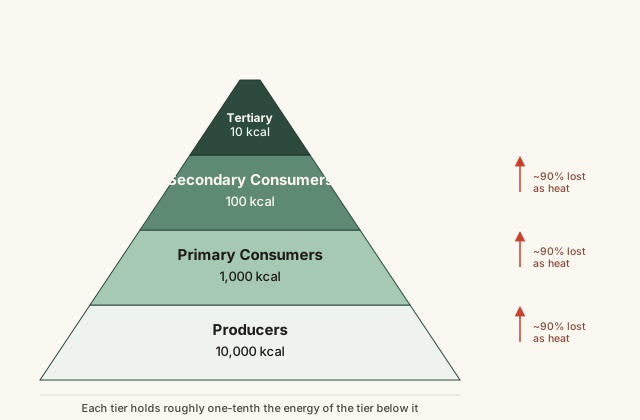
Energy pyramid: energy available at each trophic level
The pyramid shape isn't stylistic — it's a direct visual representation of the energy math. Each tier is roughly one-tenth the size of the tier below it, because roughly 90% of the energy available at one level is lost, mostly as heat, before it reaches the next level up. This is also why the pyramid can never be inverted in a stable, ongoing ecosystem: there physically isn't enough energy at the top to support more biomass than the base is generating.
Common mistakes
Common Mistakes
✕
Thinking of a food chain as a fixed, isolated sequence, when most organisms actually belong to several overlapping chains at once.
→ Picture a food web instead — most predators eat multiple prey species and most prey are eaten by multiple predators, which is what gives real ecosystems resilience when one species' population changes.
✕
Assuming energy is lost through some kind of inefficiency that could theoretically be 'fixed.'
→ The loss is mostly basic thermodynamics — organisms use energy for movement, maintaining body temperature, and cellular processes, all of which release heat. It's an unavoidable cost of being alive, not a flaw in the system.
✕
Believing apex predators are rare because they're difficult to hunt or their prey is scarce.
→ Apex predators are rare primarily because of cumulative energy loss up the food chain — by the time you reach the top trophic level, there simply isn't enough total energy in the ecosystem to support a large predator population, regardless of hunting skill.
✕
Thinking an ecosystem is just 'the animals and plants living somewhere.'
→ That's only the biotic half. The non-living abiotic factors — water, temperature, soil, sunlight — are equally part of the definition, and changing them can collapse a community without killing anything directly.
Common misconception
“Removing one predator species from an ecosystem only affects that predator's direct prey.”
Because ecosystems function as food webs rather than isolated chains, removing one species can cascade through many indirect connections — an effect ecologists call a trophic cascade. A well-documented case is the reintroduction of wolves to Yellowstone National Park in 1995: with wolves absent for decades, elk populations had grown large and grazed streamside vegetation heavily. Wolves returning reduced elk numbers and changed elk grazing behavior, which allowed willow and aspen trees along streams to recover — which in turn affected beaver populations (beavers use that wood) and stream structure itself. A single species' removal or return rippled through multiple trophic levels and even physical landscape features, not just its immediate prey.
Quick check
After wolves were reintroduced to Yellowstone in 1995, changes appeared not just in elk populations but eventually in streamside vegetation and beaver activity too. What does this best illustrate?
Try it yourself
Energy remaining after moving up trophic levels (10% rule)
Energy remaining at that level (kcal)10
What to do next
What to do next
Try the calculator above with 5 trophic-level transfers instead of 3 — notice how quickly the remaining energy approaches zero, which explains why very long food chains don't occur.
Next time you see a nature documentary, count the trophic levels in the food chain shown and estimate roughly how much of the original sunlight energy the top predator is really running on.
Look up one real trophic cascade (Yellowstone wolves, sea otters and kelp forests, or another documented case) to see the food-web effect in a real ecosystem.
Read the related entry on Plant Biology & Photosynthesis to see exactly how the energy at the base of every food chain gets captured in the first place.
FAQ
FAQ
Related terms
Related terms
Food chain
A linear sequence showing how energy passes from one organism to the next through eating relationships, starting with a producer.
Food web
The full, interconnected network of overlapping food chains within an ecosystem, showing that most organisms eat and are eaten by more than one species.
Trophic level
An organism's position in a food chain, based on how many energy transfers separate it from the original energy source (usually sunlight).
Producer
An organism, typically a plant or algae, that makes its own food from sunlight via photosynthesis, forming the energy base of nearly every food chain.
Consumer
An organism that gets its energy by eating other organisms rather than producing its own food — herbivores, carnivores, and omnivores are all consumers.
Decomposer
An organism, such as fungi or bacteria, that breaks down dead organic matter, returning nutrients to the ecosystem.
10% rule
The ecological principle that only about 10% of the energy at one trophic level is available to the next level up, with roughly 90% lost mainly as metabolic heat.
Ecosystem
A community of living organisms interacting with each other and with the non-living parts of their environment (water, soil, air, sunlight, temperature) within a defined area.
Biotic factor
A living or once-living part of an ecosystem — every plant, animal, fungus, and microorganism in it.
Abiotic factor
A non-living part of an ecosystem that still shapes what can live there — sunlight, temperature, water availability, soil chemistry, and rainfall are the main ones.
Biome
A large-scale category of ecosystems sharing a similar climate and dominant plant/animal life, such as desert, tropical rainforest, tundra, or grassland.
 KnowThis