 KnowThis
Key Takeaways
Key Takeaways
- 1Natural selection requires three ingredients: heritable variation within a population, more offspring produced than the environment can support, and some variants surviving and reproducing better than others — nothing about it requires intention or a goal.
- 2Evolution acts on populations across generations, not on individual organisms during their own lifetime — a single giraffe cannot evolve a longer neck by stretching for leaves.
- 3The evidence for evolution spans multiple independent lines — the fossil record, comparative anatomy, embryology, and direct genetic sequencing — that consistently agree with each other, which is why it is treated as well-established science, not a hypothesis in doubt.
The concept
That three-part mechanism — variation, differential reproduction, heritability — is easiest to see clearly through a specific, well-documented case where researchers could measure it directly, generation by generation.
A giraffe stretches its neck throughout its life to reach higher leaves, developing a slightly longer neck as a result. According to natural selection as understood today, will this acquired trait be passed to its offspring?
Worked examples
Example 1: Antibiotic resistance as observable natural selection (baseline case)
Example 2: Peppered moths and industrial pollution (edge case / variation)
Dark-colored peppered moths became far more common in polluted, industrial areas of 19th-century Britain, then declined again after pollution controls were introduced. What does this demonstrate?
Example 3: Whale evolution and the fossil-genetic evidence trail (real-world / applied case)
Whales are mammals descended from land-dwelling, four-legged ancestors that lived roughly 50 million years ago — a conclusion supported independently by multiple lines of evidence. The fossil record documents a sequence of transitional forms (including Pakicetus, a wolf-sized land mammal with whale-like inner ear bones, and later, increasingly aquatic forms like Ambulocetus and Rodhocetus) tracing the gradual shift from land to water over millions of years. Comparative anatomy adds independent confirmation: modern whales retain small, vestigial pelvic and leg bones buried in their bodies, remnants of limbs their land-dwelling ancestors used to walk. Genetic sequencing adds a third, independent line of evidence, showing whales are most closely related to hippopotamuses among living mammals — a relationship anatomists had also proposed based on skeletal similarities before DNA evidence became available. Three separate methods, developed and applied independently, converge on the same evolutionary history — this kind of independent convergence across fossils, anatomy, and genetics is what gives evolutionary biology its scientific strength as a well-established framework, not a single, isolated claim.
How it works (visual)
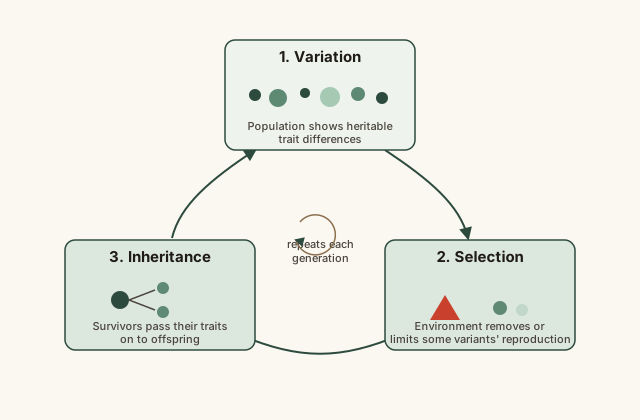
The diagram is a closed loop because natural selection is a repeating, cumulative process: each generation starts with existing variation, the environment filters who reproduces most successfully, and the traits of the survivors are passed on, shifting the population's genetic makeup slightly before the cycle repeats. Small shifts compound across many generations — this is why observable evolution (like antibiotic resistance or peppered moth coloration) can happen within years, while larger changes, like the land-to-water transition in whale ancestry, typically require millions of years and many thousands of generations of this same repeating loop.
Common mistakes
Common Mistakes
Saying an organism evolved a trait 'because it needed to' or 'in order to' survive, implying intention or foresight.
→ Mutation is random and undirected; only the selection step is non-random, filtering among traits that already happened to exist. No organism or population plans ahead for future needs.
Describing evolution as a ladder of progress from 'lower' to 'higher' organisms, with humans at the top.
→ Evolution produces a branching tree, not a ladder — every living species today is equally 'evolved' for its own environment; there's no single scale of biological superiority running from bacteria to humans.
Treating 'it's just a theory' as meaning evolution is scientifically uncertain or unproven.
→ In science, 'theory' means a well-substantiated explanation supported by extensive, repeatedly tested evidence — not a guess. Evolutionary theory is supported by independently converging evidence from fossils, anatomy, embryology, and genetics.
Common misconception
“Evolution means an organism 'wants' or 'tries' to change, and is working toward some goal, like eventually growing wings or becoming more intelligent.”
Evolution has no goal, no direction, and no foresight. Genetic mutation is random — it happens regardless of what an organism needs — and natural selection simply determines, after the fact, which existing variants survive and reproduce better in a given environment at a given time. A population doesn't evolve toward some predetermined endpoint; it responds to whatever pressures currently exist, which can and do change, sometimes reversing prior adaptations entirely (as with peppered moths after pollution controls). There is also no single ladder of "more evolved" species — every living organism today, from bacteria to blue whales, represents an unbroken, equally long line of successful ancestors stretching back to the origin of life, each currently well-adapted to its own particular environment, per the National Human Genome Research Institute and the Smithsonian's human evolution research.
A textbook illustration shows fish evolving 'toward' becoming amphibians, as if working toward that outcome. What is the accurate way to describe this transition instead?
What to do next
What to do next
- Next time you hear about antibiotic resistance in the news, connect it directly to natural selection acting on bacteria in real time, not bacteria 'learning' to resist.
- Look up one transitional fossil sequence (such as whale ancestry or early tetrapods) to see how the fossil record documents gradual change step by step.
- Notice language that implies intention in evolution ('trying to,' 'in order to') in casual conversation or media, and mentally reframe it as variation plus differential survival.
- Read the related entry on Cells & Genetics Basics to understand the DNA-level mechanism — mutation and inheritance — that natural selection actually acts on.