Animal Kingdom Facts: How Animals Are Classified and Why
Kingdom Animalia is organized into nested taxonomic ranks, from phylum down to species, and the overwhelming majority of animal species are invertebrates, not vertebrates.
Reading time
— 7 min
Updated
— Aug 19, 2026
Fact-reviewed
— Aug 19, 2026
Key Takeaways
Key Takeaways
1Every animal is classified through a nested system — kingdom, phylum, class, order, family, genus, species — and given a unique two-part scientific name like Panthera leo.
2Over 97% of known animal species are invertebrates (no backbone) — insects and other arthropods alone account for roughly 80% of all described animal species on Earth.
3Similar-looking animals aren't always closely related: sharks and dolphins share a streamlined body shape not because of shared ancestry, but because of convergent evolution toward efficient swimming.
The concept
The animal kingdom (Kingdom Animalia) includes every animal on Earth, from tigers to tapeworms. Scientists sort animals into groups based on shared body features and ancestry, starting with a huge split: does the animal have a backbone or not? Animals with a backbone — mammals, birds, reptiles, amphibians, fish — are vertebrates. Everything else — insects, spiders, worms, jellyfish, octopuses, starfish — is an invertebrate. Most people picture vertebrates first, but invertebrates make up the overwhelming majority of animal species.
That vertebrate/invertebrate split is the single biggest branch in the animal kingdom, and the numbers on each side of it are far more lopsided than most people expect.
Quick check
Which statement about vertebrates and invertebrates is accurate?
The major groups, one by one
Knowing how classification works doesn't tell you what actually separates a lizard from a frog, or a spider from an insect. Each major group is defined by real, testable traits — not just general appearance.
The five vertebrate classes: Mammals (~6,400 species) have fur or hair, are endothermic, and nurse young with milk from mammary glands — nearly all give live birth, with the rare exception of egg-laying monotremes like the platypus. Birds (~11,000 species) have feathers, are endothermic, and lay hard-shelled eggs; hollow, air-filled bones support flight, though not every bird flies (ostriches, penguins). Reptiles (~11,000 species) have dry, scaly skin and are ectothermic, meaning their body temperature tracks the environment rather than being self-regulated — most lay leathery or soft-shelled eggs on land. Amphibians (~8,000 species) have moist, permeable skin and are also ectothermic, but their defining feature is a two-stage life cycle: most start as water-breathing larvae (like a tadpole, which has gills) and undergo metamorphosis into air-breathing, often land-capable adults. Fish (~34,000 species, more than every other vertebrate class combined) live in water and breathe through gills, and split into two very different sub-groups: bony fish (the vast majority — salmon, tuna, goldfish) and cartilaginous fish (sharks and rays, whose skeleton is cartilage, not bone).
Invertebrates, beyond just "arthropods": Arthropods (insects, arachnids, crustaceans, and centipedes/millipedes) account for roughly 80% of all described animal species by themselves, but three other invertebrate groups are common enough to know on sight. Mollusks (snails, clams, octopuses, squid) have a soft body, often protected by a hard shell, and include the octopus — widely considered the most behaviorally complex invertebrate, capable of problem-solving and tool use. Cnidarians (jellyfish, coral, sea anemones) have stinging cells called nematocysts and radially symmetric bodies with no left or right side. Echinoderms (starfish, sea urchins) have five-part radial symmetry as adults and a unique water-powered hydraulic system (the water vascular system) that operates their tube feet. Roundworms (nematodes) are rarely seen but, by sheer individual count, are likely the most numerous animals on Earth — a single rotting apple can contain thousands.
Quick check
A lizard basking on a warm rock can, at that moment, have a body temperature higher than a nearby mouse. Does this mean the lizard is 'warm-blooded' too?
Worked examples
Example 1: Classifying a house cat through every taxonomic rank (baseline case)
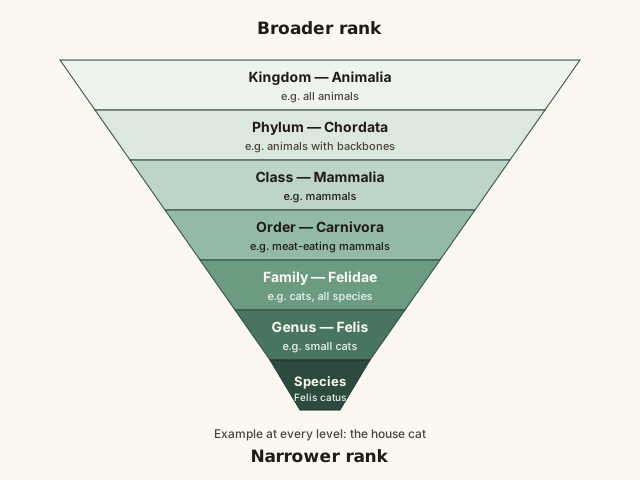
Start at the top and narrow down: Kingdom Animalia (it's an animal, not a plant or fungus) > Phylum Chordata (it has a dorsal nerve cord and, as an adult, a backbone) > Class Mammalia (it has fur and nurses young with milk) > Order Carnivora (its teeth and digestive system are built around eating meat) > Family Felidae (it shares retractable claws and skull structure with other cats) > Genus Felis (the small-cat genus) > species catus (domestic cat specifically, as opposed to Felis silvestris, the wildcat). Each rank groups the cat with progressively fewer, more closely related organisms — Family Felidae also contains lions and tigers, but Genus Felis narrows to small cats only.
Example 2: Is a sea sponge really an animal? (edge case / variation)
Sea sponges have no brain, no muscles, no nervous system, and no ability to move once settled on the seafloor — yet they are classified as animals, in Phylum Porifera. The reason isn't appearance; it's the same defining animal traits sponges share with every other animal: they're multicellular, they can't make their own food the way plants do (they filter-feed on particles from water instead), and their cells lack the rigid walls found in plant and fungal cells. Sponges are considered one of the earliest-diverging animal lineages, giving biologists a genuine edge case that tests the actual definition of "animal" rather than the intuitive picture of fur, legs, and eyes.
Quick check
A sea sponge has no brain, muscles, or ability to move on its own. Why is it still classified as an animal?
Example 3: DNA evidence reclassifying the red panda (real-world / applied case)
For decades, the red panda was shuffled between the raccoon family and the bear family based on physical similarities — a bear-like face, raccoon-like ringed tail. Genetic sequencing eventually showed it belongs to neither group closely enough to be placed in them; it's now classified in its own unique family, Ailuridae, with its closest living relatives being weasels, raccoons, and skunks only in a broader, more distant sense. This is a real, applied example of how modern taxonomy works: physical resemblance is a starting hypothesis, but DNA comparison is what actually settles classification disputes, and it regularly overturns classifications that seemed obvious from appearance alone.
How it works (visual)
Taxonomic ranks from Kingdom down to Species, using the house cat as an example
Each ring in the diagram represents a rank that includes everything inside it. Kingdom Animalia is the widest ring, holding every animal species on Earth; Species catus is the narrowest, holding only domestic cats. Two animals sharing a Family (like a house cat and a lion, both Felidae) are more closely related than two animals only sharing a Phylum (like a house cat and a salmon, both Chordata) — the narrower the shared rank, the closer the evolutionary relationship.
Common mistakes
Common Mistakes
✕
Using 'bug' loosely to mean any small crawling creature, including spiders and centipedes.
→ True bugs are a specific insect order (Hemiptera); spiders and centipedes aren't insects at all — spiders are arachnids (8 legs, 2 body segments), a separate class entirely.
✕
Assuming whales and dolphins are fish because they live in the ocean and swim.
→ Whales and dolphins are mammals — they breathe air with lungs, are warm-blooded, and nurse live young with milk. Their fish-like body shape comes from convergent evolution for swimming, not shared ancestry with fish.
✕
Thinking every animal with a backbone is a mammal.
→ Vertebrates include five major groups — mammals, birds, reptiles, amphibians, and fish — and mammals are just one branch, defined specifically by fur/hair and nursing young with milk.
✕
Assuming 'cold-blooded' means an animal's blood or body is always cold.
→ The accurate term is ectothermic — the animal's temperature simply tracks its environment rather than being internally regulated. A lizard basking in direct sun can be warmer than a nearby mammal at that moment.
✕
Treating frogs and lizards as basically the same kind of animal because both are small and low to the ground.
→ They're in entirely different classes: amphibians (frogs) have moist skin and a water-to-land metamorphosis, reptiles (lizards) have dry scaly skin and skip the aquatic larval stage entirely, hatching already land-capable.
Common misconception
“Sharks and dolphins are basically the same kind of animal, since they look alike and live in the same habitat.”
Sharks and dolphins are separated by hundreds of millions of years of evolution and belong to entirely different animal groups. Sharks are fish (cartilaginous fish, class Chondrichthyes) — cold-blooded, breathing through gills, reproducing mostly by laying eggs. Dolphins are mammals (order Cetacea) — warm-blooded, breathing air through lungs via a blowhole, and nursing live-born calves with milk. Their similar torpedo-shaped bodies and dorsal fins exist because both independently evolved efficient shapes for moving through water — a textbook case of convergent evolution, not close relation. A shark's closest relatives are other fish; a dolphin's closest relatives are other mammals, including, distantly, hippopotamuses.
Quick check
Sharks and dolphins have very similar body shapes. What best explains this similarity?
What to do next
What to do next
Next time you see an unfamiliar small creature, count its legs and body segments before calling it a 'bug' — that alone can tell you if it's an insect (6 legs), arachnid (8 legs), or something else.
Look up any animal's scientific (binomial) name and notice the genus-species structure — it instantly tells you which other species it's most closely related to.
When two animals look alike, ask whether it's shared ancestry or convergent evolution — the shark/dolphin comparison is a good mental template.
Read the related entry on Evolution & Natural Selection Basics to see the mechanism that produces both close relationships and convergent look-alikes.
FAQ
FAQ
Related terms
Related terms
Kingdom Animalia
The taxonomic kingdom containing all animals — multicellular organisms that eat other organisms for energy and typically can move under their own power.
Vertebrate
An animal with a backbone (spinal column), such as mammals, birds, reptiles, amphibians, and fish.
Invertebrate
An animal without a backbone, including insects, mollusks, worms, and jellyfish — over 97% of known animal species.
Taxonomy
The scientific system for classifying organisms into nested ranks: kingdom, phylum, class, order, family, genus, species.
Phylum
A major taxonomic rank below kingdom, grouping animals by fundamental body plan — e.g., Chordata (animals with a nerve cord) or Arthropoda (jointed-limbed animals).
Binomial nomenclature
The two-part naming system (genus + species) used to give every organism a unique scientific name, such as Panthera leo for the lion.
Convergent evolution
When unrelated species independently evolve similar traits because they adapted to similar environments or pressures, not because they share recent ancestry.
Ectothermic
Relying on external heat sources (like sunlight) to regulate body temperature, rather than generating it internally — the accurate term for what's commonly called 'cold-blooded'; body temperature varies with the environment rather than always running cold.
Endothermic
Generating and regulating body temperature internally through metabolism, independent of the surrounding environment — the accurate term for 'warm-blooded,' true of mammals and birds.
Arthropod
An invertebrate with a hard external skeleton (exoskeleton), a segmented body, and jointed limbs — the phylum that includes insects, arachnids, crustaceans, and centipedes/millipedes, and the largest animal group by species count.
Metamorphosis
A dramatic change in body form during development, as seen in most amphibians (water-breathing tadpole to air-breathing adult) and many insects (larva to pupa to adult).
 KnowThis