 KnowThis
Key Takeaways
Key Takeaways
- 1Symbiosis has three distinct categories based on who benefits: mutualism (both species benefit), commensalism (one benefits, the other is unaffected), and parasitism (one benefits at the other's expense).
- 2The same two species can sometimes shift between symbiosis categories depending on conditions — a relationship isn't always fixed in stone for all time or every context.
- 3Clownfish and sea anemones are a genuine mutualism, not a one-sided freeloading arrangement — each species provides the other with a real, measurable benefit.
The concept
That three-way split — mutualism, commensalism, parasitism — sounds simple in the abstract, but distinguishing them in a real relationship takes a closer look at exactly what each species is actually getting or losing.
Cattle egrets often follow grazing cattle, eating insects the cattle stir up from the grass as they walk. The cattle appear unaffected either way. What type of symbiosis is this?
Worked examples
Example 1: Clownfish and sea anemones — a real, two-sided mutualism (baseline case)
Example 2: When a relationship shifts from commensalism toward parasitism (edge case / variation)
Cleaner fish usually remove parasites from client fish in a mutually beneficial relationship, but researchers have observed some cleaner fish occasionally biting off healthy tissue instead. What does this best illustrate about symbiosis categories?
Example 3: Ticks, Lyme disease, and why parasitism matters for public health (real-world / applied case)
A tick feeding on a deer or a human is a straightforward parasitism example: the tick benefits by consuming a blood meal it needs to survive and reproduce, while the host is directly harmed — through blood loss, irritation, and, critically, the risk of disease transmission. Ticks can carry and transmit pathogens like the bacteria that cause Lyme disease during feeding, meaning the parasitic relationship itself is a direct vector for a broader public health concern, not just an isolated inconvenience for the individual host. This is a real-world, applied reason why understanding parasitism specifically — not symbiosis in general — matters practically: public health guidance around tick checks, repellents, and prompt tick removal exists directly because of how this particular parasitic relationship transmits disease during the feeding process.
How it works (visual)
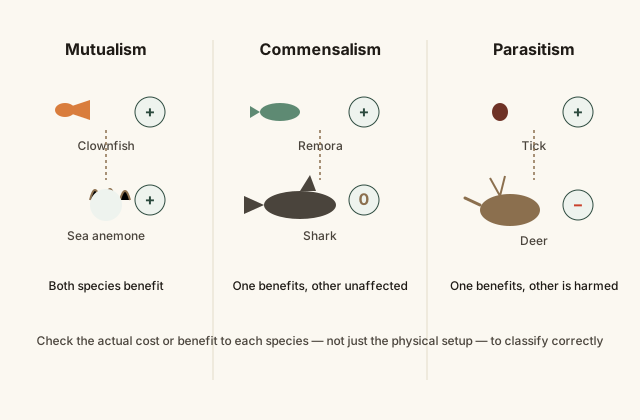
The plus, zero, and minus signs in each column are the fastest way to classify any relationship you encounter: identify what each species gains or loses, and the symbol pattern tells you the category. Two plus signs means mutualism, a plus and a zero means commensalism, and a plus and a minus means parasitism — the actual behaviors involved (living on, living near, feeding on) can look superficially similar across all three categories, which is exactly why checking the actual cost or benefit to each species, not just the physical setup, is what determines the correct classification.
Common mistakes
Common Mistakes
Using 'symbiosis' to mean only mutually beneficial relationships.
→ Symbiosis is the umbrella term for any close, ongoing relationship between two species — mutualism, commensalism, and parasitism are all forms of symbiosis, not separate from it.
Assuming any animal living closely with another is automatically helping it.
→ Check what each species actually gains or loses — commensal and parasitic relationships both involve close, ongoing contact, but only mutualism involves a real benefit to both sides.
Treating every instance of a species pair's relationship as identical and fixed forever.
→ Some relationships shift along the spectrum depending on context, as with cleaner fish that usually behave mutualistically but occasionally cheat — categories describe general patterns, not an unbreakable rule for every encounter.
Common misconception
“Small animals that ride along on or near larger animals (like remoras on sharks) are always just harmless freeloaders that give nothing back.”
This describes commensalism specifically, and it's a real, valid category — but it isn't the automatic default for every close animal relationship, and not every "rider" species is neutral. Remoras attaching to sharks for transport and leftover food scraps is a genuinely well-documented commensal relationship where the shark isn't meaningfully helped or harmed. But other superficially similar-looking relationships are actually mutualistic (cleaner fish removing parasites from larger fish, providing a real benefit) or parasitic (certain small crustaceans that attach to fish and drain nutrients, genuinely harming the host). The physical setup — one animal riding along on or near another — looks similar across all three categories; only checking the actual measured cost or benefit to each species tells you which one you're actually looking at.
Two different species are observed living in close physical contact. Based on accurate biology, what determines whether this is mutualism, commensalism, or parasitism?
What to do next
What to do next
- Next time you notice two species interacting closely — in a nature documentary or your own backyard — ask what each one is actually gaining or losing before assuming which symbiosis category applies.
- Look up one plant-pollinator relationship near you and identify the specific mutual benefit each side receives, not just 'they help each other.'
- After a tick check or outdoor activity in tick habitat, connect the recommended precautions directly to the parasitism and disease-transmission mechanism described above.
- Read the related entry on Marine Life & Ocean Biology to see more ocean-specific symbiotic relationships, including coral and its symbiotic algae.