 KnowThis
Key Takeaways
Key Takeaways
- 1A polygon's number of sides fixes its interior angle sum — every triangle sums to 180°, every quadrilateral to 360°, and the pattern (n − 2) × 180° holds for any number of sides.
- 2Every square is a rectangle (and a rhombus) — geometric category names build on each other in one direction, not both, so 'square' is a stricter, narrower claim than 'rectangle,' not a rival to it.
- 3Whether a polygon is regular (equal sides and equal angles) or irregular changes its symmetry, but not its basic classification as a triangle, quadrilateral, pentagon, and so on.
The concept
That interior-angle-sum rule isn't just trivia — it's the tool that lets you verify a shape's classification, check a construction drawing, or work out a missing angle without a protractor.
A four-sided shape has all four sides the same length, but its angles are 80°, 100°, 80°, and 100° instead of four right angles. What is this shape?
Worked examples
Example 1: Interior angle sum of a regular pentagon (baseline case)
Example 2: A concave (non-convex) polygon still obeys the same rule (edge case / variation)
A polygon has one interior angle measuring 200°. What does this tell you about the shape?
Example 3: Why honeycombs use hexagons, not squares or triangles (real-world / applied case)
Bees build honeycomb out of regular hexagons, and it's not decoration — it's geometry doing the engineering. Among shapes that can tile a flat surface with zero gaps (triangles, squares, and hexagons are the only regular polygons that do this), the hexagon encloses the most area for the least total wall length, meaning bees spend less wax building the same storage volume. A regular hexagon's interior angle, from (6 − 2) × 180° ÷ 6 = 120°, is also the specific angle that lets three hexagons meet perfectly at every vertex with no wasted or overlapping space (120° × 3 = 360°, a full turn) — the same reason hexagonal floor tiles and geodesic dome panels (built from combined hexagons and pentagons) fit together cleanly.
How it works (visual)
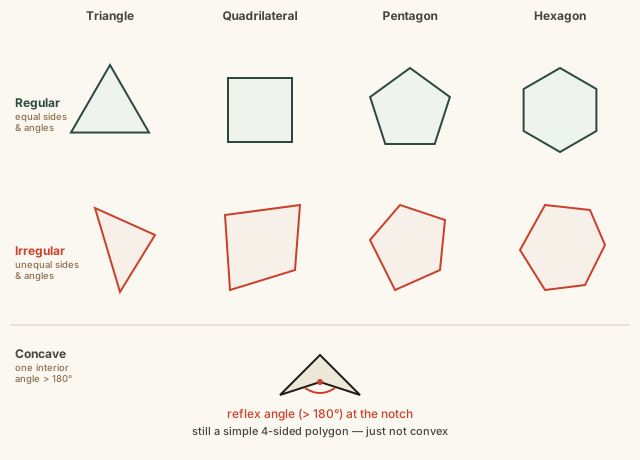
Read the grid by column first (side count fixes the shape family — three sides is always a triangle, four is always a quadrilateral) and then by row (regularity and convexity are separate properties layered on top). A shape can move down a row without ever changing its column — an irregular pentagon is still a pentagon, and a concave hexagon is still a hexagon — because "how many sides" and "how the sides and angles compare to each other" are answering two different questions.
Common mistakes
Common Mistakes
Treating 'quadrilateral' and 'square' as synonyms.
→ Quadrilateral just means 'four straight sides' — squares, rectangles, rhombuses, trapezoids, and kites are all quadrilaterals, but only one of them is a square.
Assuming equal side lengths alone make a polygon 'regular.'
→ Regular requires equal sides AND equal angles. A rhombus has four equal sides but usually unequal angles, so it's equilateral without being regular — only a square meets both conditions among four-sided shapes.
Believing every valid polygon must be convex.
→ Concave (non-convex) polygons — shapes with at least one reflex angle over 180° — are just as valid as convex ones. They still follow the same interior-angle-sum formula.
Common misconception
“A square is not a rectangle — they're two separate, unrelated shapes.”
A rectangle is defined as any quadrilateral with four right angles and opposite sides equal. A square satisfies every part of that definition, then adds one extra condition: all four sides (not just opposite pairs) are equal length. That makes a square a special case of a rectangle, not a different category — the relationship only runs one way. Every square is a rectangle, but not every rectangle is a square, the same way every dog is an animal but not every animal is a dog.
Which statement correctly describes the relationship between squares and rectangles?
Try it yourself
What to do next
What to do next
- Use the angle-sum calculator on a shape you can see right now (a book cover, a tabletop, a road sign) and check that its angles roughly add up to the predicted total.
- Next time you hear 'square' and 'rectangle' used as opposites, mentally correct it to 'a square is a special rectangle' instead.
- Look for hexagon tiling in the real world — honeycomb, bathroom tile, chain-link fencing — and connect it back to the 120° interior angle that lets three hexagons meet with zero gaps.
- Read the related entry on Angles Explained to go deeper on how individual angle types and pairs work, and Perimeter, Area & Volume to see what these same shapes let you measure.