 KnowThis
Key Takeaways
Key Takeaways
- 1In any right triangle, a² + b² = c², where c is the hypotenuse (the side opposite the 90° angle) and a and b are the two legs.
- 2The relationship only holds for right triangles — plug the side lengths of a non-right triangle into the formula and the two sides of the equation simply won't balance.
- 3It's not just a classroom formula: it's the basis of the 3-4-5 rule builders use to square corners, the diagonal size printed on every TV and monitor box, and straight-line distance math used in mapping and GPS.
The concept
The formula is simple to state — the actual skill is knowing which side is the hypotenuse, and rearranging the equation to solve for whichever side is missing.
In a right triangle, which side is always the hypotenuse?
Worked examples
Example 1: The 3-4-5 triangle (baseline case)
Example 2: Finding a missing leg — the ladder problem (edge case / variation)
A right triangle has a hypotenuse of 10 and one leg of 6. What is the length of the other leg?
Example 3: Calculating a TV or monitor's diagonal size (real-world / applied case)
Screen sizes are always advertised by diagonal length, not width or height — a "45-inch TV" means a 45-inch hypotenuse across a rectangular screen. A 16:9 widescreen with a width of about 39.2 inches and a height of about 22.0 inches has a diagonal of √(39.2² + 22.0²) = √(1,536.64 + 484) = √2,020.64 ≈ 44.95 inches, rounded up to the familiar "45-inch" spec on the box. Manufacturers use this exact calculation in reverse too: given a target diagonal size and a fixed aspect ratio (like 16:9), the Pythagorean theorem — combined with the ratio — determines the actual width and height of the panel they need to manufacture.
How it works (visual)
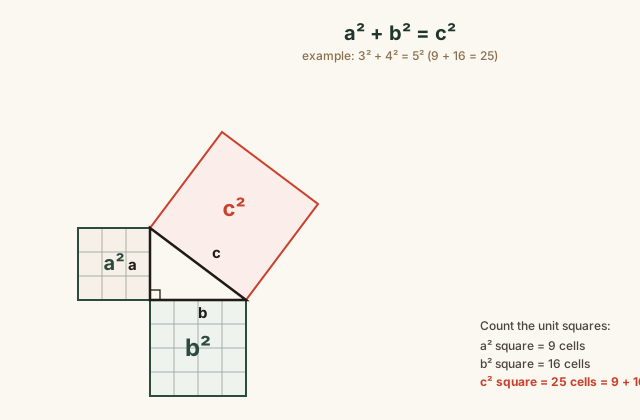
The three squares are the clearest way to see why the theorem is true rather than just believe it: build an actual square on each side of the triangle, and the areas of the two smaller squares (on the legs) always add up to exactly the area of the largest square (on the hypotenuse) — 9 + 16 = 25 for the 3-4-5 triangle, visibly and countably if you tile each square with unit squares. This is the geometric picture behind the algebra, not just a coincidence of the numbers.
Common mistakes
Common Mistakes
Applying a² + b² = c² to a triangle that isn't a right triangle.
→ The formula only works when one angle is exactly 90°. For any other triangle, a related but different formula (the Law of Cosines) is required instead.
Adding the two known sides directly instead of squaring, summing, and then taking the square root.
→ Remember the full sequence: square each known side, add those squares, then take the square root of the total. Skipping the squaring step (writing c = a + b) gives a wrong answer that happens to look plausible.
Mixing up which side is the hypotenuse when solving for a missing leg.
→ The hypotenuse is always the longest side, always opposite the right angle, and always isolated on its own side of the equation (c² = a² + b²) — never subtracted alongside a leg.
Common misconception
“The Pythagorean theorem only applies to triangles drawn in a math textbook — it doesn't matter for real-world measuring.”
It's one of the most directly applied formulas in construction, design, and navigation. Builders use the 3-4-5 rule to square foundations and wall corners without a protractor. TV and monitor manufacturers use it to relate a screen's advertised diagonal size to its actual width and height. GPS and mapping systems use it (in a slightly extended form) to calculate straight-line, "as the crow flies" distance between two points given their east-west and north-south displacement. Anywhere a right angle and a straight-line distance both matter, this formula is doing real, load-bearing work — not staying confined to a classroom.
A construction worker measures 3 feet along one wall and 4 feet along the perpendicular wall, then checks that the diagonal distance between those two points is exactly 5 feet. What is this checking for?
Try it yourself
What to do next
What to do next
- Use the hypotenuse calculator with legs 6 and 8 to confirm it lands on 10 — a scaled-up version of the 3-4-5 triple.
- Next time you see a TV or monitor's advertised screen size, remember it's a diagonal (hypotenuse) measurement, not the width or height.
- Try the 3-4-5 rule yourself with a tape measure on a real corner (a room, a fence line) to check whether it's a true right angle.
- Read the related entry on Angles Explained for the broader rules right angles follow, and Perimeter, Area & Volume for what you can calculate once a triangle's sides are known.