 KnowThis
Key Takeaways
Key Takeaways
- 1An angle measures rotation between two rays from a shared vertex, in degrees, where one full turn equals 360°.
- 2Angles follow fixed relationship rules: complementary angles sum to 90°, supplementary angles sum to 180°, and vertical angles (formed by two crossing lines) are always equal to each other.
- 3On a flat surface, a triangle's three interior angles always sum to exactly 180° — a rule reliable enough that builders and designers use it to check their own work without a protractor.
The concept
Those pairing rules aren't abstract — they're what let you find a missing angle in a diagram, a roof, or a road design without ever placing a protractor on it.
Two angles are described as 'supplementary.' What does that tell you about them?
Worked examples
Example 1: Finding a missing complementary angle (baseline case)
Example 2: Parallel lines and a transversal (edge case / variation)
A transversal crosses two parallel lines. One angle at the first crossing measures 70°. What must the alternate interior angle at the second crossing measure?
Example 3: Ladder placement and the 4-to-1 safety rule (real-world / applied case)
Ladder safety guidance from organizations like the American Ladder Institute recommends the "4-to-1 rule" for leaning a straight or extension ladder: for every 4 feet of height to the ladder's support point, its base should sit 1 foot away from the wall. That ratio works out to an angle of roughly 75.5° between the ladder and the ground — steep enough to climb safely without excessive strain, but shallow enough that the ladder resists sliding backward or tipping. A ladder set up too upright (closer to 90°, base too close to the wall) risks tipping backward; one set up too shallow (base too far out) risks the base sliding out from under the climber. The angle isn't an arbitrary safety suggestion — it's a specific, measurable target that ladder placement is checked against.
How it works (visual)
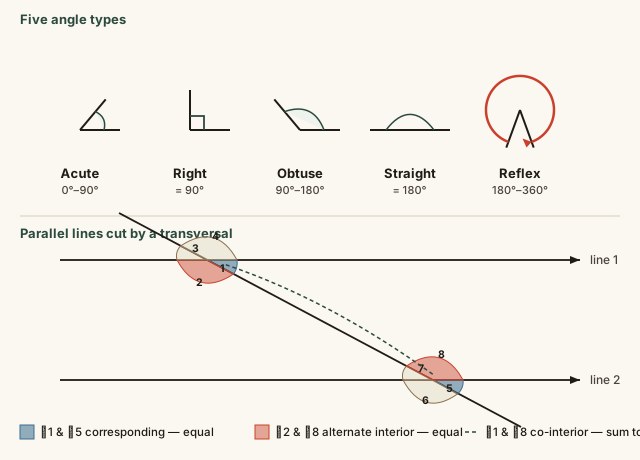
Read the top row left to right as a single number line of increasing rotation, from a sharp acute angle up through a full reflex angle just short of 360°. The bottom row shows why a transversal is so useful for measurement: crossing two parallel lines creates eight angles total, but they only take two distinct values, repeated — meaning measuring just one angle tells you all eight, provided the two lines are genuinely parallel.
Common mistakes
Common Mistakes
Mixing up complementary (90°) and supplementary (180°) angles.
→ A memory trick: 'C' for complementary comes before 'S' for supplementary in the alphabet, and 90 comes before 180 — complementary is the smaller total.
Assuming two angles that 'look' equal in a diagram actually are equal, without a stated reason (parallel lines, vertical angles, or a given measurement).
→ Only rely on angle equality when it's guaranteed by a specific rule — vertical angles, alternate interior angles on confirmed parallel lines, or angles explicitly marked as congruent. Visual appearance alone isn't proof.
Misreading a protractor's inner and outer scale, getting 180° minus the true angle instead of the angle itself.
→ Always check which scale starts at 0° from the ray you're measuring from — most protractors have two scales running in opposite directions, and using the wrong one flips the reading.
Common misconception
“A triangle's three angles always add up to exactly 180°, everywhere, no exceptions.”
That rule holds only on a flat (Euclidean) surface. Draw a "triangle" on a sphere — like Earth's surface — using great-circle lines (the shortest path between two points on a sphere, the kind planes actually fly), and the angle sum can exceed 180°. A classic example: start at the North Pole, travel down a line of longitude to the equator (a 90° turn), travel a quarter of the way around the equator (another 90° turn), then travel straight back up to the pole (a third 90° turn) — three 90° angles summing to 270°, not 180°. This isn't a trick; it's the basis of spherical and non-Euclidean geometry, used in real navigation and mapping over large distances.
Why can a triangle drawn on the surface of a sphere have angles that sum to more than 180°?
Try it yourself
What to do next
What to do next
- Use the complementary and supplementary calculators above on two angles you can see right now — a book corner, a door frame — and check the pairing rule holds.
- Next time you look at parallel lines crossed by a third line (railroad tracks, a ladder against a fence), try to spot a pair of equal alternate interior angles.
- If you ever set up a ladder, check the base distance against the 4-to-1 rule (1 foot of base distance for every 4 feet of height) before climbing.
- Read the related entry on Basic Shapes & Properties to see how angle rules combine with side counts to define polygons, and The Pythagorean Theorem for right-angle-specific calculations.