 KnowThis
Key Takeaways
Key Takeaways
- 1Line symmetry means one half of a shape mirrors the other across a line; rotational symmetry means a shape looks unchanged after being rotated less than a full 360° turn around its center.
- 2A shape can have one type of symmetry without the other — the letter 'S' has rotational symmetry but no line symmetry, while the letter 'A' has line symmetry but no rotational symmetry.
- 3Regular polygons carry both kinds in a predictable pattern: a regular polygon with n sides has exactly n lines of symmetry and rotational symmetry of order n, repeating every 360°/n of a turn.
The concept
Once you can tell line symmetry and rotational symmetry apart, it becomes obvious that most everyday "symmetric-looking" objects are only symmetric in one of the two senses — not both automatically.
A rectangle (not a square) is reflected across a vertical line through its center and lands exactly on itself. Does this rectangle also automatically have rotational symmetry?
Worked examples
Example 1: A square's full symmetry count (baseline case)
Example 2: Letters that break the "both kinds together" pattern (edge case / variation)
The letter 'S' looks identical after being rotated 180°, but no straight line can be drawn through it that produces two mirror-image halves. What does this tell you about 'S'?
Example 3: Five-fold symmetry in starfish (real-world / applied case)
Most starfish species display pentaradial symmetry — five-fold rotational symmetry arranged around a central point, with (in most species) five arms extending outward at roughly 72° intervals (360° ÷ 5). Rotate a typical starfish 72° around its center, and its overall body plan looks essentially unchanged, repeating five times over a full turn. This is genuine biological rotational symmetry, not just a visual impression — it reflects the actual underlying body structure that develops during the starfish's growth. It's a useful natural counterexample to the assumption that living things are built primarily around line (bilateral) symmetry the way most animals, including humans, are.
How it works (visual)
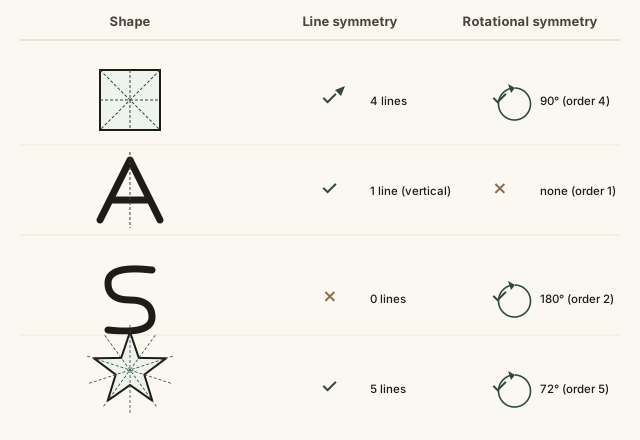
Reading the grid as a two-column checklist — line symmetry present or absent, rotational symmetry present or absent — makes it clear that the four possible combinations (both, line-only, rotation-only, neither) are all genuinely represented in ordinary shapes and letters, not just theoretical edge cases invented for a textbook.
Common mistakes
Common Mistakes
Calling any shape that 'looks balanced' symmetric without applying a precise fold or rotation test.
→ Symmetry is a specific, testable property — actually check whether folding along a proposed line, or rotating by a proposed angle, produces an exact match, not just a rough visual balance.
Assuming line symmetry and rotational symmetry always occur together.
→ Test each one independently. The letters 'A' and 'S' are simple proof that a shape can have exactly one type of symmetry without the other.
Assuming every four-sided shape has 4 lines of symmetry like a square does.
→ The number of symmetry lines depends on the specific shape, not just the side count — a generic rectangle has only 2, a generic rhombus has only 2, and a generic parallelogram can have 0.
Common misconception
“The human face (or body) is perfectly symmetric.”
Human faces and bodies show only approximate bilateral (line) symmetry, not perfect symmetry. Measured carefully, most real faces have detectable left-right differences — one eye set slightly higher or larger than the other, asymmetric nostril shapes, uneven ear height — differences large enough to be measured, even if they're too subtle to notice at a glance. True near-perfect geometric symmetry is more reliably found in specific natural forms like snowflakes (six-fold) or starfish (five-fold rotational), and in precisely engineered objects, than in human anatomy, which develops through a much less exact biological process.
A close, precise measurement of a human face typically finds small differences between its left and right sides. What does this tell you about human facial symmetry?
Try it yourself
What to do next
What to do next
- Test five capital letters from your own name for line symmetry, rotational symmetry, both, or neither — most alphabets split roughly evenly across all four categories.
- Use the rotational symmetry calculator on a stop sign (8 sides) and a honeycomb cell (6 sides) to see the pattern extend beyond squares and triangles.
- Next time someone calls a face or object 'perfectly symmetric,' treat it as an approximation, not a literal geometric claim.
- Read the related entry on Basic Shapes & Properties for how side count and angle rules combine to define the shapes symmetry applies to, and Angles Explained for the rotation math underneath rotational symmetry.