The world is conventionally divided into 195 countries — 193 United Nations member states plus 2 UN observer states — each with a capital city that serves as its seat of government, though that capital is often not the country's largest or most famous city.
Reading time
— 5 min
Updated
— Aug 16, 2026
Fact-reviewed
— Aug 16, 2026
Key Takeaways
Key Takeaways
1There are 195 countries by the most common count: 193 United Nations member states plus 2 UN observer states (the Holy See and the State of Palestine) — but the exact number shifts depending on which disputed or partially recognized territories you count.
2A capital city is simply wherever a country's government sits by law or tradition — it does not have to be the largest, richest, or most internationally famous city in that country.
3Some countries split capital functions across multiple cities (South Africa has three), and some governments physically operate from a city that isn't the constitutional capital at all (Netherlands, Bolivia).
The concept
A country is an independent nation with its own government and defined borders, and its capital city is the official home base of that government — where the president, parliament, or equivalent institutions are based. Most people learn a tidy list of "195 countries," each with one capital. In practice, most of that holds up: nearly every country does have a single, uncontested capital. But both halves of that sentence have real exceptions worth knowing, which is exactly why this topic keeps showing up in trivia and geography quizzes.
Knowing that exceptions exist is one thing — being able to spot the pattern behind them is more useful, so the next step is testing that against a case almost everyone gets wrong on the first try.
Quick check
Which of these is true about the relationship between a country's capital city and its largest city?
Worked examples
Example 1: Counting to 195 (baseline case)
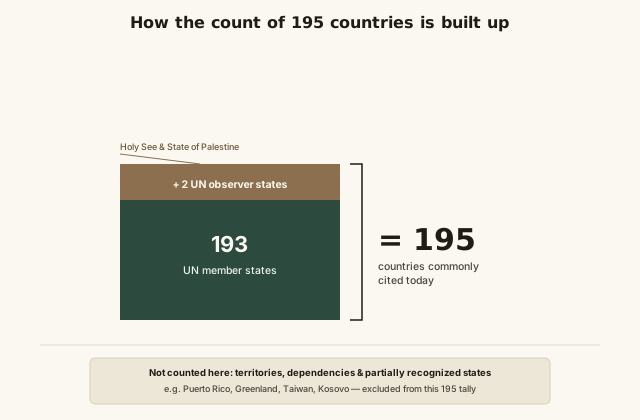
Start with the UN's 193 member states — every one of them recognized by essentially the entire international community and holding a vote in the General Assembly. Add the Holy See (governing seat of the Vatican) and the State of Palestine, both granted "permanent observer state" status by the General Assembly, and the commonly cited total reaches 195. This is the figure used by the U.S. Department of State's "Independent States in the World" list and matches what most atlases and geography curricula teach. It deliberately excludes territories, dependencies, and states that are recognized by only some countries — those get their own separate accounting, covered in the entry on disputed regions.
Example 2: When the capital isn't the biggest city (edge case / variation)
In the United States, Washington, D.C. is the capital, but New York City has roughly 15 times its population. The same pattern repeats worldwide: Australia's capital is Canberra, not Sydney or Melbourne — Canberra was purpose-built in the early 20th century specifically as a compromise capital between the two rival cities. Brazil moved its capital from Rio de Janeiro to the newly constructed Brasília in 1960, partly to draw development toward the country's interior. Turkey's capital is Ankara, not the far larger and more famous Istanbul. In each case, the choice reflects a deliberate decision — political neutrality, geographic centrality, or a push to develop an underdeveloped region — rather than simply naming whichever city already had the most people.
Quick check
Brazil moved its capital from Rio de Janeiro to Brasília in 1960. What was a major reason for building an entirely new capital city rather than keeping Rio?
Example 3: Reading a real capitals list correctly (real-world / applied case)
When cross-checking a "country and capital" list against an atlas or the CIA World Factbook, three details commonly trip people up: (1) some countries list more than one capital, so a single-answer quiz format may need to accept either (South Africa, Bolivia, Sri Lanka — whose official capital is Sri Jayawardenepura Kotte even though Colombo functions as the de facto commercial capital); (2) territories and dependencies (Puerto Rico, Greenland, Hong Kong) have administrative capitals but are not themselves sovereign countries, so they shouldn't be counted among the 195; and (3) political changes do occur — Egypt has been constructing a new administrative capital east of Cairo since 2015, intended to eventually house key government functions, so "current capital" lists benefit from checking a recently updated, authoritative source like the CIA World Factbook rather than an older printed atlas.
How it works (visual)
How the count of 195 countries is built up
The diagram separates the two building blocks of the "195" figure — full UN membership and observer status — from everything excluded from it. That excluded category is large and genuinely contested: Taiwan, Kosovo, Western Sahara, and similar cases are administered as self-governing entities in practice but are not universally recognized as sovereign states, so different reference sources (encyclopedias, atlases, government agencies) can report slightly different totals depending on their counting rules.
Common mistakes
Common Mistakes
✕
Assuming every country's capital is automatically also its largest or most famous city.
→ Check rather than assume — the U.S., Australia, Brazil, Canada, Turkey, and Nigeria are all well-known counterexamples where the capital is a different city than the largest one.
✕
Treating 'country' and 'territory' as interchangeable when counting toward a total like 195.
→ Territories and dependencies (Puerto Rico, Greenland, Hong Kong, Bermuda) have their own local capitals or administrative centers but are governed under another sovereign state, so they aren't counted separately in the 195 figure.
✕
Citing a single fixed number of countries as permanently settled fact.
→ 195 is the most common convention (193 UN members + 2 observer states), but the true count shifts slightly depending on how a source treats disputed or partially recognized states like Taiwan or Kosovo — always check the counting method a source uses.
Common misconception
“A country's capital is always its largest city.”
Capital status is a legal and administrative designation chosen by a country's government or constitution — it has nothing to do with population size. Many countries deliberately pick a smaller, more centrally located, or more politically neutral city as capital specifically to avoid favoring one dominant metropolitan region: Washington, D.C. over New York City; Canberra over Sydney or Melbourne; Ottawa over Toronto; Brasília over Rio de Janeiro or São Paulo; Abuja over Lagos. In each of these cases the capital was either purpose-built or chosen as a deliberate compromise, and the country's largest city plays no formal role in government at all.
Quick check
Which of these best explains why a country might choose a capital city that is not its largest city?
What to do next
What to do next
Next time you see a 'countries and capitals' quiz, check whether it's using the 195-country convention (193 UN members + 2 observers) or a different count, since totals do vary by source.
Pick five countries you think you know well and verify their capitals against the CIA World Factbook — you may find at least one surprise where the capital isn't the city you'd expect.
Read the entry on Borders & How They're Defined to see how a country's territory — not just its capital — gets legally established in the first place.
Read the entry on Territories, Dependencies & Disputed Regions to understand why the '195' figure excludes places like Taiwan, Kosovo, and Western Sahara.
FAQ
FAQ
Related terms
Related terms
Sovereign state
A political entity with a permanent population, defined territory, functioning government, and the capacity to enter relations with other states — the formal definition of a 'country.'
Capital city
The city officially designated as the seat of a country's government, where its central governing institutions are usually located.
UN member state
A sovereign country that has been admitted to full membership in the United Nations by a vote of the General Assembly on the Security Council's recommendation.
UN observer state
A state recognized enough to participate in UN proceedings without full voting membership; currently the Holy See and the State of Palestine hold this status.
Seat of government
The city where a country's primary governing institutions physically operate, which is not always the same city as its constitutional or ceremonial capital.
Primate city
A country's largest city, which in many countries is also the capital, but in a significant number of countries is a different city entirely.
 KnowThis