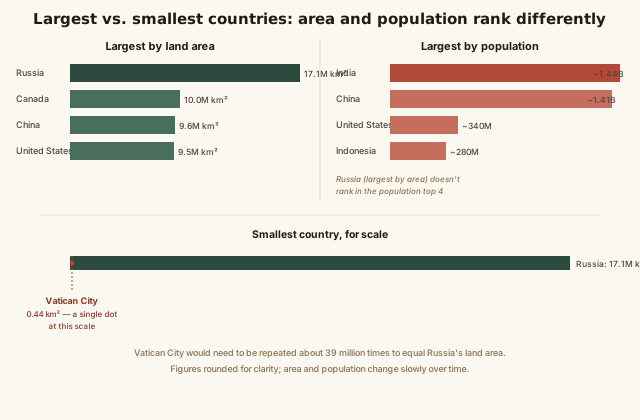
Russia is the world's largest country by land area at roughly 17.1 million square kilometers, while Vatican City is the smallest at under half a square kilometer — and ranking countries by population produces an entirely different, often surprising, list.
Reading time
— 5 min
Updated
— Aug 16, 2026
Fact-reviewed
— Aug 16, 2026
Key Takeaways
Key Takeaways
1Russia is the world's largest country by land area, at roughly 17.1 million square kilometers — more than 11% of Earth's total land area — and spans 11 time zones.
2Vatican City is the world's smallest sovereign country, at just under 0.49 square kilometers — smaller than most college campuses, and about 39,000 times smaller than Russia.
3'Largest' and 'smallest' depend entirely on what you're measuring: Russia is largest by land area but not by population, and ranking by population produces a completely different list topped by India and China.
The concept
By land area, Russia is the world's largest country by a wide margin — nearly twice the size of the second-largest, Canada. At the opposite end, Vatican City, the independent city-state that surrounds St. Peter's Basilica in Rome, is the smallest country in the world, so small it could fit inside New York's Central Park several times over. But "largest" and "smallest" aren't fixed labels — they change depending on what you're actually measuring, which is the real lesson behind this topic.
That gap between "biggest by land" and "biggest by people" is the single most useful distinction in this topic — the next check tests exactly that.
Quick check
Russia is the largest country in the world by land area. Is it also the country with the largest population?
Worked examples
Example 1: Russia vs. Vatican City by area (baseline case)
Russia covers about 17,098,242 square kilometers according to the CIA World Factbook; Vatican City covers about 0.49 square kilometers. Dividing the two shows Russia is roughly 34.9 million times larger than Vatican City by land area — a scale difference so large it's genuinely hard to visualize. To put Russia's size in perspective on its own: at 17.1 million square kilometers, it's larger than the entire continent of South America (about 17.8 million km² is close, so Russia is nearly comparable to an entire continent) and covers more than 11% of all dry land on the planet.
Example 2: Largest by area vs. largest by population (edge case / variation)
Ranking the same set of countries by two different metrics produces two different top-fours. By land area: Russia, Canada, China (or the United States, depending on measurement conventions), and the United States (or China). By population: India, China, the United States, and Indonesia. Canada, despite ranking second by area, doesn't even crack the top 30 by population — it has a large land area but a comparatively small population of roughly 40 million, concentrated in a narrow band near its southern border with the United States. This is the clearest possible demonstration that "biggest country" is not one single fact, but depends entirely on which of at least three separate measurements (area, population, or population density) is being used.
Quick check
Canada is the second-largest country in the world by land area, yet it doesn't rank anywhere near the top by population. What best explains this?
Example 3: What Russia's 11 time zones actually mean day to day (real-world / applied case)
Because Russia's land area is so vast, it spans 11 time zones — more than any other country, and more than the contiguous United States (4 time zones) and China (which, despite being nearly as wide geographically, uses a single official time zone nationwide for administrative unity). This has real practical consequences: a phone call between Russia's westernmost region (Kaliningrad) and its easternmost (Chukotka, near Alaska) can cross a time difference of up to 10 hours — comparable to calling between London and Hawaii — even though both locations are within the same country's borders. China's choice to use one time zone despite similar east-west width shows that time zone count is a policy decision layered on top of geography, not a strict physical requirement of a country's size.
How it works (visual)
Largest vs. smallest countries by area, and how the population ranking differs
Placing the two rankings side by side makes the core point visually obvious: Russia dominates the area chart but disappears from the population chart's top ranks, while India and China dominate the population chart despite neither being the single largest country by area. The tiny Vatican City inset reinforces just how extreme the size range across all 195 countries actually is — from a fraction of a square kilometer to nearly 17.1 million.
Common mistakes
Common Mistakes
✕
Assuming the largest country by area must also have the largest population.
→ These are independent measurements. Russia leads by area but ranks far behind India, China, the US, and Indonesia by population — check which metric a claim is actually using.
✕
Confusing Vatican City (a fully sovereign country) with a mere neighborhood or district of Rome.
→ Vatican City is a fully independent sovereign state with its own government, currency-issuing rights, postal system, and observer status at the UN — it just happens to be entirely surrounded by the city of Rome, Italy.
✕
Assuming a country's number of time zones scales directly and automatically with its geographic width.
→ It's partly a policy choice, not just physics — China spans roughly the same longitude range as the contiguous United States but uses a single official time zone nationwide, while Russia's 11 time zones reflect a deliberate administrative choice to follow its geographic width more closely.
Common misconception
“The 'biggest' country in the world is a single, fixed fact everyone agrees on.”
"Biggest" depends entirely on what's being measured. Russia is the largest country by land area by a wide margin. India and China are the largest by population, each with roughly 1.4 billion people, while Russia's population is far smaller by comparison despite its huge territory. A third ranking, by population density, produces yet another different list topped by tiny, heavily urbanized countries like Monaco and Singapore. None of these three rankings are wrong — they're just answering different questions, so the honest answer to "what's the biggest country?" is "biggest by what measurement?"
Quick check
A news headline says 'World's Biggest Countries' without specifying a metric. What's the most accurate way to interpret this?
Try it yourself
What share of Earth's land area does a country cover?
Share of Earth's total surface area (%)3.35
What share of world population does a country's population represent?
Share of world population (%)17.07
What to do next
What to do next
Try the calculators above with Canada's area (about 9,984,670 km²) and its population (about 40 million) to see the area-versus-population gap in numbers, not just words.
Next time you see a 'largest country' claim, check whether it's ranking by land area, population, or population density before treating it as complete.
Look up Vatican City on a map and compare its size directly to a familiar local landmark, like a park or a college campus, to make the scale concrete.
Read the entry on Landlocked Countries to see how a country's shape, not just its size, can define what's actually possible for its economy and military.
FAQ
FAQ
Related terms
Related terms
Land area
The total surface area of a country's territory, usually measured in square kilometers or square miles, and the most common basis for ranking 'largest' and 'smallest' countries.
Microstate
An extremely small sovereign country, typically under a few hundred square kilometers, such as Vatican City, Monaco, or San Marino.
Population density
The number of people living per unit of land area (e.g., per square kilometer) — a separate measure from either total land area or total population.
Time zone
One of the standardized regions of the globe that share the same clock time, relevant to large countries like Russia that span multiple such zones.
Contiguous territory
Territory that forms a single unbroken landmass, as opposed to being split across separate, non-touching areas.
 KnowThis