United Nations & Global Political Bodies (basic overview)
The United Nations, founded in 1945 and now made up of 193 member states, works through six main organs — most notably the General Assembly, where every member state gets one vote, and the Security Council, where five permanent members hold veto power over substantive decisions.
Reading time
— 6 min
Updated
— Aug 16, 2026
Fact-reviewed
— Aug 16, 2026
Key Takeaways
Key Takeaways
1The United Nations was founded in 1945 by 51 original member states and has grown to 193 member states today, making it the world's largest intergovernmental organization.
2The UN works through six main organs, but two matter most for day-to-day understanding: the General Assembly (one vote per country) and the Security Council (15 members, with 5 holding veto power).
3The UN is a distinct body from regional organizations like the European Union, the African Union, or NATO — it has near-universal global membership but generally less direct authority over its members' internal affairs than a regional bloc like the EU has over its own members.
The concept
The United Nations is an organization almost every country in the world belongs to, created after World War II to help prevent future large-scale wars and to coordinate international cooperation on everything from peacekeeping to public health to refugee assistance. It isn't a world government — it can't pass laws that automatically apply inside member countries — but it does have real tools: it can authorize peacekeeping missions, impose economic sanctions, and, through its Security Council, make some decisions that member states are legally bound to follow.
The General Assembly's "one country, one vote" system and the Security Council's very different veto-based system are the two structural facts that explain almost everything about how the UN actually makes decisions — the next check tests exactly that distinction.
Quick check
In the UN General Assembly, does a large, populous country like India get more votes than a small country like Malta?
Worked examples
Example 1: How a Security Council resolution actually passes (baseline case)
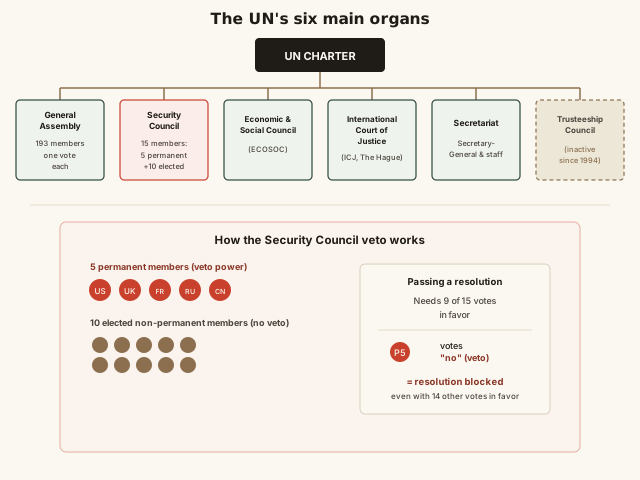
A substantive Security Council resolution needs at least 9 of the 15 members voting in favor, and critically, none of the 5 permanent members (China, France, Russia, the UK, the US) voting against — a single "no" from any one of them is enough to block the resolution entirely, regardless of how the other 14 members vote. A permanent member can also choose to abstain rather than vote no, which by long-standing Council practice does not count as a veto and allows the resolution to proceed if it otherwise has enough support. This is different from the General Assembly, where most resolutions need only a simple majority (or two-thirds for specific important questions) and no single country can unilaterally block the outcome.
Example 2: Why the UN isn't the same thing as the EU, NATO, or the African Union (edge case / variation)
It's a common mix-up: the UN is often confused with regional organizations that serve very different purposes. The European Union is a regional political and economic union of 27 member states with its own directly elected parliament, a shared currency used by most members, and the power to pass laws that apply directly inside member countries — authority well beyond anything the UN has over its 193 members. NATO is a regional military alliance of 32 countries built around a mutual-defense commitment (an armed attack on one member is treated as an attack on all). The African Union, with 55 member states, coordinates political and economic cooperation across the African continent specifically. The UN, by contrast, has near-universal global membership but comparatively limited direct authority over its members' internal governance — it works primarily through international law, diplomacy, peacekeeping mandates, and Security Council resolutions rather than by passing enforceable domestic legislation.
Quick check
A news article mentions 'the UN passed new trade laws that automatically apply inside all 193 member countries.' Is this an accurate description of how the UN works?
Example 3: Tracing a real UN peacekeeping mission (real-world / applied case)
When a conflict threatens international peace and security, the process typically starts with the Security Council authorizing a peacekeeping mission by resolution — specifying its mandate (what the mission is allowed to do), troop levels, and duration. UN member states then voluntarily contribute military and police personnel (the UN itself has no standing army of its own), which serve under the UN flag and a UN-appointed mission command, funded through UN peacekeeping assessments paid by member states. The mission's mandate can be renewed, expanded, or ended by further Security Council resolutions, meaning ongoing peacekeeping operations depend on continued Security Council agreement — including, in principle, the continued absence of a P5 veto against renewing the mandate.
How it works (visual)
The UN's six main organs and how the Security Council's veto works
The diagram separates the UN's most-discussed feature — the Security Council's veto — from its broader six-organ structure, since most public confusion about "how the UN works" really comes down to conflating the General Assembly's one-country-one-vote system with the Security Council's much smaller, veto-weighted one. Both are real UN organs operating under the same charter, but they follow fundamentally different voting rules and produce fundamentally different levels of binding authority.
Common mistakes
Common Mistakes
✕
Assuming the UN General Assembly and the UN Security Council work the same way.
→ The General Assembly gives every member state one equal vote and passes non-binding resolutions; the Security Council has only 15 members, 5 with veto power, and can pass resolutions that are legally binding on all member states.
✕
Confusing the United Nations with regional bodies like the European Union, NATO, or the African Union.
→ The UN has near-universal global membership but comparatively limited direct authority over members' domestic affairs; regional bodies like the EU have far fewer members but, in the EU's case, considerably more direct legal authority over them.
✕
Assuming the UN maintains its own standing army for peacekeeping missions.
→ The UN has no standing military force of its own — peacekeeping missions are staffed by troops and police voluntarily contributed by individual member states, operating under a UN mandate and UN command.
Common misconception
“All 193 UN member states have an equal say in how the organization's most important decisions get made.”
The General Assembly does give every member state an equal single vote — but the Security Council, which handles matters of international peace and security and can issue legally binding resolutions, does not work that way at all. Only 5 of the 193 member states (China, France, Russia, the United Kingdom, and the United States) hold permanent seats with veto power, meaning any one of them alone can block a substantive resolution regardless of how the other 187 non-permanent-seat member states feel about it. This structural imbalance, dating to the UN's 1945 founding, is one of the most frequently cited criticisms of the organization and a recurring subject of UN reform proposals.
Quick check
Which statement most accurately describes decision-making power across the UN's different organs?
What to do next
What to do next
Look up the current 10 non-permanent Security Council members — they rotate on two-year terms, so the list changes regularly, unlike the fixed 5 permanent members.
Next time you see a UN resolution reported in the news, check whether it came from the General Assembly (non-binding) or the Security Council (potentially binding) — the distinction changes what the resolution actually accomplishes.
Compare the UN's global membership and limited domestic authority against a regional body like the EU's smaller membership and much broader legal authority over its own members.
Read the entry on Territories, Dependencies & Disputed Regions to see how specific UN bodies, like the Special Committee on Decolonization, handle real unresolved cases.
FAQ
FAQ
Related terms
Related terms
United Nations (UN)
An intergovernmental organization founded in 1945 to maintain international peace and security, currently comprising 193 member states.
General Assembly
The UN's main deliberative body, where every member state holds one vote regardless of size or population.
Security Council
The UN body responsible for maintaining international peace and security, made up of 15 members, with binding authority that other UN organs lack.
Veto power
The ability of any one of the Security Council's five permanent members (China, France, Russia, the United Kingdom, and the United States) to block a substantive Council resolution with a single 'no' vote.
Secretariat
The UN organ that carries out the day-to-day administrative and operational work of the organization, headed by the Secretary-General.
International Court of Justice (ICJ)
The UN's principal judicial organ, based in The Hague, Netherlands, which settles legal disputes between states and gives advisory opinions on international legal questions.
 KnowThis