Water Cycle & Oceans: Where Earth's Water Actually Is, and How It Moves
The water cycle is the continuous movement of water between oceans, atmosphere, and land through evaporation, condensation, precipitation, and runoff.
Reading time
— 5 min
Updated
— Aug 16, 2026
Fact-reviewed
— Aug 16, 2026
Key Takeaways
Key Takeaways
1About 96.5% of all water on Earth is saltwater in the oceans; of the remaining freshwater, most is locked in glaciers and ice or deep groundwater, leaving less than 1% of Earth's total water as accessible surface freshwater in lakes and rivers.
2The water cycle moves the same fixed amount of water endlessly between ocean, atmosphere, and land through evaporation, condensation, precipitation, and runoff — no water is created or destroyed in the process, only relocated and changed in state.
3Different parts of the cycle hold onto water for wildly different lengths of time: water vapor lasts about 9 days in the atmosphere on average, while deep groundwater can take centuries to millennia to move, which is why aquifer depletion doesn't reverse quickly.
The concept
The water cycle is the ongoing loop water travels through: the sun heats the ocean surface, turning some of that water into invisible vapor that rises into the sky (evaporation). High in the cooler atmosphere, that vapor turns back into tiny water droplets, forming clouds (condensation). When those droplets combine and get heavy enough, they fall back down as rain or snow (precipitation), which then flows into rivers, soaks into the ground, or runs straight back to the ocean — where the whole cycle starts again.
That's the loop in outline. The details worth knowing are how unevenly Earth's water is actually distributed, and how differently each part of the system holds onto it before letting go.
Quick check
If evaporation, condensation, and precipitation just keep cycling water endlessly, is any new water being created in the process?
Worked examples
Example 1: Tracing a single water molecule through the cycle (baseline case)
A water molecule evaporates from the surface of the Pacific Ocean, absorbing latent heat energy as it turns to vapor. It rises, cools, and condenses into a cloud droplet within roughly 9 days on average — the typical residence time of water vapor in the atmosphere, according to USGS estimates. That droplet falls as rain over a mountain range, and from there its path forks: it might run off immediately into a stream and reach the ocean again within weeks, or it might infiltrate the soil and become groundwater, where it could sit for decades, centuries, or in some deep aquifers, thousands of years before re-emerging. The same molecule, over Earth's history, has likely made this loop — ocean to air to land and back — countless times.
Example 2: The scale of a major river's daily discharge (edge case / variation)
Most water cycle discussions focus on the invisible, slow parts — vapor and groundwater. Rivers are the visible, fast-moving exception, and their scale is easy to underestimate. The Mississippi River discharges roughly 16,800 cubic meters of water into the Gulf of Mexico every second on average, according to USGS gauging data. Multiplied across a full day (86,400 seconds), that's over 1.45 billion cubic meters of water — more than 580,000 Olympic swimming pools' worth — returning to the ocean in a single 24-hour period from just one river system, illustrating how much of the water cycle's total flow moves through a comparatively small number of major rivers.
Quick check
A river discharges a large, steady volume of water into the ocean every day. Where did that water most directly come from?
Water has an unusually high specific heat capacity — it takes a large amount of energy to change its temperature compared to most other common substances, including air and land. Because oceans cover about 71% of Earth's surface and absorb enormous amounts of solar energy without heating up quickly, they act as a massive thermal buffer. This is why coastal cities typically experience milder seasonal temperature swings than inland cities at the same latitude: the nearby ocean absorbs heat slowly through summer and releases it slowly through winter, moderating both extremes. Inland regions, lacking that buffer, swing to hotter summers and colder winters for the same amount of incoming sunlight over the year.
How it works (visual)
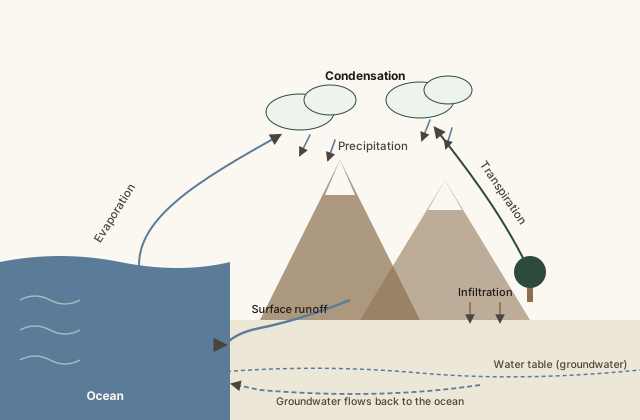
The water cycle: evaporation, condensation, precipitation, and runoff between ocean, atmosphere, and land
Follow the arrows starting at the ocean surface, the largest source in the diagram by far: solar heating drives evaporation upward, water vapor condenses into clouds, and precipitation falls over both ocean and land. Over land, precipitation splits into two paths — fast surface runoff through streams and rivers back to the ocean, and slow infiltration into groundwater, which can take a vastly longer route back. Every arrow in this diagram represents the same water being relocated and changing physical state, never created or destroyed, which is the core idea the whole cycle rests on.
Common mistakes
Common Mistakes
✕
Thinking rain comes from 'empty' sky rather than water vapor that was already there, evaporated from a surface earlier.
→ Rain is condensed water vapor falling back down — trace it backward and it always leads to an earlier evaporation event, usually from an ocean, lake, or plant.
✕
Treating the water cycle as strictly one-directional: ocean evaporates, it rains, done.
→ The cycle includes multiple parallel pathways — transpiration from plants, infiltration into groundwater, and surface runoff — not just a single ocean-to-rain loop.
✕
Assuming freshwater and saltwater differ only in taste, with roughly similar amounts of each available worldwide.
→ The difference in scale is enormous: saltwater makes up about 96.5% of all water on Earth, and most of the remaining freshwater is locked in ice or deep groundwater, not readily accessible surface freshwater.
Common misconception
“Most of the water on Earth is available freshwater we could use if we needed to.”
The opposite is true. According to USGS estimates, roughly 96.5% of all water on Earth is saline ocean water. Of the remaining 2.5% that's freshwater, about 68.7% is locked in glaciers and ice caps and roughly 30.1% is groundwater, much of it too deep or too slow-moving to access easily. That leaves well under 1% of all water on Earth as the surface freshwater in lakes, rivers, and shallow accessible groundwater that supplies most human use — a strikingly small slice of the total, which is exactly why freshwater scarcity is a real regional issue even though water, in total, seems abundant.
Quick check
If nearly 71% of Earth's surface is covered in water, why do some regions still face serious freshwater shortages?
Try it yourself
Calculate a river's daily water volume from its discharge rate
Water volume moved per day (cubic meters)1,451,520,000
What to do next
What to do next
Next time it rains, trace the water backward in your head: cloud, condensation, evaporation, an ocean or lake surface somewhere upwind.
Try the calculator above with a river near you (discharge rates are published by USGS gauging stations) to see the real daily volume moving past a single point.
Notice whether you live in a coastal or inland location and connect it to milder or more extreme seasonal temperature swings, driven by the ocean's high specific heat capacity.
Read the related entry on Weather & Climate Basics to see how evaporation and condensation also drive day-to-day weather, not just the long-term cycle.
FAQ
FAQ
Related terms
Related terms
Evaporation
The process by which liquid water absorbs enough heat energy to turn into water vapor, primarily from oceans, lakes, and rivers.
Condensation
The process by which water vapor cools and turns back into liquid droplets, forming clouds and fog.
Precipitation
Water falling from the atmosphere to Earth's surface as rain, snow, sleet, or hail.
Transpiration
The release of water vapor from plants through pores in their leaves, part of the water cycle alongside evaporation.
Groundwater
Water stored underground in the pore spaces and cracks of soil and rock, often accessed through wells.
Residence time
The average length of time a water molecule stays in a particular part of the water cycle — atmosphere, ocean, ice, or groundwater — before moving on.
Thermohaline circulation
A global pattern of deep ocean currents driven by differences in water density caused by temperature and salinity.
 KnowThis