Seasons & Earth's Tilt: Why It's Not About Distance From the Sun
Seasons are caused by Earth's roughly 23.5° axial tilt, which changes the angle and duration of sunlight each hemisphere receives as Earth orbits the Sun — not by changing distance from the Sun.
Reading time
— 5 min
Updated
— Aug 16, 2026
Fact-reviewed
— Aug 16, 2026
Key Takeaways
Key Takeaways
1Seasons are caused by Earth's roughly 23.5° axial tilt, not by changing distance from the Sun — Earth is actually closest to the Sun (perihelion) in early January, in the middle of Northern Hemisphere winter.
2The tilt changes two things through the year for a given hemisphere: the angle sunlight hits the ground (more direct, concentrated sunlight in summer; more slanted, spread-out sunlight in winter) and the number of daylight hours (longer summer days, shorter winter days).
3Because the tilt affects each hemisphere oppositely at the same point in Earth's orbit, the Northern and Southern Hemispheres always experience opposite seasons — when it's summer in New York, it's winter in Sydney.
The concept
Earth doesn't spin perfectly upright as it orbits the Sun — it's tilted on its axis by about 23.5°, like a slightly leaning top. As Earth travels around the Sun over a year, that tilt means the Northern Hemisphere sometimes leans toward the Sun (getting more direct sunlight and longer days — summer) and sometimes leans away (getting more indirect sunlight and shorter days — winter). The Southern Hemisphere experiences the exact opposite at the same time, which is why seasons are reversed between the two halves of the planet.
That's the tilt mechanism in outline. The part worth working through with real numbers is exactly how much that tilt changes the sun's angle in the sky — because that angle, not distance, is what actually determines how concentrated the incoming solar energy is.
Quick check
Earth's distance from the Sun changes only slightly across the year, and it's actually closest in January. So what physically causes summer and winter?
Worked examples
Example 1: Sun angle at 40°N latitude, summer vs. winter (baseline case)
Using the relationship sun altitude at solar noon = 90° − |latitude − solar declination|: at 40°N latitude on the summer solstice, when declination is about +23.5°, altitude = 90 − |40 − 23.5| = 90 − 16.5 = 73.5° above the horizon — nearly overhead, delivering concentrated, high-intensity sunlight. On the winter solstice, declination flips to about -23.5°, giving altitude = 90 − |40 − (−23.5)| = 90 − 63.5 = 26.5° — a low, slanted angle that spreads the same amount of sunlight over a much larger patch of ground, delivering far less energy per square meter, on top of fewer daylight hours to add it up over. That roughly 47° swing in sun angle across the year, at the same location, is the direct, measurable signature of axial tilt at work.
Example 2: The tropics and the poles — two seasonal edge cases (edge case / variation)
Within the tropics — the band of latitude between 23.5°N and 23.5°S — the Sun can reach a full 90° altitude (directly overhead) at solar noon on at least one day of the year, something that never happens outside that band; this is precisely why the boundary latitudes are named the Tropic of Cancer and Tropic of Capricorn. At the opposite extreme, near the poles, the tilt effect becomes so pronounced that the Sun can stay continuously above the horizon for weeks or months around the summer solstice (the "midnight sun") or continuously below it around the winter solstice (polar night) — the same tilt mechanism as everywhere else, just taken to its most extreme geographic expression.
Quick check
Near the North Pole in midsummer, the Sun stays above the horizon for weeks without setting. What causes this 'midnight sun' effect?
Example 3: Why Australia celebrates Christmas in summer (real-world / applied case)
In late December, Earth's axial tilt points the Northern Hemisphere away from the Sun and the Southern Hemisphere toward it — the same orbital position, opposite sunlight exposure for each half of the planet. That's why Australia, Argentina, and South Africa experience their warmest, longest days right around Christmas, while the Northern Hemisphere experiences its shortest, coldest ones at the very same moment. Nothing about Earth's distance from the Sun changes between a Northern and Southern Hemisphere location on the same date — both are the same distance from the Sun on any given day — so the opposite seasons are conclusive, direct evidence that tilt, not distance, is the actual mechanism at work.
How it works (visual)
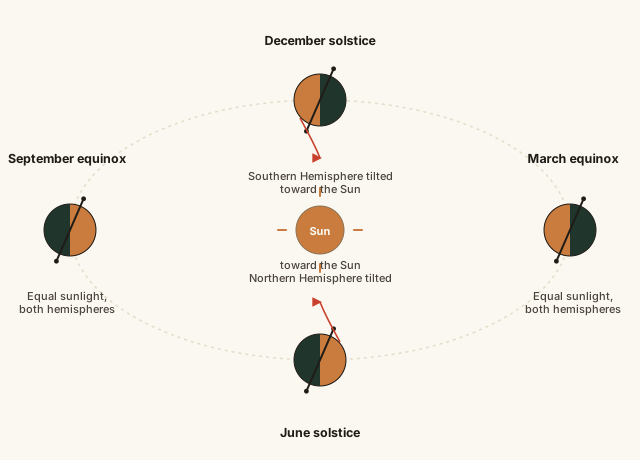
Earth's tilted axis at four points in its orbit around the Sun
The critical detail in this diagram is that Earth's axis points in the same fixed direction in space at every orbital position — it doesn't wobble to follow the Sun. That fixed tilt is what makes the Northern Hemisphere angle toward the Sun in June and away from it in December, purely because of where Earth happens to be in its orbit relative to that unchanging axis direction. Trace the two solstice positions and notice they're roughly the same distance from the Sun — it's the angle of the tilted axis relative to the Sun's direction, not the distance, that flips from one solstice to the other.
Common mistakes
Common Mistakes
✕
Believing summer happens because Earth is physically closer to the Sun.
→ Earth is actually closest to the Sun in early January, during Northern Hemisphere winter. Seasons are driven by axial tilt changing sunlight angle and day length, not by orbital distance.
✕
Assuming every location on Earth experiences four clearly distinct seasons.
→ Near the equator, where the Sun's angle stays high year-round, temperature varies little across the year — many tropical regions instead have wet and dry seasons driven by shifting rain belts, not the four-season temperature pattern common at mid-latitudes.
✕
Assuming day length is roughly the same everywhere on any given date.
→ Day length varies dramatically by latitude — equatorial regions stay close to 12 hours of daylight year-round, while high-latitude regions can swing to 24-hour daylight or 24-hour darkness near the solstices.
Common misconception
“Summer happens because Earth is closer to the Sun, and winter happens because it's farther away.”
Earth's orbit is only mildly elliptical, and it's actually closest to the Sun (perihelion, about 147.1 million km) in early January — the middle of Northern Hemisphere winter — and farthest (aphelion, about 152.1 million km) in early July, during Northern Hemisphere summer, according to NASA. The real driver is Earth's roughly 23.5° axial tilt, which changes the angle sunlight strikes a hemisphere and how many daylight hours it gets. The clearest proof: the Northern and Southern Hemispheres are always the same distance from the Sun at any given moment, yet they experience opposite seasons — a distance-based explanation simply can't account for that.
Quick check
If Earth is actually closest to the Sun in January, why is it winter in the Northern Hemisphere at that exact time?
Try it yourself
Calculate the Sun's altitude at solar noon (90° − |latitude − declination|)
Sun's altitude at solar noon (degrees above horizon)73.5
What to do next
What to do next
Try the calculator above with your own latitude and a declination of -23.5° (winter solstice) versus +23.5° (summer solstice) to see your local sun-angle swing.
Next December or June, message a friend in the opposite hemisphere and compare seasons directly — it's a quick, concrete confirmation that tilt, not distance, drives the pattern.
Notice how much earlier or later sunset happens as the seasons change where you live, and connect it back to changing solar declination.
Read the related entry on Weather & Climate Basics to see how this seasonal solar-energy pattern combines with atmospheric circulation to produce actual weather.
FAQ
FAQ
Related terms
Related terms
Axial tilt
The angle, about 23.5°, between Earth's rotational axis and the plane of its orbit around the Sun — the root cause of the seasons.
Solstice
The two points in Earth's orbit (around June 21 and December 21) when a hemisphere is tilted most directly toward or away from the Sun, producing the year's longest or shortest day.
Equinox
The two points in Earth's orbit (around March 20 and September 22) when neither hemisphere is tilted toward or away from the Sun, producing roughly equal day and night length worldwide.
Solar declination
The angle between the Sun's rays and Earth's equatorial plane, which varies from about -23.5° to +23.5° across the year as Earth orbits while tilted.
Perihelion and aphelion
Perihelion is the point in Earth's orbit closest to the Sun (early January); aphelion is the farthest point (early July) — the small distance difference between them is not what causes the seasons.
Tropics
The band of latitude between the Tropic of Cancer (23.5°N) and the Tropic of Capricorn (23.5°S), the only region where the Sun can appear directly overhead at solar noon.
 KnowThis