Earth's Structure & Plate Tectonics: The Layers Below Your Feet, Moving
Earth is made of a thin crust, a thick mostly-solid mantle, a liquid outer core, and a solid inner core, with the crust broken into moving tectonic plates.
Reading time
— 6 min
Updated
— Aug 16, 2026
Fact-reviewed
— Aug 16, 2026
Key Takeaways
Key Takeaways
1Earth has four main layers — crust, mantle, outer core, and inner core — defined by composition and physical state, not just depth: the mantle is mostly solid rock that flows like extremely thick tar over millions of years, and only the outer core is liquid.
2Earth's rigid outer shell (the lithosphere) is broken into roughly 15 major tectonic plates that drift a few centimeters per year — about the rate a fingernail grows — driven by heat-driven convection in the mantle beneath them.
3Where plates meet determines what happens there: pulling apart builds new ocean floor, colliding builds mountains or sinks one plate beneath the other, and sliding past each other produces the friction that causes most major earthquakes.
The concept
Earth isn't solid rock all the way through. Peel it back like an onion and you'd find a thin outer crust (the ground under your feet), a much thicker mantle of hot rock beneath it, and finally a metal core at the very center. That crust isn't one solid shell — it's cracked into giant pieces called tectonic plates, and those plates are slowly sliding around, which is why continents have moved over Earth's history and why earthquakes and volcanoes cluster in predictable bands.
Knowing the layers explains what Earth is made of. The more useful question — and the one that explains earthquakes, volcanoes, and mountain ranges — is what happens at the boundaries where the rigid plates on top meet each other.
Quick check
Tectonic plates move only a few centimeters per year, about as fast as a fingernail grows. Why does this slow motion matter?
Worked examples
Example 1: What's actually beneath your feet, layer by layer (baseline case)
Standing on continental crust, you're on top of roughly 30-50 km of granite-rich rock — a thin skin compared to Earth's 6,371 km radius, proportionally thinner than an apple's skin relative to the apple. Below that sits the mantle, extending down to about 2,900 km, hot enough to flow slowly as solid rock over geologic time. Past that boundary is the liquid outer core (to about 5,150 km depth), and finally the solid inner core at the very center. Temperature rises with depth throughout — the mantle-core boundary is estimated near 4,000-5,000°C, and the inner core's center may exceed 5,200°C, comparable to the surface of the sun, held in check from melting by crushing pressure rather than by being cooler.
Example 2: Why the inner core is solid despite being the hottest layer (edge case / variation)
It seems backwards: the inner core is hotter than the outer core, yet the inner core is solid and the outer core is liquid. The resolution is pressure, not just temperature. A material's melting point rises under higher pressure, because atoms need even more thermal energy to break free of a tightly compressed crystal structure. At the inner core, pressure reaches roughly 3.6 million atmospheres — high enough to push iron's melting point above the actual temperature there, keeping it solid. In the outer core, pressure is lower (though still enormous), so despite being somewhat cooler than the inner core, it's still above the local melting point and stays liquid. This is the same physical principle — melting point shifting with pressure — that also explains why some glaciers can melt slightly at their base under their own weight even in freezing air.
Quick check
The inner core is hotter than the outer core, yet the inner core is solid while the outer core is liquid. What explains this?
Example 3: The Hawaiian Islands as a moving-plate record (real-world / applied case)
The Hawaiian Islands sit in the middle of the Pacific Plate, far from any plate boundary, yet they're one of Earth's most active volcanic chains — because a stationary hotspot of rising magma deep in the mantle has been punching through the moving Pacific Plate above it for millions of years. As the plate slides northwest over the fixed hotspot at roughly 7 cm per year, each island forms directly above the hotspot, then gets carried away and goes volcanically dormant as the plate carries it onward, while a new island begins forming behind it. This is why the islands get progressively older moving northwest: the Big Island, still directly over the hotspot, is geologically young (under 1 million years), while Kauai, roughly 500 km northwest, is around 5 million years old — a distance and age gap consistent with a plate creeping along at a few centimeters a year.
How it works (visual)
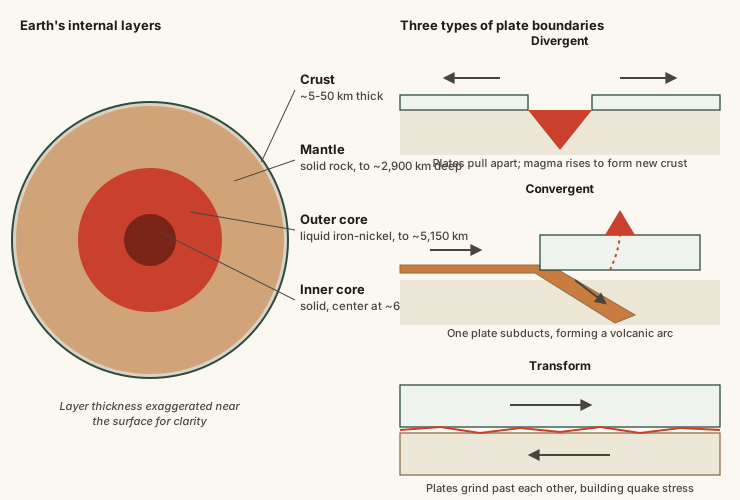
Earth's internal layers and the three types of tectonic plate boundaries
Notice how thin the crust is relative to the other three layers — if Earth were scaled down to the size of an apple, the crust would be thinner than the apple's skin. Then look at the three boundary types on the right: divergent boundaries (like the Mid-Atlantic Ridge) create new crust as plates pull apart; convergent boundaries either crumple rock upward into mountains (continent-continent collisions, like the Himalayas) or force one plate down into the mantle at a subduction zone (ocean-continent collisions, producing volcanic arcs and the deepest ocean trenches); transform boundaries, like California's San Andreas Fault, simply grind two plates past each other sideways, building up the stress that releases as earthquakes.
Common mistakes
Common Mistakes
✕
Assuming oceanic crust is thicker than continental crust because oceans are so large.
→ It's the opposite — oceanic crust is thin (5-10 km) but dense basalt, while continental crust is much thicker (30-50 km) but less dense granite. Thickness and surface area aren't related.
✕
Thinking Earth's entire core is molten liquid.
→ Only the outer core is liquid. The inner core, despite being hotter, is solid because the pressure there is high enough to keep iron from melting.
✕
Assuming plate motion is too slow to matter within any meaningful timeframe.
→ A few centimeters a year compounds dramatically over millions of years — enough to open the Atlantic Ocean, build the Himalayas, and reposition entire continents since Earth's early history.
Common misconception
“Earthquakes and volcanoes only happen exactly on the plate boundary lines you'd see drawn on a map.”
Most major earthquakes and volcanoes do cluster along plate boundaries, but genuine exceptions exist well within plate interiors. The New Madrid Seismic Zone in the central United States, far from any modern plate boundary, produced a sequence of severe earthquakes in 1811-1812 — among the largest in recorded U.S. history — caused by ancient, buried zones of crustal weakness reactivated by regional stress, as documented by the USGS. Hotspot volcanism, like Hawaii's, is a second exception: it's driven by a fixed plume of rising mantle magma with no relationship to a nearby plate edge at all. Plate boundaries explain most, but not all, of Earth's seismic and volcanic activity.
Quick check
The central United States, far from any tectonic plate boundary, experienced a sequence of major earthquakes in 1811-1812. How is this possible if earthquakes only happen at plate boundaries?
Try it yourself
Estimate a hotspot island's age from distance and plate speed
Estimated island age (millions of years)7.14
Project a mountain's future height from its uplift rate
Projected height (meters)8,853
What to do next
What to do next
Look up your region on a global plate boundary map to see whether you live near a divergent, convergent, or transform boundary — or well within a plate interior.
Try the hotspot calculator above with Kauai's real distance (~500 km) from Hawaii's active hotspot to see how well it matches Kauai's known age of roughly 5 million years.
Next time you read about an earthquake, check whether it happened at a plate boundary or is a rarer intraplate event.
Read the related entry on Natural Disasters to see how plate boundary type predicts earthquake and volcano risk in more detail.
FAQ
FAQ
Related terms
Related terms
Crust
Earth's thin, rigid outermost layer — roughly 5-10 km thick under oceans and 30-50 km thick under continents.
Mantle
The thick, mostly-solid rock layer beneath the crust, about 2,900 km deep, that flows extremely slowly over millions of years.
Core
Earth's center, split into a liquid iron-nickel outer core (which generates the magnetic field) and a solid iron-nickel inner core.
Lithosphere
The rigid outer shell combining the crust and the uppermost mantle, broken into the tectonic plates that move across the planet's surface.
Plate tectonics
The theory that Earth's lithosphere is divided into large plates that move slowly atop the more pliable mantle beneath, driven by mantle convection.
Subduction
The process where one tectonic plate is forced beneath another and sinks into the mantle, typically at a convergent plate boundary.
Hotspot
A relatively fixed source of magma rising from deep in the mantle that punches through a moving plate above it, producing a chain of volcanoes over time.
 KnowThis