 KnowThis
Key Takeaways
Key Takeaways
- 1A mineral has a fixed chemical recipe and an orderly crystal structure; a rock is simply an aggregate of one or more minerals — granite, for example, is a rock made of the minerals quartz, feldspar, and mica bound together.
- 2Rocks form through three fundamentally different processes — cooling molten rock (igneous), compacting and cementing sediment (sedimentary), or transforming existing rock under heat and pressure without melting it (metamorphic) — and the rock cycle can move rock between all three categories over geologic time.
- 3Density, hardness, and crystal structure — not color or size — are what geologists actually use to identify a mineral, because two minerals with identical chemistry can look completely different depending on how their atoms are arranged.
The concept
Knowing the three rock categories explains how geologists classify what they find in the field. The physical properties that identify a specific mineral within a rock are where the practical, hands-on science actually happens.
This same rock-and-mineral science is what defines a natural resource in the ground. A mineral only becomes an ore — worth mining — when it's concentrated enough, in a large enough deposit, to extract profitably with current technology: iron ore is rock with a high enough concentration of iron-bearing minerals like hematite or magnetite to be worth processing, while the same iron dispersed thinly through ordinary rock isn't. Quarried rock itself is a resource too — limestone for cement, granite for countertops and construction, sand and gravel for concrete — extracted directly rather than refined for a specific element. Because ore grade and rock type are set by which of the three formation processes a deposit went through (metal ores often concentrate through igneous or hydrothermal processes; building stone is usually quarried igneous, sedimentary, or metamorphic rock directly), the same rock cycle covered above is what determines where on Earth these resources are found at all.
Two mineral specimens have the exact same chemical formula but look completely different — one is soft and dull, the other is hard and glassy. What's the most likely explanation?
Worked examples
Example 1: Identifying a mineral by density (baseline case)
Example 2: Diamond and graphite — same element, opposite minerals (edge case / variation)
Diamond and graphite are both pure carbon, yet one is the hardest known mineral and the other is soft enough to write with. What accounts for the difference?
Example 3: Limestone into marble — the rock cycle in action (real-world / applied case)
How it works (visual)
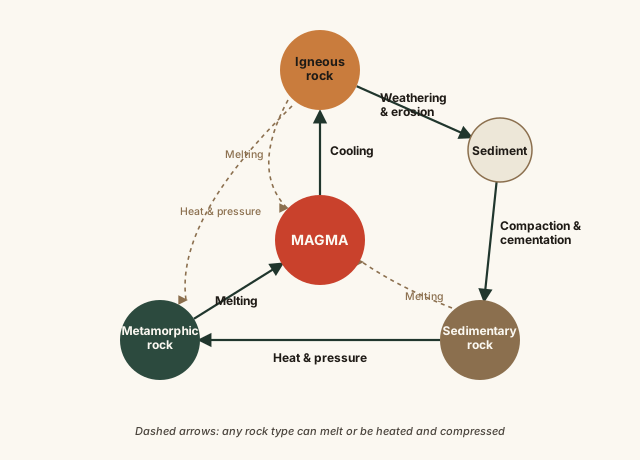
Notice there's no single starting point in this diagram — every arrow points to another category, and every rock type can eventually become any other type given enough time and the right conditions. Follow one path: magma cools into igneous rock at the top, weathering breaks it into sediment, compaction and cementation turn that sediment into sedimentary rock, heat and pressure at a plate boundary transform it into metamorphic rock, and if it's ever driven deep enough to melt, it becomes magma again — closing the loop over a timescale of millions of years.
Common mistakes
Common Mistakes
Using 'rock' and 'mineral' interchangeably, as if they mean the same thing.
→ A mineral is a single, chemically defined substance; a rock is an aggregate made of one or more minerals. Granite is a rock made of the minerals quartz, feldspar, and mica.
Assuming a mineral's hardness (Mohs scale) tells you how tough or durable it is overall.
→ Hardness measures scratch resistance only. Diamond is the hardest mineral but can still fracture along weak crystal planes (cleavage) with a sharp, well-aimed blow — hardness and toughness (resistance to breaking) are different properties.
Judging a mineral's identity mainly by its color.
→ Color is one of the least reliable identifiers — impurities can change a mineral's color dramatically (quartz alone appears clear, purple, pink, and smoky-brown depending on trace impurities) while density, hardness, and crystal structure stay far more consistent.
Common misconception
“Diamonds and pencil graphite can't really be related — one is a rare, priceless gem and the other is cheap and everywhere.”
They're both pure carbon, chemically identical — the enormous difference in appearance, hardness, and value comes entirely from how the carbon atoms are bonded. Diamond forms deep in the mantle under extreme pressure and temperature, locking carbon atoms into a rigid lattice where each atom bonds to four neighbors. Graphite forms under far milder conditions, with carbon atoms bonding to only three neighbors in loosely stacked flat sheets. Same element, same periodic table entry, radically different mineral — a clean demonstration that a mineral's identity depends on structure, not just composition.
Since diamond and graphite are both 100% carbon, shouldn't they have essentially the same properties?
Try it yourself
What to do next
What to do next
- Next time you see a countertop, building facade, or piece of jewelry, try to identify whether the stone is igneous (granite), sedimentary (limestone), or metamorphic (marble) from its texture.
- Try the density calculator above on a rock or mineral sample at home using a kitchen scale and water displacement in a measuring cup.
- Look up your region's dominant rock type and connect it to its likely formation history — volcanic activity, ancient seafloor, or mountain-building pressure.
- Read the related entry on Earth's Structure & Plate Tectonics to see how plate collisions supply the heat and pressure that drive metamorphic rock formation.