 KnowThis
Key Takeaways
Key Takeaways
- 1Phase changes you see every day — fog, dew, a sweating glass, a fogged-up mirror — are governed by both temperature and how much moisture the surrounding air can hold, not by heat alone.
- 2Condensation happens when air cools below its dew point and releases the same latent heat that evaporation absorbed earlier — evaporation and condensation are the same mechanism running in opposite directions.
- 3These small-scale mechanisms scale straight up into the global water cycle: the fog on your window and a rain cloud form by the same physics, just at different sizes.
The concept
That dew-point mechanism explains most of the phase changes you run into around the house without ever touching a stove — but the clearest way to see it in action is to walk through a few real, everyday cases with actual numbers attached.
On a cold winter day, you can see your breath as a visible white cloud. What is actually happening?
Worked examples
Example 1: Dew forming on grass overnight (baseline case)
Example 2: Dry ice fog vs. a fogged bathroom mirror (edge case / variation)
Why does a fog machine using dry ice produce a visible white cloud?
Example 3: Why evaporative coolers work in Phoenix but not Miami (real-world / applied case)
Evaporative coolers (sometimes called swamp coolers) cool air by blowing it across water-soaked pads, using the same latent-heat mechanism as sweating: evaporating water pulls heat energy out of the surrounding air. In a dry climate like Phoenix, the air is far from saturated, so water evaporates readily and pulls a large amount of heat out of the air stream, producing a real, noticeable cooling effect. In a humid climate like Miami, the air is already close to its saturation point, so far less additional water vapor can evaporate into it — the cooling pads stay wet and soggy but barely evaporate, and the cooling effect largely disappears. This is why evaporative cooling is popular across the arid U.S. Southwest and essentially useless along the humid Gulf Coast.
An evaporative cooler works well in a dry desert climate but barely cools the air in a humid coastal climate. What explains the difference?
How it works (visual)
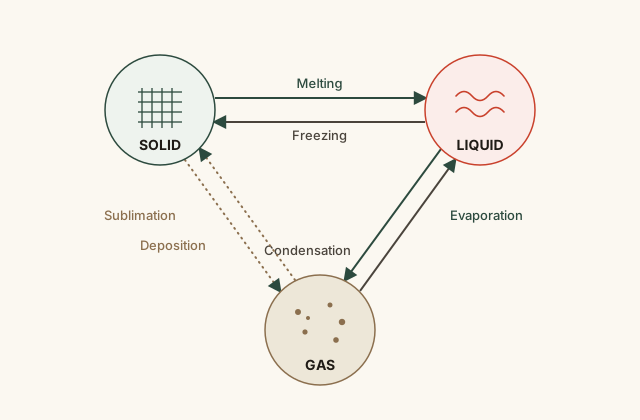
Notice that every arrow in this cycle has a reverse arrow right next to it, and every transition either absorbs or releases the same fixed amount of latent heat depending on which direction it runs. Fog, dew, and a sweating glass are all sitting on the evaporation/condensation arrow; dry-ice fog and morning frost are both examples of the sublimation/deposition shortcut that skips liquid entirely.
Common mistakes
Common Mistakes
Thinking fog or mist is water vapor itself, made visible.
→ Water vapor is a gas and is always invisible. Fog, mist, and steam clouds are tiny liquid water droplets that have already condensed — visibility only starts after condensation happens.
Believing the white cloud from dry ice is the carbon dioxide gas itself.
→ CO₂ gas is colorless. The visible cloud is condensed water vapor from the surrounding air, chilled below its dew point by the cold CO₂.
Treating humidity and temperature as the same thing, or assuming 'muggy' always means 'hot.'
→ Humidity measures how much water vapor the air is holding relative to its capacity — a day can be cool and still feel muggy if the air is close to saturated.
Common misconception
“The white cloud coming out of a boiling kettle's spout is water vapor.”
Look closely at a boiling kettle and there's a small, clear gap right at the spout before the visible cloud starts — that gap is the actual water vapor (a gas), and it's invisible. As that hot vapor hits the cooler air a short distance away, it condenses almost instantly into the visible white cloud of tiny liquid droplets. What you're calling "steam" in everyday speech is technically condensed water, not the water vapor itself — true water vapor never becomes visible on its own.
If you look closely at a boiling kettle's spout, there's a small clear gap before the visible white cloud appears. What is in that clear gap?
Try it yourself
What to do next
What to do next
- Check a cold drink glass on a warm day and connect the sweating you see to condensation, not the glass 'leaking.'
- Watch your breath on the next cold morning and identify the exact mechanism: warm, moist air hitting its dew point almost instantly.
- If you live somewhere humid, notice why fans and evaporative coolers feel far less effective than they do in a dry climate.
- Read the related entry on Matter & States of Matter for the full particle-level picture behind these same transitions.