 KnowThis
Key Takeaways
Key Takeaways
- 1Metals lose their outer electrons easily, forming a shared 'sea' of free electrons — this single fact directly causes their electrical conductivity, malleability, and shine.
- 2Non-metals hold their electrons tightly and tend to gain electrons rather than lose them, giving them the opposite profile: poor conductors, and brittle rather than bendable if solid.
- 3Roughly 80% of elements on the periodic table are metals, with a thin staircase-shaped band of metalloids — like silicon and germanium — sharing traits of both groups.
The concept
That electron-holding difference isn't just a classroom rule — it's the actual mechanism engineers exploit every time they choose a specific metal, non-metal, or blend of the two for a real job.
Electrical wiring is almost always made from copper or aluminum rather than a non-metal like sulfur. Why?
Worked examples
Example 1: Comparing conductivity of copper and sulfur (baseline case)
Example 2: Carbon — a non-metal that sometimes conducts (edge case / variation)
Graphite and diamond are both pure carbon, yet graphite conducts electricity and diamond does not. What explains this?
Example 3: Why bronze and stainless steel are deliberately mixed metals (real-world / applied case)
Pure metals rarely have exactly the properties engineers want, so metals are frequently combined into alloys to blend properties. Bronze mixes copper with tin, producing a harder, more corrosion-resistant material than either metal alone — historically valuable enough to define the Bronze Age. Stainless steel mixes iron with chromium (and often nickel), where the chromium forms a thin, self-repairing oxide layer on the surface that resists rust far better than plain iron, while the iron provides strength and the whole mixture keeps a metal's characteristic conductivity and malleability. Alloying works because the free electron sea persists across the mixed metal atoms, so the blend keeps its overall metallic character while gaining new mechanical or chemical properties from the specific combination chosen.
How it works (visual)
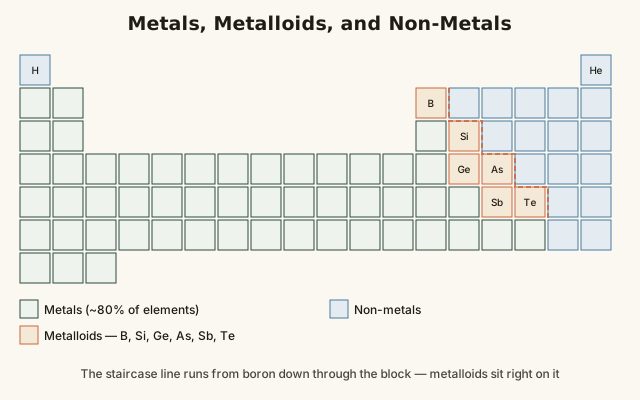
Trace the staircase line running from boron down to astatine — everything to the lower-left of that line is a metal, everything to the upper-right is a non-metal, and the handful of elements sitting directly on the line are the metalloids. Silicon's position right on that boundary is exactly why it behaves as a semiconductor: metallic enough to conduct under the right conditions, non-metallic enough not to conduct freely like copper — the property the entire semiconductor industry is built on.
Common mistakes
Common Mistakes
Assuming all non-metals must be gases.
→ Many non-metals are solids at room temperature — sulfur, carbon, iodine, and phosphorus are all solid non-metals. Only some non-metals, like oxygen and nitrogen, are gases under normal conditions.
Believing all metals are magnetic.
→ Ferromagnetism (strong attraction to a magnet) is actually rare even among metals — only iron, nickel, cobalt, and a few rare-earth elements show it strongly. Copper, aluminum, and gold are all metals but aren't magnetic.
Thinking a shiny appearance always means a substance is a metal.
→ A few non-metals, like solid iodine crystals, have a metallic-looking luster despite being non-metals — shine alone isn't a reliable test; conductivity and malleability are better indicators.
Common misconception
“If a material is attracted to a magnet, it must be a metal — and all metals should behave that way.”
Magnetism (specifically ferromagnetism, the strong kind that sticks to a fridge magnet) has nothing to do with the metal/non-metal boundary itself. Among all the metallic elements, only iron, nickel, cobalt, and a small number of rare-earth elements are strongly ferromagnetic at room temperature. The vast majority of metals — aluminum, copper, gold, silver, lead — show no noticeable attraction to an ordinary magnet at all. Magnetism depends on a specific, unusual arrangement of unpaired electron spins that most metals simply don't have, so "magnetic" and "metal" are overlapping but very different categories.
A fridge magnet sticks strongly to a steel can but does not stick at all to an aluminum can. Does this mean aluminum isn't a metal?
What to do next
What to do next
- Test a few household items with a magnet — notice how few actually stick, even though many of them are clearly metal (aluminum foil, a copper coin).
- Look at a pencil's graphite core and a diamond ring side by side and connect their opposite conductivity to the same element arranged two different ways.
- Check the ingredient list on a stainless steel item (often stamped '18/8' or '18/10') and connect those numbers to chromium and nickel content.
- Read the related entry on Atoms & Elements for the underlying electron structure that drives this whole metal/non-metal split.