 KnowThis
Key Takeaways
Key Takeaways
- 1Order of operations exists so a written expression like 3 + 4 × 2 has exactly one correct value — without a fixed sequence, the same expression could honestly be read two different ways.
- 2BODMAS and PEMDAS aren't competing systems — they spell out the identical priority order in different words. Multiplication and division share one tier (done left to right); addition and subtraction share the tier after that (also left to right).
- 3Reading an expression like a sentence, strictly left to right with no priority, gives the wrong answer for most real expressions: 3 + 4 × 2 read that way gives 14, but the correct value is 11.
The concept
What is 3 + 4 × 2?
Worked examples
Example 1: A simple mixed expression (baseline case)
Example 2: Brackets and an exponent together (edge case / variation)
What is (3 + 4) × 2²?
Example 3: A coupon at checkout (real-world / applied case)
A shopper buys 3 shirts at $18 each and applies a single $5 coupon to the whole order. Written correctly, the total is 3 × 18 - 5. Order of operations resolves the multiplication first: 3 × 18 = 54, then subtracts the coupon: 54 - 5 = 49, for a total of $49. If a cashier mistakenly grouped it as 3 × (18 - 5) instead — applying the $5 discount to each shirt's price before multiplying — the total would come out to 3 × 13 = $39, a full $10 off from the correct total. The bracket placement isn't cosmetic here; it's the difference between a coupon applied once to the order and a coupon effectively applied three times.
How it works (visual)
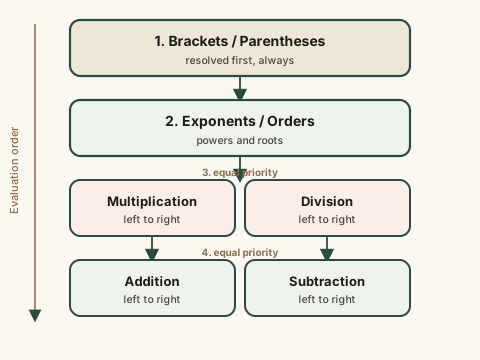
Work down the tiers one at a time, fully clearing each tier before moving to the next — resolve every bracket in the expression before touching any exponent, resolve every exponent before touching any multiplication or division, and so on. Within the tied tiers (multiplication/division, and separately addition/subtraction), move strictly left to right; the diagram's two middle tiers being drawn as equal-width, side-by-side boxes rather than stacked ones is the visual reminder that neither operation in that pair outranks the other.
Common mistakes
Common Mistakes
Reading the letters in BODMAS or PEMDAS as a strict ranking, so always doing division before multiplication (or the reverse).
→ Multiplication and division share one priority tier; addition and subtraction share the next. Within a tied tier, work left to right in whichever order the operations appear.
Multiplying or dividing before clearing brackets, when both appear in the same expression.
→ Brackets always resolve first, no exceptions — fully evaluate everything inside a bracket before applying any operation outside it.
Evaluating a whole expression strictly left to right, the way you'd read a sentence, ignoring operator priority entirely.
→ Identify every bracket, exponent, then multiplication/division, then addition/subtraction pass before evaluating anything — priority tier decides order, not left-to-right position in the writing.
Common misconception
“Order of operations (BODMAS/PEMDAS) is just an arbitrary rule that textbooks invented, not something mathematically necessary.”
Without a fixed, universally agreed sequence, a single written expression could legitimately be evaluated to different values by different people — 3 + 4 × 2 could mean 11 or 14 depending on which operation someone chose to do first, with no way to tell which was intended. That breaks a basic requirement of mathematical notation: a written expression has to represent exactly one number. Order of operations isn't decoration on top of arithmetic — it's the agreement that makes written arithmetic expressions unambiguous at all, the same way traffic rules make shared roads usable rather than a matter of driver preference.
Why do BODMAS and PEMDAS matter, rather than each person just evaluating an expression in whatever order feels natural?
Try it yourself
What to do next
What to do next
- Before evaluating any mixed expression, scan it once for brackets and exponents and resolve those first, before touching multiplication, division, addition, or subtraction.
- When multiplication and division appear together with no brackets, work left to right rather than assuming one operation always goes before the other.
- Rewrite a real-world calculation (a bill with tax, a discount applied to multiple items) as a single expression and check whether bracket placement changes the answer — it usually does.
- Read the related entry on Exponents & Powers to see how the 'exponents before multiplication' tier plays out with negative and fractional exponents.