 KnowThis
Key Takeaways
Key Takeaways
- 1Positive and negative numbers measure both a size and a direction from zero — the sign tells you which side of the number line you're on, the digits tell you how far.
- 2Subtracting a negative number and adding a positive number are the same move in disguise: 5 - (-3) and 5 + 3 both land on 8. There's really only one rule — add the opposite.
- 3Multiplying or dividing two numbers with the same sign always gives a positive result; different signs always give a negative result — and this isn't an arbitrary convention, it falls directly out of the distributive property.
The concept
Which is larger: -2 or -8?
Worked examples
Example 1: Adding a positive to a negative balance (baseline case)
Example 2: Subtracting a negative temperature change (edge case)
What is -20 - (-12)?
Example 3: Elevation change from Death Valley to Mount Whitney (real-world / applied case)
Badwater Basin in Death Valley National Park sits at -86 meters (282 feet below sea level) — the lowest point in North America, according to the National Park Service. Mount Whitney, roughly 136 km away, is the highest point in the contiguous United States at 4,421 meters (14,505 feet), per the U.S. Geological Survey. The total elevation gain between the two is 4,421 - (-86) = 4,507 meters — over four and a half kilometers of vertical climb. The negative starting elevation doesn't get ignored or treated as zero; it has to be subtracted properly, which is exactly why the gain is larger than Mount Whitney's height above sea level alone.
How it works (visual)
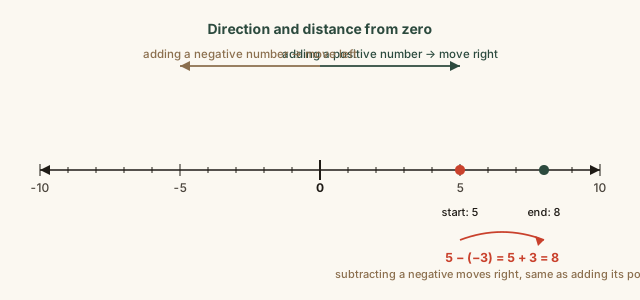
Every addition or subtraction of a signed number is a instruction to move along this line: "+" moves right, "-" moves left, and the number tells you how far. Subtracting a negative number reverses that leftward instruction back into a rightward move — which is the entire reason "minus a minus" behaves like a plus. Multiplication and division don't move a point along the line; instead, a negative multiplier or divisor flips which side of zero the result lands on, while the same-sign case leaves it on the positive side.
Common mistakes
Common Mistakes
Assuming a negative number with a bigger digit is always 'more' than one with a smaller digit (thinking -8 > -2).
→ Compare position on the number line, not digit size. Among negatives, the one closer to zero is larger: -2 > -8.
Turning 'subtract a negative' into 'add another negative' instead of 'add a positive' (computing 5 - (-3) as 5 + (-3) = 2).
→ Subtracting a negative always converts to adding its positive value: 5 - (-3) = 5 + 3 = 8.
Forgetting to include a negative starting value when computing a total change (e.g. leaving out a below-zero starting point).
→ Always subtract the true starting value, including its sign, in full: change = end value − start value, even when the start value is negative.
Common misconception
“A negative times a negative should logically stay negative — two 'bad' signs shouldn't be able to combine into a 'good' one.”
The rule isn't a convention chosen for convenience — it's forced by keeping the rest of arithmetic consistent. Starting from 0 = -1 × (1 + -1) and expanding with the distributive property, the only value that makes the equation balance is (-1)(-1) = 1. A concrete way to feel it: if a value has been falling at a rate of -3 units per hour, then 4 hours ago (time = -4) it must have been higher by (-3) × (-4) = 12 units — going backward in time through a decreasing quantity necessarily lands on a larger value, which is exactly what the positive result represents.
A tank's water level has been dropping at a steady -3 cm per hour for the last several hours. Using that rate, what was the water level 5 hours ago relative to right now?
Try it yourself
What to do next
What to do next
- Sketch a number line and physically mark where a calculation lands before trusting the arithmetic — most sign errors are caught instantly by seeing the direction is wrong.
- Next time you subtract a negative number, rewrite it as addition first (a - (-b) becomes a + b) before doing anything else.
- Check your bank or credit card statement for a negative balance and practice adding a payment to it — that's real-world signed-number addition happening every billing cycle.
- Read the related entry on Order of Operations to see how signed numbers interact with multiplication and parentheses inside a larger expression.