 KnowThis
Key Takeaways
Key Takeaways
- 1Squaring multiplies a number by itself once (n² = n × n); cubing multiplies it by itself twice more (n³ = n × n × n). Square roots and cube roots are the exact reverse operations.
- 2Only some numbers have a 'nice' whole-number square root — perfect squares like 1, 4, 9, 16, 25 do, but the square root of most whole numbers is an irrational, non-terminating decimal.
- 3Cube roots are defined for negative numbers, but square roots (within real numbers) aren't — this is a genuine mathematical asymmetry, not an inconsistency: a negative number cubed stays negative, but a negative number squared always turns positive.
The concept
What is 25 a perfect square of?
Worked examples
Example 1: Squaring and cubing 12 (baseline case)
Example 2: The cube root of a negative number (edge case / variation)
What is the cube root of -8?
Example 3: Finding a square garden's side length and diagonal (real-world / applied case)
A square patio has an area of 225 square feet. To find the length of one side, take the square root of the area: √225 = 15, since 15 × 15 = 225 — so each side of the patio is 15 feet. To find the diagonal distance across the patio (useful for laying a diagonal walkway or fitting a diagonal umbrella stand), use the Pythagorean relationship for a square: diagonal = side × √2 ≈ 15 × 1.41421 ≈ 21.2 feet. That √2 isn't a rounding convenience — it's a genuinely irrational number, which is exactly why the diagonal of a square with a whole-number side length essentially never comes out to a clean whole number itself.
How it works (visual)
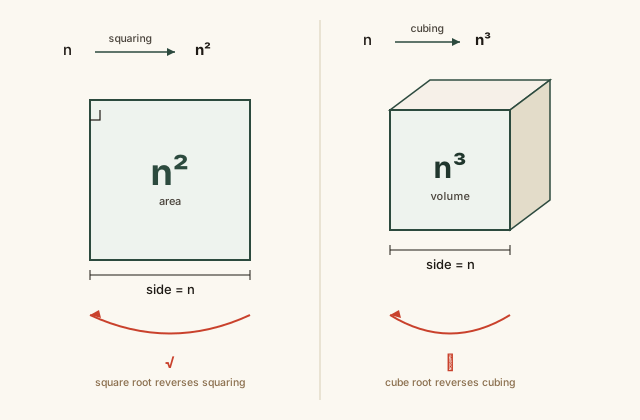
Squaring and cubing have a direct geometric meaning: n² is literally the area of a square with side length n, and n³ is literally the volume of a cube with side length n. Reading the diagram's arrows in reverse is exactly what a root computes — given an area, the square root recovers the side length that produced it; given a volume, the cube root recovers the side length that produced it. This is also why square roots and cube roots only ever make sense as "what side length gives this area/volume," which is the geometric reason square roots of negative numbers have no real answer: no real square has a negative area.
Common mistakes
Common Mistakes
Confusing 'squaring a number' with 'doubling it' (thinking 5² = 10 instead of 25).
→ Squaring means multiplying a number by itself, not by 2. 5² means 5 × 5 = 25; doubling 5 would be 5 × 2 = 10, a completely different operation.
Assuming a square root distributes over addition, i.e. √(a + b) = √a + √b.
→ Square roots don't distribute over addition or subtraction. √(9 + 16) = √25 = 5, but √9 + √16 = 3 + 4 = 7 — the two results aren't equal, so never split a root across a sum this way.
Forgetting that an equation like x² = 25 has two solutions, +5 and -5, and reporting only the positive one.
→ When solving x² = n for x, include both the positive and negative root (x = ±√n) unless the context (like a physical length) rules the negative one out.
Common misconception
“Squaring a number always makes it bigger.”
That's only true for numbers greater than 1 (or less than -1). Squaring a fraction between 0 and 1 makes it smaller, not bigger: 0.5² = 0.25, which is half of 0.5, not more than it. Squaring 1 or 0 leaves them unchanged (1² = 1, 0² = 0). The "squaring makes numbers bigger" intuition comes from experience with whole numbers greater than 1, but it silently breaks the moment a fraction, a decimal less than 1, or zero is involved — which matters in real calculations like compounding a small percentage or working with probabilities, both of which routinely involve numbers between 0 and 1.
Which is larger: 0.5 or 0.5 squared?
Try it yourself
What to do next
What to do next
- Memorize the perfect squares from 1² through 15² — recognizing them on sight makes both squaring and square-rooting dramatically faster.
- Next time you square a fraction or a decimal less than 1, check whether the result got bigger or smaller — it's a fast way to catch the 'squaring always grows numbers' misconception in your own work.
- Practice finding the cube root of a few negative numbers (like -8, -27, -64) to build intuition for why cube roots, unlike square roots, work fine with negatives.
- Read the related entry on Exponents & Powers to see how squares and cubes generalize to any whole-number exponent, not just 2 and 3.