 KnowThis
Key Takeaways
Key Takeaways
- 1The 'base' of a number system is just how many digits it uses before rolling over to a new place — decimal (base 10) uses 0-9, binary (base 2) uses only 0-1, hexadecimal (base 16) uses 0-9 plus A-F.
- 2Different bases aren't arbitrary inventions — base-10 likely traces to counting on ten fingers, base-60 (Babylonian) survives today in 60 minutes per hour and 360 degrees in a circle, and base-2 became essential once electronic switches (on/off) needed a number system to match.
- 3Every base represents exactly the same underlying values — 13 in decimal, 1101 in binary, and D in hexadecimal are three different labels for the identical quantity.
The concept
Knowing that bases are just different-sized digit alphabets is the easy part. The genuinely useful skill is converting a number from one base into another — which is mechanical once you see it done with real numbers.
Binary uses only two digits, 0 and 1, while decimal uses ten digits, 0-9. What does this actually mean for how binary numbers are written?
Worked examples
Example 1: Converting decimal 13 to binary (baseline case)
Example 2: Converting decimal 255 to hexadecimal and binary side by side (edge case / variation)
A color code like #FF5733 uses hexadecimal instead of binary. Why is hexadecimal preferred here?
Example 3: Base 60's survival in your daily clock and compass (real-world / applied case)
You use a base-60 number system every single day without thinking about it. An hour splits into 60 minutes, and a minute splits into 60 seconds — both directly inherited from Babylonian sexagesimal counting, chosen because 60 divides evenly by 1, 2, 3, 4, 5, 6, 10, 12, 15, 20, and 30, which made it unusually practical for splitting time or angles into clean fractions without remainders. The same base-60 legacy shows up in geography and navigation: a circle is divided into 360 degrees (6 x 60), and each degree of latitude or longitude further splits into 60 minutes and 60 seconds of arc. None of this is coincidence — it's a nearly 4,000-year-old counting convention still running underneath modern clocks, compasses, and GPS coordinates.
How it works (visual)
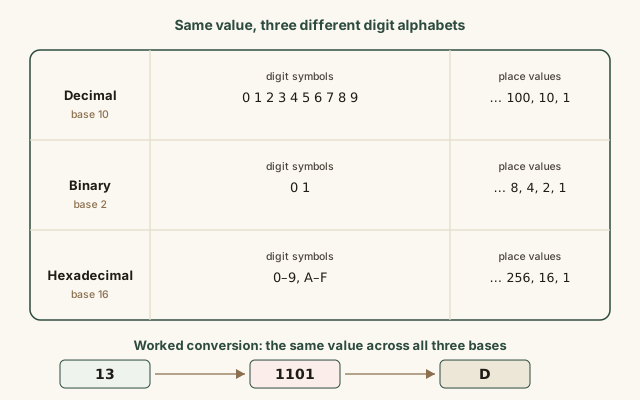
Follow one row across the diagram at a time: the digit symbols available in that base, then how those symbols combine using place value to build the number 13. What the diagram makes visible is that going to a smaller base (binary) means more digit positions but simpler symbols, while going to a larger base (hexadecimal) means fewer digit positions but a bigger symbol alphabet — the same fundamental trade-off every number system across history has made differently.
Common mistakes
Common Mistakes
Reading a binary number like 1101 as 'one thousand one hundred one' the way you'd read a decimal number.
→ Binary place values are powers of 2 (1, 2, 4, 8...), not powers of 10 — 1101 in binary is 8+4+0+1 = 13 in decimal, not anything close to 'one thousand one hundred one.'
Assuming hexadecimal digits stop at 9, the same as decimal.
→ Hexadecimal continues past 9 using letters A through F to represent the values 10 through 15 — F is a valid single hex digit worth 15, not an error.
Thinking binary was invented specifically for computers.
→ Binary arithmetic was formalized by Gottfried Leibniz in the late 1600s, roughly 250 years before electronic computers existed — computers adopted binary later because it happened to match how electronic switches naturally work.
Common misconception
“Binary was invented for computers, and didn't exist as a mathematical idea before electronics.”
Binary arithmetic is a genuinely old mathematical idea. Gottfried Wilhelm Leibniz formalized base-2 arithmetic by 1679 and published his work on it in 1701 — roughly two and a half centuries before the first electronic computers were built. Binary became central to computing for a specific engineering reason discovered much later: a transistor or electronic switch reliably holds exactly two states, on and off, which map perfectly onto the two binary digits 0 and 1. Computers didn't create binary — engineers adopted a centuries-old number system because it happened to be the ideal match for how electronic hardware actually behaves.
If binary existed as a mathematical idea roughly 250 years before electronic computers, why did computing specifically adopt it rather than decimal or another base?
Try it yourself
What to do next
What to do next
- Use the calculator above to convert your age or house number to binary, then check it by hand using the place-value method from Example 1.
- Next time you see a web color code like #FF5733, recognize each pair of hex digits as a compact stand-in for 8 binary bits.
- Notice the next time you check a clock or a map coordinate that you're using a nearly 4,000-year-old Babylonian base-60 counting system.
- Read the related entry on History of the Number Zero to see how positional notation (the backbone of every base system here) depended on zero being invented first.