 KnowThis
Key Takeaways
Key Takeaways
- 1Roman numerals use just seven symbols — I, V, X, L, C, D, M — combined with addition and subtraction rules, instead of position and a zero the way modern numbers work.
- 2Subtractive notation (IV for 4, IX for 9) lets a smaller symbol placed before a larger one subtract its value, keeping numbers shorter than writing every unit out (IIII).
- 3Roman numerals have no place-value system and no zero, which made them workable for labeling and inscriptions but genuinely impractical for arithmetic — Romans actually did calculation on a separate counting device, the abacus.
The concept
Those two rules — add when a smaller symbol follows a larger one, subtract when it comes before — are really all you need. The best way to see them actually work is to build a real number from scratch.
In Roman numerals, IX and XI use the same two symbols (I and X) but represent very different values. What determines the difference?
Worked examples
Example 1: Converting a full year, 1994, into Roman numerals (baseline case)
Example 2: Why clock faces often show IIII instead of IV (edge case / variation)
Ancient Romans themselves often wrote 4 as IIII rather than IV. What does this tell you about subtractive notation?
Example 3: Roman numerals in everyday modern use (real-world / applied case)
Roman numerals never disappeared from daily life — they just moved into labeling rather than calculation. Super Bowl championships are numbered in Roman numerals (Super Bowl LVIII = 58th game: L=50, VIII=8). Movie and TV copyright notices often display the year this way (MMXXVI = 2026: MM=2000, XXVI=20+6). Book chapters, monarchs' names (Elizabeth II), and building cornerstones commonly use them too. In every one of these cases, the numeral is doing a labeling or ceremonial job, not an arithmetic one — nobody is adding two Roman numerals together to get a Super Bowl schedule; the number is simply looked up, converted mentally to a familiar Arabic numeral, and used for identification. That's precisely the role Roman numerals still fill well today, and the role positional Hindu-Arabic numerals (with a working zero) took over for actual computation centuries ago.
How it works (visual)
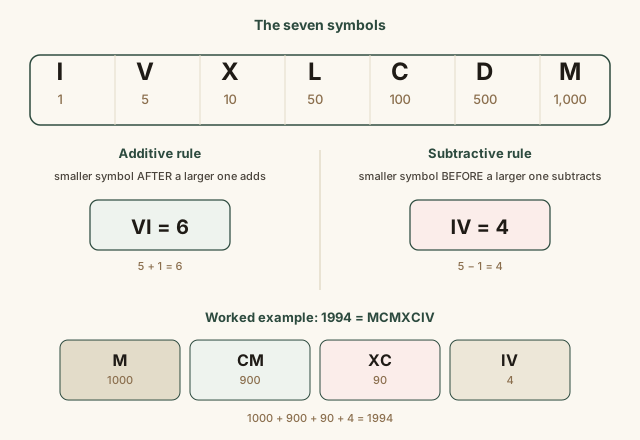
Read the chart left to right and the pattern becomes mechanical: find the biggest symbol value that fits into what's left of your number, write it down, subtract it, and repeat — dropping into a subtractive pair (like CM or XC) whenever the next digit is a 4 or a 9. That greedy, symbol-by-symbol process is exactly how any Arabic-to-Roman conversion, by hand or by computer, actually works.
Common mistakes
Common Mistakes
Writing four of the same symbol in a row when a shorter subtractive form exists, e.g. writing VIIII instead of IX for 9.
→ Standard modern usage limits repetition to three of the same symbol in a row (III is fine, IIII is not standard) and uses subtractive notation instead — IX, not VIIII, for 9.
Assuming any smaller symbol before a larger one always subtracts, e.g. treating 'IL' as a valid way to write 49.
→ Only specific subtractive pairs are valid: I before V or X, X before L or C, C before D or M. 'IL' isn't standard — 49 is written XLIX (XL = 40, IX = 9).
Trying to do arithmetic (like multiplication) directly on Roman numerals the way you would with Arabic digits.
→ Roman numerals have no place value, so there's no simple digit-by-digit method for multiplying or dividing them — convert to a positional number system to calculate, then convert back if a Roman numeral output is needed.
Common misconception
“Roman numerals can represent any number just as efficiently as the modern number system.”
Roman numerals get dramatically longer and harder to read as numbers grow, because the system has no place value and no zero to compress information the way modern digits do. The number 3,888, for instance, requires eleven symbols (MMMDCCCLXXXVIII) — modern notation needs only four digits. There's also no clean, native way to represent zero, negative numbers, or fractions smaller than 1/12 in the classical system, and no simple method for multiplying or dividing two Roman numerals directly. Roman numerals work well for labeling — clock faces, chapter numbers, championship games — precisely because those uses only ever need to represent one fixed number at a time, never to calculate with it.
Why did positional Hindu-Arabic numerals (with a zero) eventually replace Roman numerals for actual calculation, even though Roman numerals stayed in use for labeling?
What to do next
What to do next
- Convert this year and your birth year into Roman numerals by hand using the largest-symbol-first method shown in Example 1.
- Next time you watch a Super Bowl or see a movie's copyright date, decode the Roman numeral instead of skipping past it.
- Look at an analog clock face near you and check whether it uses IIII or IV for the 4 — now you know both are historically legitimate.
- Read the related entry on History of the Number Zero to see exactly what Roman numerals were missing that positional decimal numbers solved.