 KnowThis
Key Takeaways
Key Takeaways
- 1Zero had to be invented twice, in two different roles: first as a placeholder marking an empty position in a positional number system, and much later as a full number you can add, subtract, and (with famous difficulty) divide by.
- 2The placeholder version appeared independently in at least two civilizations — Babylon (by around the 3rd century BCE) and the Maya of Mesoamerica (by around 665 CE) — without either culture influencing the other.
- 3Zero as a genuine number with formal arithmetic rules was first written down in India, in Brahmagupta's 628 CE text the Brahmasphutasiddhanta, and reached Europe centuries later through Islamic scholarship and Fibonacci's 1202 book Liber Abaci.
The concept
That gap between "zero as a placeholder" and "zero as a number" is easy to miss today because both jobs feel automatic to a modern reader — but it only clicks once you see what actually goes wrong without each one.
Babylonian scribes used positional notation for over 1,000 years with no symbol for an empty place at all. What real problem did this create?
Worked examples
Example 1: Why a placeholder matters — with real numbers (baseline case)
Example 2: Brahmagupta's rules for zero — including the one he got wrong (edge case / variation)
Brahmagupta correctly defined most basic operations with zero, but proposed one rule that modern mathematics rejects. Which one?
Example 3: How zero-as-placeholder still runs your world today (real-world / applied case)
Every time a computer stores a number, it's using positional notation directly descended from this history — just in base 2 (binary) instead of base 10. The number 1,001 in binary means one 8, zero 4s, zero 2s, and one 1 (8 + 0 + 0 + 1 = 9 in decimal) — and if binary had no zero to hold the empty 4s and 2s positions, that number would collapse into something unreadable, exactly like the Babylonian ambiguity above. Every bank balance, every barcode, every line of software running on a phone or laptop depends on zero doing its original job: holding a place so digits mean what they're supposed to mean.
How it works (visual)
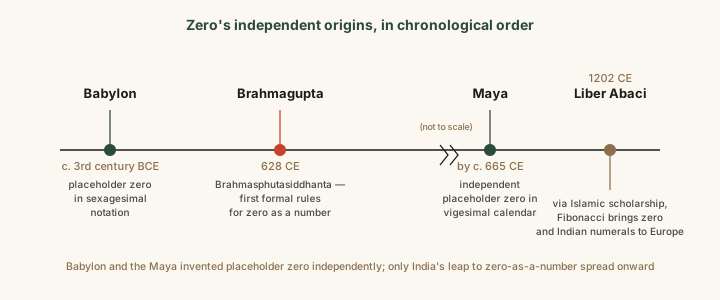
Notice the timeline doesn't move in a straight line from one culture to the next — Babylon and the Maya each arrived at a placeholder zero independently, centuries apart, without contact between them, which is why historians treat zero as one of mathematics' clearest cases of independent invention. Only the Indian mathematicians' step — treating zero as a number with its own arithmetic — is the single branch that fed forward into the number system the entire world uses today.
Common mistakes
Common Mistakes
Assuming zero has always been part of every number system, since it feels so basic today.
→ Remember zero is a late invention — the Egyptians, Greeks, and Romans all did serious mathematics without any symbol for zero at all.
Treating 'placeholder zero' and 'zero as a number' as the same discovery.
→ They're two separate breakthroughs, made in different places at different times — a placeholder just marks an empty position; a true zero can be added, subtracted, and multiplied like any other number.
Assuming division by zero just equals zero, the way Brahmagupta first proposed.
→ Division by zero is undefined in modern mathematics, not equal to zero — this is one specific rule even zero's original formalizer got wrong, and later mathematicians corrected.
Common misconception
“Zero was always part of counting systems, since counting is such a basic, intuitive human activity.”
Counting systems were built to represent quantities of physical things — sheep, coins, days — and "nothing" isn't a thing you count. Because of this, most ancient civilizations, including the Egyptians, Greeks, and Romans, had no symbol for zero at all in their standard number systems. Zero as a placeholder had to be invented independently at least twice (Babylon and the Maya), and zero as a full number with its own arithmetic rules — the version modern math relies on — was a distinct, later breakthrough first formalized in India around 628 CE. Far from intuitive, zero was one of the slowest and hardest ideas in the history of mathematics to fully work out.
The ancient Greeks made enormous advances in geometry but, unlike India, never developed zero as a number. What does this suggest about zero?
Try it yourself
What to do next
What to do next
- Write out a number like 3,005 and try removing its zeros — see for yourself how much ambiguity disappears the moment a placeholder is gone.
- Try the calculator above with a few different numbers to see how the thousands place is only meaningful because zero can hold the places around it.
- Next time you see a computer or phone process a number, remember it's running the same positional-notation trick as ancient Babylon and India, just in binary instead of decimal.
- Read the related entry on Number Systems Across Cultures to see how base-2 and base-16 systems build directly on the positional-zero idea covered here.