 KnowThis
Key Takeaways
Key Takeaways
- 1The Fibonacci sequence (0, 1, 1, 2, 3, 5, 8, 13, 21...) is built by a simple rule — each term is the sum of the two terms before it — first popularized in Europe by Leonardo of Pisa (Fibonacci) in 1202, though Indian mathematicians described the same pattern centuries earlier.
- 2The ratio between consecutive Fibonacci numbers gets closer and closer to the golden ratio (≈1.61803) the further the sequence continues, but never reaches it exactly.
- 3Fibonacci-numbered spirals genuinely appear in plants like sunflowers and pinecones because of a real growth mechanism — new growth emerging at a repeating 137.5-degree 'golden angle' packs most efficiently — not because nature is 'designed' around the sequence.
The concept
That recurrence rule is simple to state but easy to underuse — its real payoff shows up once you follow it through actual numbers and see how fast it grows, and how precisely it tracks the golden ratio.
The Fibonacci sequence begins 0, 1, 1, 2, 3, 5, 8, 13... What determines the next number after 13?
Worked examples
Example 1: Generating the first ten Fibonacci numbers by hand (baseline case)
Example 2: Watching the ratio of consecutive terms converge on phi (edge case / variation)
Early Fibonacci ratios (like 2/1 = 2.0 and 1/1 = 1.0) are far from the golden ratio (≈1.618). What happens to the ratio as you move further into the sequence?
Example 3: Counting real spirals on a sunflower head (real-world / applied case)
Look closely at a sunflower's seed head and you'll see two sets of spirals winding in opposite directions — one set curving clockwise, the other counterclockwise. Botanists studying real sunflowers (including citizen-science counting projects) have repeatedly found the spiral counts land on adjacent Fibonacci numbers: commonly 34 spirals one direction and 55 the other, or 55 and 89 on larger flower heads. This isn't a coincidence or a cherry-picked example — it's the direct, mechanical result of each new seed forming at the golden angle (≈137.5°) from the one before it during the flower's growth, which packs the maximum number of seeds into the seed head with minimal wasted space. The same spiral-counting pattern shows up in pinecone scales and pineapple eyes for the identical structural reason.
How it works (visual)
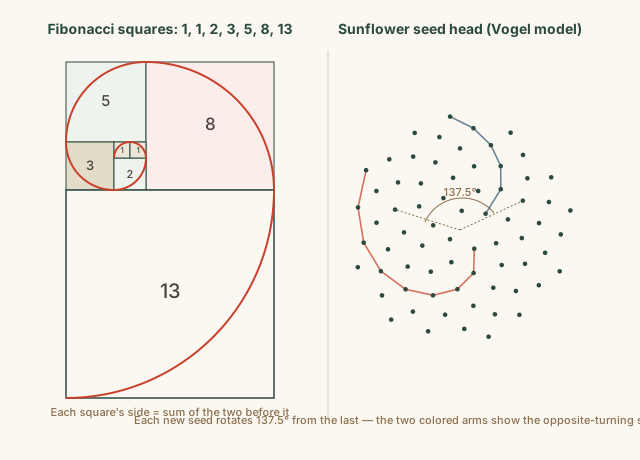
In the left panel, each new square's side length is the sum of the two previous squares' side lengths — the same recurrence rule as the number sequence itself, just drawn geometrically. In the right panel, the 137.5-degree rotation between each new seed is what generates the visible spiral families; because that specific angle is derived from the golden ratio, the resulting spiral counts consistently land on Fibonacci numbers as the seed head fills in.
Common mistakes
Common Mistakes
Believing Fibonacci himself first discovered or invented the sequence.
→ Indian mathematicians (including Pingala, Virahanka, and Hemachandra) described the identical numerical pattern centuries earlier while studying Sanskrit poetic meter — Fibonacci introduced it to Western Europe in 1202, but didn't originate it.
Assuming every spiral pattern in nature — hurricanes, galaxies, nautilus shells — is a 'Fibonacci spiral.'
→ Many natural spirals are logarithmic spirals shaped by entirely different physical processes (fluid dynamics, gravity) with no connection to Fibonacci numbers or the golden angle — the sunflower/pinecone mechanism is a specific botanical phenomenon, not a universal rule of nature.
Treating the Fibonacci sequence and the golden ratio as interchangeable, or as literally the same number.
→ The Fibonacci sequence is a list of whole numbers; the golden ratio is one fixed irrational number their consecutive ratios approach but never exactly equal.
Common misconception
“Leonardo Fibonacci discovered the Fibonacci sequence.”
The sequence that carries his name was already known well before Fibonacci wrote about it. Indian mathematicians studying the rhythmic patterns of Sanskrit poetry — how many ways a meter can be built from short and long syllables — worked out the identical recurrence, with scholars including Pingala, Virahanka, and Hemachandra contributing to this understanding between roughly the 3rd century BCE and the 12th century CE. Fibonacci's real contribution, in his 1202 book Liber Abaci, was introducing the sequence to Western European mathematics through a hypothetical rabbit-population problem — and, more importantly, helping introduce the Hindu-Arabic decimal number system itself to Europe. The sequence's name reflects who popularized it in the West, not who discovered it first.
If Indian mathematicians described the Fibonacci sequence centuries before Fibonacci, why is the sequence named after him?
Try it yourself
What to do next
What to do next
- Use the calculator above to find a few different terms, then divide consecutive results by hand to watch the ratio close in on 1.618.
- Next time you see a sunflower, pinecone, or pineapple, count its opposing spiral sets — you'll very likely land on two adjacent Fibonacci numbers.
- Sketch the square-based Fibonacci spiral from Example 1 (squares of side 1,1,2,3,5,8) to see the recurrence rule expressed geometrically.
- Read the related entry on Famous Mathematical Constants to see exactly how the golden ratio phi is derived algebraically and where it shows up beyond the Fibonacci sequence.