 KnowThis
Key Takeaways
Key Takeaways
- 1Pi (≈3.14159) is the ratio of any circle's circumference to its diameter; e (≈2.71828) is the limit of continuous compound growth; the golden ratio phi (≈1.61803) is the proportion where the whole is to the larger part as the larger part is to the smaller.
- 2All three constants are irrational — their decimal digits never terminate or repeat — and pi and e are additionally transcendental, meaning they can't be the solution to any polynomial equation with whole-number coefficients.
- 3Each constant comes from a specific, verifiable relationship, not mysticism: pi from circle geometry, e from growth processes like continuous compounding, and phi from a precise self-repeating ratio also approximated by the Fibonacci sequence.
The concept
Each constant earns its fame from a different kind of relationship — geometric, growth-based, and proportional. Real numbers make the difference between them click fastest.
Pi is defined as a circle's circumference divided by its diameter. What happens to the value of pi as the circle gets bigger?
Worked examples
Example 1: Using pi to find a circle's circumference (baseline case)
Example 2: e and the real gap between annual and continuous compounding (edge case / variation)
Compounding interest daily instead of annually increases your return. Could compounding it every microsecond eventually beat the continuous-compounding formula using e?
Example 3: The golden ratio in financial chart analysis (real-world / applied case)
Financial technical analysts use a set of "Fibonacci retracement" levels — including 61.8%, which is simply 1 divided by phi (1/1.618... ≈ 0.618) — to mark potential support and resistance levels after a stock or currency has a significant price swing. If a stock rises from $100 to $150 (a $50 move) and then pulls back, a trader watching the 61.8% retracement level would calculate: $150 - (0.618 x $50) = $150 - $30.90 = $119.10, marking that price as a level worth watching for the pullback to stabilize. Whether or not markets truly "respect" these levels is debated among analysts and economists, but the technique itself is a real, widely documented, and precisely calculable application of phi's numeric ratio outside pure mathematics.
How it works (visual)
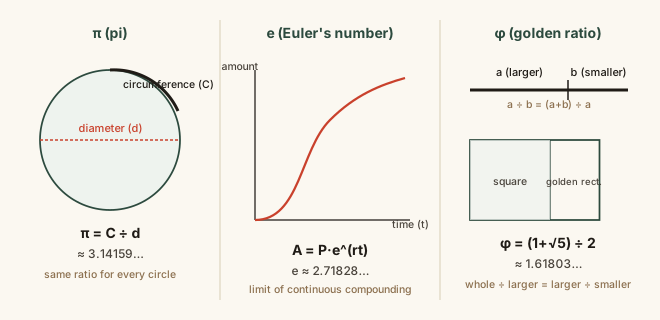
Each panel isolates exactly one relationship: circle geometry for pi, continuous growth for e, and a self-repeating division for phi. None of the three constants require the others to be defined — they're independent discoveries that happen to reappear across very different branches of mathematics, which is precisely why Euler's identity (linking pi, e, and other constants in one equation) is considered such a remarkable, non-obvious result.
Common mistakes
Common Mistakes
Rounding pi to 3.14 and treating that as the exact value for precise calculations.
→ 3.14 is a convenient approximation, not the exact value — pi's decimal digits continue forever without repeating, so more precision (3.14159265...) matters for anything requiring real accuracy.
Assuming e is just 'a constant used in advanced math' with no concrete meaning.
→ e has a specific, concrete definition: it's the limit of continuous compound growth. Anywhere something grows continuously and proportionally to its current size, e shows up.
Treating the golden ratio and the Fibonacci sequence as literally the same thing.
→ They're related but distinct — the golden ratio is an exact, fixed number (φ = (1+√5)/2 ≈ 1.61803), while the Fibonacci sequence is a list of whole numbers whose consecutive ratios only approach phi as the sequence continues.
Common misconception
“The golden ratio appears in essentially every beautiful or well-designed object in art, architecture, and nature.”
Many widely repeated claims — that the Parthenon, the Great Pyramid of Giza, or the Mona Lisa were deliberately designed using the golden ratio — are not supported by historical evidence and have been directly challenged by historians of mathematics and art historians who've re-measured the actual proportions involved. A 1992 analysis by mathematician George Markowsky, published in The College Mathematics Journal, traced many of these claims to loose measurements and retroactive pattern-matching rather than documented design intent. Genuine, well-documented mathematical appearances of the golden ratio do exist — its precise algebraic definition, its connection to the Fibonacci sequence's limiting ratio, and specific geometric constructions — but the sweeping claim that it explains beauty wherever it's "found" is a popular myth that outpaces the actual evidence.
Historians have re-measured famous buildings and artworks often claimed to use the golden ratio, like the Parthenon and the Mona Lisa. What have they generally found?
Try it yourself
What to do next
What to do next
- Use the circumference calculator on a real circular object (a plate, a wheel) and check it against a tape measure.
- Try the compound growth calculator with your own numbers and compare it to a standard once-a-year compounding calculation — see how close (but never over) the continuous result gets.
- Measure a rectangle you have on hand (a book, a card, a screen) and run its dimensions through the golden ratio calculator to see how close it lands to 1.618.
- Read the related entry on Fibonacci Sequence & Nature to see exactly how phi emerges from a simple whole-number sequence.