Colonialism is the historical practice of one country establishing political and economic control over another territory or people, most often through settlement, administration, and resource extraction, spanning roughly the late 15th century to the late 20th century in its European form.
Reading time
— 5 min
Updated
— Aug 16, 2026
Fact-reviewed
— Aug 16, 2026
Key Takeaways
Key Takeaways
1Colonialism refers to a state establishing political and economic control over another territory, using mechanisms that ranged from direct military conquest to chartered trading companies granted governing powers.
2European colonial expansion ran from roughly the 1490s through the mid-20th century, and historians document it as involving resource extraction, forced and coerced labor systems, and — consistently — organized resistance from colonized populations.
3Decolonization was not a single event but a decades-long, uneven process: Ghana gained independence in 1957, most African colonies by the mid-1960s, and some territories, like Portugal's African colonies, not until the mid-1970s.
The concept
Colonialism is what historians call it when one country takes political and economic control over another territory and its people — usually through some mix of settlement, military force, and administrative rule. In the era most commonly discussed today, several European states (Spain, Portugal, the Netherlands, France, Britain, Belgium, and others) established colonies across the Americas, Africa, and Asia between the late 15th and mid-20th centuries. The specific methods varied a great deal by time, place, and colonizing power, but the common thread historians point to is one government or company exercising authority over a population that had no say in that arrangement.
Understanding these mechanisms — conquest, chartered companies, forced labor systems, and formal administration — makes it easier to see why decolonization, discussed next, took such different forms and timelines in different parts of the world.
Quick check
Which of these was a real mechanism European powers used to establish colonial control, according to historians?
Worked examples
Example 1: Spanish colonization of the Americas (baseline case)
Following Columbus's 1492 voyage, the Spanish crown established direct colonial administration across large parts of the Americas, extracting silver and gold — notably from the mines at Potosí, in present-day Bolivia — and imposing the encomienda system, under which colonists were granted the right to demand forced labor and tribute from Indigenous populations. Historians also document catastrophic Indigenous population decline in the century after contact, attributed by researchers primarily to the introduction of diseases such as smallpox to which Indigenous peoples had no prior immunity, compounded by forced labor and displacement.
Example 2: Company rule in Asia (variation / different mechanism)
In South and Southeast Asia, initial European colonial presence often took a different form: the Dutch East India Company and the English East India Company were private, profit-driven trading corporations granted government charters that included the authority to maintain armies, administer territory, and collect taxes. The English East India Company effectively ruled large portions of India directly for roughly a century before the British Crown formally assumed direct control in 1858, following the 1857 Indian Rebellion. This company-administered model is a documented variation on the more direct state-run colonization seen in the Americas.
Example 3: Decolonization and its lasting borders (real-world / present-day relevance)
Historians and organizations including the United Nations point to colonial-era border decisions — especially those made at the 1884–85 Berlin Conference for Africa — as a documented factor that political scientists and historians cite when analyzing some present-day regional and ethnic conflicts, since many modern national borders were drawn to reflect colonial administrative convenience rather than existing ethnic, linguistic, or political boundaries. Decolonization itself unfolded unevenly: Ghana became the first sub-Saharan African colony to gain independence in 1957, most other African colonies followed by the mid-1960s, and Portugal's African colonies (including Angola and Mozambique) did not gain independence until 1974–75, following a change in government in Portugal itself.
Quick check
Did decolonization happen as a single event affecting all colonies at once?
How it works (visual)
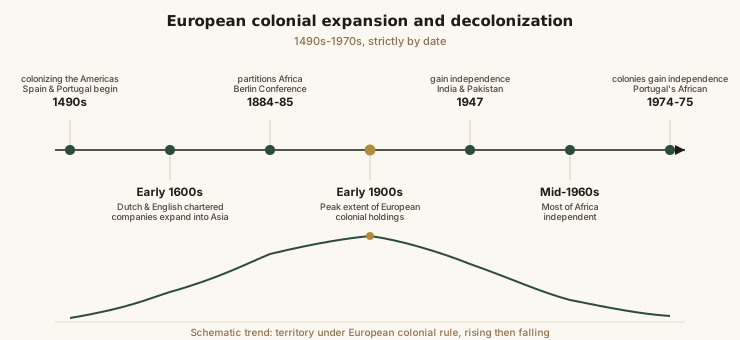
European colonial expansion and decolonization, 1490s–1970s
Plotted on a single timeline, the roughly 480 years between Columbus's 1492 voyage and the last major waves of decolonization in the 1970s show two distinct movements: a long buildup of colonial holdings across four centuries, followed by a comparatively fast unwinding concentrated mostly within about three decades after 1945.
Common mistakes
Common Mistakes
✕
Treating 'colonialism' as a single uniform practice applied the same way everywhere.
→ Historians document meaningfully different mechanisms across regions and eras — direct crown administration in Spanish America, chartered company rule in much of colonial Asia, and settler colonization in places like Australia and parts of Africa, each with different structures and consequences.
✕
Assuming decolonization was quick and happened at roughly the same time everywhere.
→ It spanned decades — from India and Pakistan's independence in 1947 to Portugal's African colonies not becoming independent until 1974-75, nearly 30 years later.
✕
Overlooking that resistance to colonial rule was a constant, documented feature rather than a rare exception.
→ Historians document organized resistance and rebellion throughout the colonial era, from the Haitian Revolution (1791-1804) to 20th-century independence movements across Asia and Africa — colonial rule was contested from the outset, not passively accepted.
Common misconception
“Colonial rule ended everywhere at essentially the same time, shortly after World War II.”
The end of colonial rule was a decades-long, uneven process rather than a single postwar event. India and Pakistan gained independence in 1947; Ghana became the first sub-Saharan African colony to do so in 1957; most other African colonies followed between roughly 1958 and 1966; and Portugal's African colonies, including Angola and Mozambique, did not become independent until 1974–75, following a change of government in Portugal itself. Hong Kong's 1997 return to China, ending over 150 years of British administration, is sometimes cited by historians as one of the last major milestones in this long unwinding.
Quick check
Which of these dates is documented as the year Ghana — the first sub-Saharan African colony to do so — gained independence?
What to do next
What to do next
Next time a country's borders look oddly straight on a map, check whether they date to a colonial-era administrative decision rather than a natural or negotiated boundary.
When you see an independence date for a country, notice roughly where it falls in the broader 1940s-1970s decolonization wave rather than assuming a single shared timeline.
Notice the difference between direct state colonial rule and chartered-company rule when reading about a specific colony's history — they involved different structures of authority.
Read the related entries on the Mughal, Ottoman, and British Empires for how these general colonial mechanisms played out in specific, well-documented cases.
FAQ
FAQ
Related terms
Related terms
Colonialism
The practice of a state establishing political, administrative, and often economic control over another territory or people, typically involving settlement or direct governance.
Imperialism
The broader policy or ideology of extending a state's power and influence over other territories, of which colonialism is one common mechanism.
Chartered company
A private trading company granted official government authority — including, in some cases, the power to govern territory and raise armed forces — to conduct trade and administration abroad, such as the English or Dutch East India Companies.
Decolonization
The process by which colonies gained political independence from colonial powers, occurring in a major wave across Africa, Asia, and the Caribbean mainly between the 1940s and 1970s.
Berlin Conference
An 1884–85 meeting of European powers in Berlin that set rules for the partition of Africa among colonial claimants, without African representation at the table.
 KnowThis