 KnowThis
Key Takeaways
Key Takeaways
- 1By the 1920s, the British Empire was the largest empire in recorded history by land area, commonly cited as covering roughly a quarter of the Earth's land surface and population at its peak.
- 2It grew through a mix of mechanisms — chartered trading companies (notably the East India Company), direct Crown administration, and settler colonization — not through one single method applied everywhere.
- 3Historians document the empire's expansion as involving both trade and military conquest, along with documented systems of forced labor and slavery, and consistent, organized resistance from colonized populations throughout its history.
The concept
That distinction — between the empire's trading origins and the military, administrative, and coercive mechanisms historians document alongside it — is central to understanding how it actually grew and how, eventually, it came apart.
What was the English East India Company, and what role did it play in British imperial expansion in India?
Worked examples
Example 1: The East India Company's rule in India (baseline case)
Example 2: Dominion status in Canada and Australia (variation / different governance path)
Example 3: The Commonwealth of Nations today (real-world / present-day relevance)
How did the path to self-government for a settler colony like Canada compare, historically, to British rule in India?
How it works (visual)
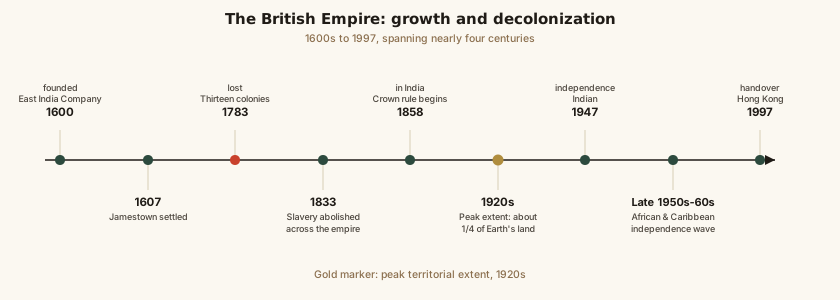
Laid out across nearly four centuries, the empire's growth was gradual and uneven across regions, while its decolonization, though still spanning roughly five decades after 1947, moved noticeably faster — a pattern historians attribute in large part to the economic and political costs of maintaining direct colonial rule after two world wars, combined with sustained independence movements across the empire's territories.
Common mistakes
Common Mistakes
Treating the British Empire as a single, uniformly governed entity.
→ Governance varied significantly — from company rule and direct Crown colonies to largely self-governing dominions like Canada and Australia — documented as genuinely different administrative structures, not one system applied everywhere.
Assuming the empire's growth was driven only by peaceful trade.
→ Historians document trade, settlement, and military conquest as all playing a role, alongside documented systems of forced labor and the empire's significant historical participation in the transatlantic slave trade before its 1807 and 1833 abolition acts.
Assuming decolonization happened all at once, right after World War II.
→ It spanned roughly five decades — India and Pakistan in 1947, most of Africa and the Caribbean through the late 1950s and 1960s, and the 1997 Hong Kong handover often cited as the practical closing chapter.
Common misconception
“The British Empire was primarily a peaceful trading arrangement.”
Historians document the empire's expansion as involving a combination of trade, settlement, and military conquest, alongside systems of forced labor and coercion. Britain was a major participant in the transatlantic slave trade during the 17th and 18th centuries before Parliament abolished the trade in 1807 and slavery itself, in most of the empire, in 1833 — with compensation paid to slave owners rather than to enslaved people, a documented fact from UK Treasury and National Archives records. Expansion into India moved through the East India Company's use of its own private army to gain and hold territory, and later British rule faced sustained, organized resistance across the empire, including the Indian independence movement and the Mau Mau uprising in Kenya in the 1950s. Trade was undeniably central to the empire's economy, but historians are consistent that trade alone does not account for how territorial control was established and maintained.
According to UK Treasury and National Archives records, who received financial compensation under the 1833 Slavery Abolition Act?
What to do next
What to do next
- Next time 'the British Empire' comes up as a single idea, ask which governance structure is being discussed — company rule, Crown colony, or dominion — since they worked differently.
- When you hear the empire described as primarily peaceful trade, weigh that against the documented record of conquest, forced labor, and resistance historians point to.
- Notice how long decolonization actually took (1947 to 1997) rather than assuming it was a single postwar event.
- Read the related entry on Colonialism for the broader mechanisms — chartered companies, forced labor systems, resistance movements — that also shaped other empires covered in this collection.