 KnowThis
Key Takeaways
Key Takeaways
- 1The Ottoman Empire lasted 623 years, from its founding around 1299 to its formal dissolution in 1922 — one of the longest-lived empires in history.
- 2At its height under Suleiman the Magnificent (r. 1520–1566), it spanned three continents: Southeast Europe, the Middle East, and North Africa, not just the Middle East alone.
- 3The 1453 conquest of Constantinople under Mehmed II ended the Byzantine Empire and gave the Ottomans a capital, later Istanbul, that remains one of the world's major cities today.
The concept
That gap between the empire's peak territorial extent under Suleiman and its later, much longer period of gradual retreat is worth keeping in mind — the Ottoman Empire's 623-year span includes centuries of both expansion and contraction, not one steady trajectory.
What event in 1453 is widely treated as the key turning point that gave the Ottoman Empire its lasting capital?
Worked examples
Example 1: The 1453 conquest of Constantinople (baseline case)
Example 2: The failed sieges of Vienna (variation / limits of expansion)
Example 3: Istanbul and Ottoman legacy today (real-world / applied case)
What was the millet system in the Ottoman Empire?
How it works (visual)
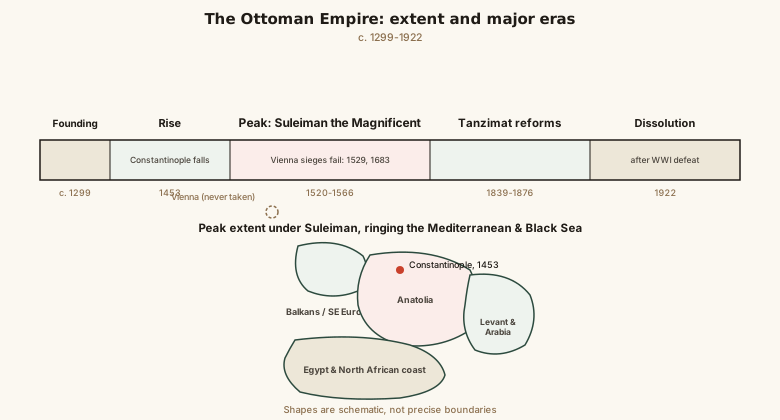
Mapped at its height, Ottoman territory reached from the gates of Vienna in the northwest, through Anatolia and the Levant, down along the North African coast as far as Algeria — a three-continent footprint that makes describing it as a single-region "Middle Eastern" empire an incomplete picture of its actual historical extent.
Common mistakes
Common Mistakes
Describing the Ottoman Empire as only a Middle Eastern power.
→ At its height it spanned Southeast Europe, the Middle East, and North Africa simultaneously — governing large Christian and Jewish populations in the Balkans alongside its Middle Eastern and North African territories.
Assuming the empire expanded steadily for its entire 623-year existence.
→ Expansion was largely concentrated in its first roughly 250-350 years; after the failed 1683 siege of Vienna, the empire entered a long period of gradual territorial contraction that lasted into the 20th century.
Confusing the fall of Constantinople (1453) with the fall of the Ottoman Empire itself.
→ 1453 was the Ottomans' conquest of Constantinople, ending the Byzantine Empire and marking an early high point of Ottoman power — the Ottoman Empire itself didn't dissolve until 1922, nearly 470 years later.
Common misconception
“The Ottoman Empire was a purely Middle Eastern empire.”
At its height in the 16th and 17th centuries, the Ottoman Empire spanned three continents simultaneously: Southeast Europe (including much of the Balkans, up to the outskirts of Vienna), the Middle East, and North Africa (including Egypt and territory as far west as Algeria). It governed a religiously and ethnically diverse population that included large Orthodox Christian, Armenian Christian, and Jewish communities, managed in part through the millet system's framework for religious self-governance. Historians describe the empire as a genuinely multi-continental, multi-religious state throughout most of its history, not a religiously or geographically uniform "Middle Eastern" power.
Which three continents did the Ottoman Empire span at its territorial height?
What to do next
What to do next
- Next time someone calls the Ottoman Empire 'a Middle Eastern empire,' mentally add its Southeast European and North African territory to the picture.
- When you hear 'fall of Constantinople,' place it correctly in 1453 — the start of a new Ottoman era, not the empire's end.
- Notice the two failed sieges of Vienna (1529, 1683) next time European history from this period comes up — they mark the empire's furthest reach, not its founding or its collapse.
- Read the related entry on the Mughal Empire to compare how two large, religiously diverse Islamic-ruled empires of the same broad era each handled governing non-Muslim populations.