 KnowThis
Key Takeaways
Key Takeaways
- 1On the morning of September 11, 2001, 19 hijackers affiliated with al-Qaeda took control of four commercial airplanes, crashing two into the World Trade Center in New York City, one into the Pentagon, and one into a field near Shanksville, Pennsylvania, after passengers and crew tried to retake the plane.
- 2The 9/11 Memorial & Museum documents 2,977 people killed across all four locations, not counting the 19 hijackers, with thousands more injured and, in the years since, thousands of responders and survivors have died from illnesses linked to toxic dust exposure at Ground Zero.
- 3The attacks reshaped global security policy for a generation: the U.S. invaded Afghanistan within a month, aviation security was overhauled worldwide, and NATO invoked its collective-defense clause for the first time in its history.
The concept
Understanding what happened that morning is only part of the picture — the attacks also set off two decades of policy change in the United States and internationally, which is where their global significance mostly lies today.
How many commercial airplanes were hijacked in the September 11, 2001 attacks?
Worked examples
Example 1: The chronology of the attacks (baseline case)
Example 2: A documented pattern, not a single isolated event (context / exception to the "out of nowhere" framing)
Example 3: How the attacks still shape daily life today (real-world / present-day case)
Why did United Airlines Flight 93 crash in a field near Shanksville, Pennsylvania, rather than reach an intended target?
How it works (visual)
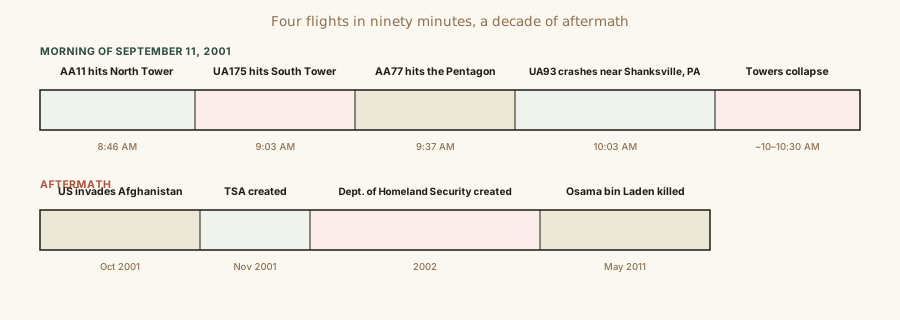
The timeline shows two distinct phases: the attacks themselves, compressed into roughly 80 minutes that morning, and the much longer institutional response that followed over the next two decades, from new federal agencies to a military campaign that became the longest war in U.S. history before U.S. forces withdrew from Afghanistan in 2021.
Common mistakes
Common Mistakes
Citing different death toll figures interchangeably without noting what they count.
→ The 9/11 Memorial & Museum's figure of 2,977 covers the direct attacks; it does not include the thousands of responders and survivors who have since died of illnesses linked to toxic dust exposure at Ground Zero, which is tracked separately through the federally administered World Trade Center Health Program.
Treating 9/11 as a completely isolated, unprecedented attack with no prior warning pattern.
→ The 9/11 Commission's report documents a sequence of earlier attacks tied to the same network — the 1993 World Trade Center bombing, the 1998 embassy bombings, and the 2000 USS Cole bombing — as part of an escalating campaign.
Assuming the U.S. response to 9/11 began and ended quickly.
→ The military campaign launched in Afghanistan in October 2001 continued for nearly two decades, and institutional changes like the Department of Homeland Security and TSA remain permanent parts of U.S. government structure today.
Common misconception
“9/11 was a single, isolated event that came out of nowhere and had no lasting global impact beyond that day.”
Neither half of that framing holds up against the documented record. The 9/11 Commission's report ties the attacks to a pattern of earlier al-Qaeda attacks going back to 1993, and historians describe 9/11 as the culmination of an escalating campaign rather than a singular surprise. Its aftermath was equally far-reaching: it triggered the U.S. invasion of Afghanistan, NATO's first-ever invocation of its collective-defense clause, the creation of the Department of Homeland Security and the Transportation Security Administration, and a global overhaul of aviation security that is still in place today, according to the National Archives and the 9/11 Memorial & Museum.
Which of the following is documented as part of the pattern of attacks that preceded September 11, 2001?
Try it yourself
What to do next
What to do next
- Next time you go through airport security screening, recognize it as a direct, lasting policy change that followed the September 11 attacks.
- When you hear 9/11 described as coming entirely without precedent, remember the documented pattern of earlier al-Qaeda attacks the 9/11 Commission identified beforehand.
- If you visit the National September 11 Memorial & Museum, notice that the twin reflecting pools sit exactly within the original towers' footprints.
- When reading about the war in Afghanistan, connect it back to its documented starting point — the U.S. military campaign launched in October 2001, weeks after the attacks.