 KnowThis
Key Takeaways
Key Takeaways
- 1The decade opened with the Arab Spring, a wave of pro-democracy protests that began in Tunisia in December 2010 and spread across the Middle East and North Africa, producing outcomes that ranged from political transition to prolonged civil war depending on the country.
- 2In March 2011, a magnitude 9.0-9.1 earthquake and resulting tsunami struck northeastern Japan, killing nearly 20,000 people and triggering a severe nuclear accident at the Fukushima Daiichi power plant, according to Encyclopaedia Britannica.
- 3The decade closed with the United Kingdom's June 2016 Brexit referendum, in which voters chose to leave the European Union, alongside the December 2015 Paris Agreement, a global treaty on climate change adopted by nearly every country.
The concept
As with the decade before it, no single event defines the 2010s on its own — political upheaval, natural disaster, and a major geopolitical vote all left lasting marks in different parts of the world, often with very different outcomes even within the same event.
Where did the protests that became known as the Arab Spring begin?
Three defining events of the 2010s
The Arab Spring (2010-2012)
The Japan earthquake, tsunami, and Fukushima disaster (2011)
The Brexit referendum (2016)
What triggered the severe nuclear accident at the Fukushima Daiichi power plant in 2011?
How it works (visual)
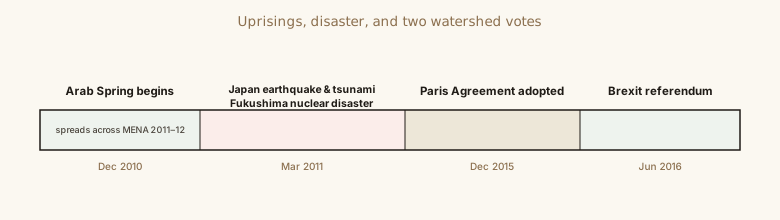
Laid out chronologically, the decade again splits into distinct threads: a political-upheaval thread beginning with the Arab Spring, a natural-disaster-and-nuclear-safety thread centered on the 2011 Japan disaster, and a geopolitical thread running through the Paris Agreement and closing with the Brexit vote.
Common mistakes
Common Mistakes
Assuming the Arab Spring produced the same outcome — democratic transition — in every country it touched.
→ Outcomes varied sharply by country: Tunisia is generally seen as the clearest democratic transition, while Libya and Syria fell into prolonged civil wars, and Egypt saw a 2013 military-led change of government after its 2011 uprising.
Thinking the Fukushima nuclear accident was caused directly by the earthquake.
→ The earthquake itself did not cause the meltdowns — the tsunami that followed disabled the plant's cooling systems, which is what led to the reactor damage.
Assuming the Brexit referendum immediately took the UK out of the European Union.
→ The June 2016 vote authorized the process, but formal withdrawal negotiations took years, with the UK's exit from the EU not completed until the end of January 2020.
Common misconception
“Major global events of a decade can be reduced to just one or two headline events.”
The 2010s alone included a region-spanning political movement with sharply different outcomes by country (the Arab Spring), one of the most powerful earthquakes ever recorded paired with a major nuclear accident (the 2011 Japan disaster), a landmark international climate treaty (the 2015 Paris Agreement), and a consequential national vote that took years to fully implement (the 2016 Brexit referendum). Historians generally treat these as separate, largely unrelated storylines that happened to unfold in the same ten-year span, not variations on one theme.
Which outcome did the Arab Spring produce consistently across every country it affected?
What to do next
What to do next
- Next time someone describes the Arab Spring as a single, uniform event, mention at least two countries with very different outcomes — Tunisia versus Libya or Syria.
- When you hear about Fukushima, remember the sequence: earthquake, then tsunami, then disabled cooling systems, then meltdown — not a single direct cause.
- Notice the difference between the Brexit vote (June 2016) and the UK's actual departure from the EU (January 2020) next time either date comes up.
- Read the related entry on major global events of the 2000s to see how the decade's opening events connect back to the previous one.