The internet grew from ARPANET, a U.S. government-funded computer network first connected in 1969, into a global system that, following the 1989-1991 invention of the World Wide Web at CERN, reshaped commerce, communication, and media within roughly a generation.
Reading time
— 5 min
Updated
— Aug 16, 2026
Fact-reviewed
— Aug 16, 2026
Key Takeaways
Key Takeaways
1The Internet and the World Wide Web are not the same thing — the Internet is the underlying network, first connected as ARPANET in 1969, while the Web is a system of linked documents built on top of it, invented by Tim Berners-Lee at CERN between 1989 and 1991.
2Public and commercial adoption exploded through the 1990s, driven by graphical browsers and the dot-com boom, then crashed hard in the 2000-2001 dot-com bust before rebuilding on broadband and, later, mobile connections.
3According to Pew Research Center, internet use has gone from a minority activity in the 1990s to something the large majority of adults in many countries now do daily, reshaping commerce, communication, and media within roughly one generation.
The concept
The Internet started as a government-funded research network, not a consumer product. ARPANET, funded by the U.S. Department of Defense, connected its first computers in 1969, linking a handful of university and research computers together. Over the next two decades it grew into a wider network of connected networks, which is literally what the word "internet" means. What most people picture when they think of the "internet" today, though, — pages, links, and browsers — is technically the World Wide Web, a system built on top of the Internet and invented separately, decades later.
That distinction between the Internet as a network and the Web as one thing built on top of it matters for understanding everything that follows — the boom, the bust, and the slow shift from a novelty to something most people now use every day.
Quick check
What is the difference between the Internet and the World Wide Web?
Worked examples
Example 1: From ARPANET to the standardized Internet (baseline case)
ARPANET connected its first computers, at UCLA and Stanford Research Institute, in 1969. Over the following years, more research institutions joined, and on January 1, 1983 — an event engineers still refer to as "flag day" — the network fully switched to the TCP/IP protocol suite, the standardized addressing and data-transfer system that remains the technical foundation of the Internet today. This is the point most historians and Britannica mark as the true birth of the Internet as a unified, interoperable network, rather than a single research project.
Example 2: The invention of the World Wide Web and the dot-com bust (variation / turning point)
Tim Berners-Lee's 1989-1991 work at CERN gave the existing Internet something it had lacked: an easy way to link and browse documents using a Web browser. That innovation, paired with graphical browsers like Mosaic and Netscape in the mid-1990s, triggered explosive commercial growth — the "dot-com boom." But growth outran sound business fundamentals for many companies, and the bubble burst in 2000-2001, wiping out a large share of internet-company stock value. The lesson historians draw from this variation is important: the underlying technology kept growing in usage throughout, even while the financial bubble built on top of it collapsed.
Example 3: The smartphone-driven, always-on internet of today (real-world / applied case)
The internet most people use today looks very different from the dial-up, desktop-bound version of the 1990s. Broadband replaced dial-up through the 2000s, removing the need to tie up a phone line, and after the 2007 introduction of the smartphone, mobile internet access became the default way many people go online. Pew Research Center's ongoing surveys document this shift concretely: internet and broadband adoption, once a minority activity confined to certain demographics, has become close to universal among adults in the countries Pew tracks, fundamentally changing banking, shopping, news, and everyday communication.
Quick check
What was the 'dot-com bust' of 2000-2001?
How it works (visual)
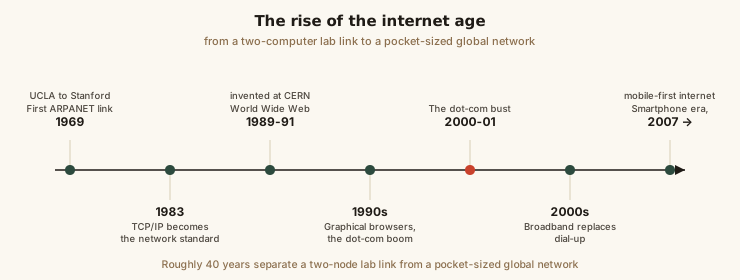
The Internet's rise: from ARPANET to the mobile-first Web
The diagram splits cleanly into two eras: a slow-building network phase from 1969 to the early 1990s, largely invisible to the public, and a much faster public-adoption phase from the mid-1990s onward, once the Web gave the network an interface ordinary people could actually use.
Common mistakes
Common Mistakes
✕
Using 'the Internet' and 'the World Wide Web' as interchangeable terms.
→ The Internet is the network (dating to ARPANET in 1969); the Web is a document-linking system built on top of it, invented separately by Tim Berners-Lee in 1989-1991.
✕
Assuming one single person or company invented the internet.
→ It developed over decades through government-funded research (ARPANET), international collaboration on protocols, and Tim Berners-Lee's separate invention of the Web — no single inventor or company owns the whole history.
✕
Treating global internet access as already universal today.
→ Pew Research Center's data shows adoption is high in many countries but still not complete — meaningful gaps in access persist by age, income, and region, even as usage keeps climbing.
Common misconception
“The Internet and the World Wide Web are the same thing.”
They describe two different layers of technology. The Internet is the physical and logical network of connected computers, tracing back to ARPANET's first connection in 1969 and standardized around TCP/IP in 1983. The World Wide Web is a system of linked documents, pages, and browsers built on top of that existing network, invented separately by Tim Berners-Lee at CERN between 1989 and 1991. You can use the Internet without the Web — email and file transfer protocols predate the Web and still don't require a browser — but the Web cannot exist without the Internet underneath it, according to CERN's own history of the invention.
Quick check
Which came first: the Internet (as a network) or the World Wide Web?
Try it yourself
Years since the World Wide Web became publicly available
Years since the Web's 1991 public release0.0 years
What to do next
What to do next
Next time someone says 'the internet' and 'the web' as if they're the same thing, mentally separate the network (1969) from the document-linking system built on top of it (1989-1991).
When you hear a company or individual credited with 'inventing the internet,' remember it developed through decades of government-funded research and international protocol standards, not a single inventor.
Notice how much of your own internet use now happens on a phone rather than a desktop — that shift dates specifically to the years following the 2007 introduction of the smartphone.
Read the related entries on major global events of the 2000s and 2010s to see how internet growth intersected with the decade's other major stories.
FAQ
FAQ
Related terms
Related terms
ARPANET
A U.S. government-funded computer network, first connected in 1969, widely credited as the direct technical predecessor of today's Internet.
World Wide Web
A system for linking and accessing documents over the Internet using browsers and hyperlinks, proposed by Tim Berners-Lee at CERN in 1989 and made publicly available in 1991 — distinct from the Internet itself, which is the underlying network.
TCP/IP
The core set of communication protocols standardizing how data is broken into packets and routed across networks, adopted as the Internet's standard on January 1, 1983, an event sometimes called "flag day."
Broadband
Always-on, high-capacity internet access (such as cable, fiber, or DSL) that replaced slower dial-up connections requiring a phone line to be tied up during use.
 KnowThis