UNESCO World Heritage Sites: What the Designation Actually Means
A UNESCO World Heritage Site is a place formally recognized under the 1972 World Heritage Convention as having Outstanding Universal Value, through a multi-stage nomination and evaluation process — most designated sites are cultural, not natural.
Reading time
— 5 min
Updated
— Aug 16, 2026
Fact-reviewed
— Aug 16, 2026
Key Takeaways
Key Takeaways
1A UNESCO World Heritage Site is a formal designation under a 1972 international treaty, awarded only after a multi-year nomination, technical evaluation, and committee vote — it's not an informal 'best of' list.
2The large majority of the more than 1,100 sites on the World Heritage List are cultural (monuments, historic cities), not natural — natural sites are actually a minority category.
3World Heritage status isn't permanent: sites can be added to the 'World Heritage in Danger' list under threat, and in rare cases can even be removed from the World Heritage List entirely.
The concept
A UNESCO World Heritage Site is a place officially recognized by the United Nations' cultural agency as having exceptional value to all of humanity — not just to the country it's in. This can be a natural wonder, a historic city, a monument, or a mix of both. More than 1,100 sites currently hold this status, spread across well over a hundred countries. Getting the designation isn't automatic or informal — a country has to formally nominate the site, and international experts have to evaluate it, before a committee votes to approve it.
That distinction between a formal treaty-based designation and an informal "best of" list is the single most important thing to understand about UNESCO status — and it's clearest when you walk through exactly how a site earns it.
Quick check
How does a site actually become a UNESCO World Heritage Site?
Worked examples
Example 1: The nomination-to-inscription pipeline (baseline case)
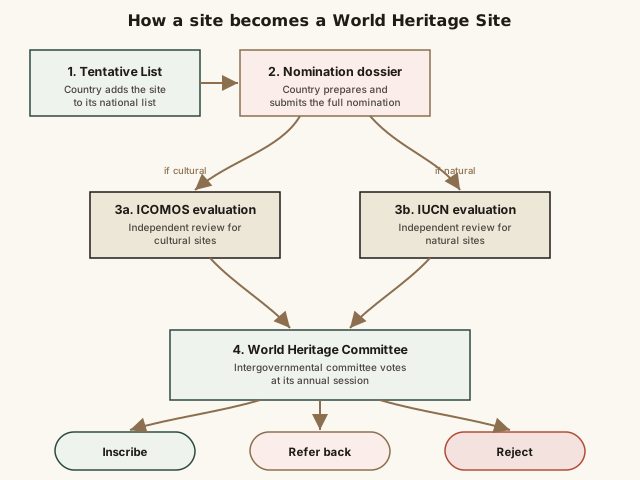
Before a country can nominate any site, that site must first appear on the country's Tentative List — its own inventory of future candidates — typically for at least a year. The country then prepares a detailed nomination dossier explaining how the site meets at least one of UNESCO's ten selection criteria and demonstrating adequate legal protection and a management plan. Independent advisory bodies then conduct a technical evaluation: the International Council on Monuments and Sites (ICOMOS) reviews cultural nominations, and the International Union for Conservation of Nature (IUCN) reviews natural nominations. Only after that evaluation does the intergovernmental World Heritage Committee — representing 21 member states at any given time — vote on whether to inscribe the site. The entire process typically takes well over a year from nomination to a final decision.
Example 2: Delisting — when World Heritage status is withdrawn (edge case / variation)
Germany's Dresden Elbe Valley was inscribed as a cultural landscape in 2004, but the World Heritage Committee removed it from the list in 2009 after the city proceeded with building a four-lane road bridge, the Waldschlösschenbrücke, directly through the middle of the valley — a decision the Committee determined had destroyed the very visual and cultural integrity the site had been designated for. It remains one of only three sites ever fully delisted, and it's a clear edge case showing that World Heritage status is a conditional recognition, contingent on maintaining a site's integrity, not a permanent, unconditional honor once granted.
Quick check
Germany's Dresden Elbe Valley was removed from the World Heritage List in 2009, several years after being inscribed. Why?
Example 3: The Bamiyan Buddhas and the "in Danger" mechanism (real-world / applied case)
Afghanistan's Cultural Landscape and Archaeological Remains of the Bamiyan Valley was inscribed on the World Heritage List and simultaneously placed on the List of World Heritage in Danger in 2003 — two years after the Taliban destroyed the site's two giant standing Buddha statues, carved into a cliff face roughly 1,500 years earlier, in an internationally condemned act in 2001. The "in Danger" listing in this case wasn't a warning ahead of damage — it followed a documented loss, and functions instead to focus international conservation attention and funding on protecting what remains of the site and its surrounding archaeological landscape. This shows the "in Danger" list operating exactly as designed: not a punishment, but a mechanism for concentrating global support on a site under serious threat.
How it works (visual)
How a site becomes a UNESCO World Heritage Site: the nomination pipeline
Each stage in this pipeline exists to keep the designation meaningful — the Tentative List forces advance planning, the dossier forces the host country to document exactly how the site meets a specific criterion, and the independent ICOMOS/IUCN evaluation exists precisely so the decision doesn't rest on the nominating country's own judgment alone. The Committee vote is the final check, not the first one.
Common mistakes
Common Mistakes
✕
Assuming a UNESCO World Heritage Site is mainly a tourism marketing label.
→ It's a formal treaty-based designation under the 1972 World Heritage Convention, requiring nomination, independent technical evaluation, and a committee vote — not a marketing award.
✕
Assuming World Heritage status, once granted, is permanent regardless of what happens to the site afterward.
→ Status is conditional on maintaining the site's Outstanding Universal Value — sites can be placed on the 'in Danger' list, and in rare cases (three so far) removed entirely.
✕
Assuming most World Heritage Sites are natural wonders like national parks.
→ Cultural sites — historic cities, monuments, archaeological remains — make up roughly three-quarters of the list; natural sites are the minority category.
Common misconception
“All UNESCO World Heritage Sites are natural wonders, like national parks or nature reserves.”
Most World Heritage Sites are actually cultural, not natural — roughly three-quarters of the more than 1,100 sites on the list are cultural sites such as historic cities, monuments, and archaeological remains. Natural sites (ecosystems, geological formations) make up only around one in eight, and mixed sites (both cultural and natural significance) a small remaining share. The confusion is understandable, since famous natural sites like the Great Barrier Reef and Yellowstone are frequently in the news, but numerically they're the minority category on the list, not the majority.
Quick check
What share of UNESCO World Heritage Sites are natural (rather than cultural or mixed)?
Try it yourself
A region's share of the world's total UNESCO sites
Share of the world's total sites (%)4.35
What to do next
What to do next
Try the calculator above with a specific country's site count to see what share of the world's total World Heritage List it holds.
Next time you visit a UNESCO site, look up which of the ten official selection criteria it was inscribed under — it's usually posted or easy to find on the UNESCO site page.
Check the current World Heritage in Danger list to see which sites are under active threat right now, and why.
Read the related entry on Famous Natural Wonders of the World to see how UNESCO's natural-site category compares to informal 'wonders' lists.
FAQ
FAQ
Related terms
Related terms
World Heritage Convention
The 1972 international agreement, adopted by UNESCO member states, that established the World Heritage List and the framework for identifying and protecting sites of Outstanding Universal Value.
Outstanding Universal Value
UNESCO's core standard for World Heritage status — cultural or natural significance so exceptional it transcends national boundaries and matters to all of humanity.
Tentative List
A country's own inventory of sites it intends to nominate for World Heritage status in future years, a required first step before a formal nomination.
Cultural landscape
A UNESCO site category recognizing places shaped by the combined work of nature and humans, rather than purely natural or purely built sites.
World Heritage in Danger
A separate UNESCO list flagging inscribed sites under serious threat from conflict, natural disaster, or unchecked development, intended to draw international attention and support.
 KnowThis