Famous Natural Wonders of the World, and How Each One Actually Formed
The world's most famous natural wonders each formed through a distinct geologic or biological process — erosion, tectonic uplift, volcanic construction, or living reef growth — on timescales ranging from decades to tens of millions of years.
Reading time
— 5 min
Updated
— Aug 16, 2026
Fact-reviewed
— Aug 16, 2026
Key Takeaways
Key Takeaways
1Natural wonders form through very different processes — some are carved away by erosion over millions of years (the Grand Canyon), while others are built up, either by living organisms (the Great Barrier Reef) or by sudden volcanic eruption (Paricutin).
2There is no single official 'Seven Natural Wonders of the World' list — several competing, unofficial lists exist, unlike UNESCO's formally designated World Heritage Sites.
3The Great Barrier Reef is a living structure, built by billions of tiny coral polyps over thousands of years, which is also why it's vulnerable to damage from warming ocean water in a way that a stone canyon isn't.
The concept
A natural wonder is a large-scale natural feature famous enough, and dramatic enough, to draw worldwide attention — the Grand Canyon, the Great Barrier Reef, Mount Everest, Victoria Falls, the Amazon Rainforest. Each one is famous for a different reason and formed by a completely different process: some were carved away over millions of years by rivers or glaciers, some were built up by volcanic eruptions, and at least one — the Great Barrier Reef — was built by billions of tiny living animals, one skeleton at a time.
That range of timescales — from a volcano born in a farmer's cornfield within a single decade to a canyon carved over millions of years — is easiest to grasp by comparing two wonders directly.
Quick check
The Grand Canyon and the Great Barrier Reef are both famous natural wonders, but they formed through fundamentally different processes. What's the key difference?
Worked examples
Example 1: How the Grand Canyon was carved (baseline case)
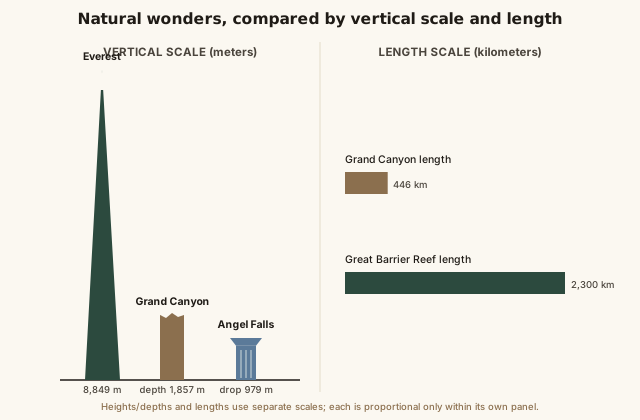
The Colorado River has been cutting through the Colorado Plateau for an estimated 5 to 6 million years, aided by the region's gradual tectonic uplift, which kept raising the land and giving the river fresh rock to cut through at a steeper gradient. The result today is a canyon up to about 1,857 meters (6,093 feet) deep and roughly 446 kilometers (277 miles) long, with walls exposing rock layers dating back nearly 1.8 billion years. It's a textbook erosional wonder: no single event, just water, sediment, and gravity working continuously for millions of years.
Example 2: Paricutin — a volcano born in a decade (edge case / variation)
Most natural wonders take millions of years to form — Paricutin didn't. In 1943, a Mexican farmer named Dionisio Pulido watched a crack open in his cornfield and begin emitting smoke and ash; within a single day, a small cone had formed, and within a year the volcano had grown to over 336 meters (1,102 feet) tall. It continued erupting until 1952, ultimately reaching about 424 meters (1,391 feet), before going dormant. Paricutin is a genuine edge case in this topic: it's one of the very few volcanoes in recorded history whose entire life cycle, from birth to dormancy, was directly observed by scientists and local residents — a natural wonder that formed on a human timescale rather than a geologic one.
Quick check
Most famous natural wonders took thousands to millions of years to form. What makes Paricutin volcano in Mexico an unusual exception?
Example 3: The Great Barrier Reef as a living, vulnerable structure (real-world / applied case)
Because the Great Barrier Reef is built and maintained by living coral polyps, it responds to environmental stress the way a living organism does — not the way a static rock formation does. When ocean water stays unusually warm for extended periods, coral undergoes coral bleaching, expelling the symbiotic algae that give it color and much of its energy; the coral survives bleaching if conditions improve quickly, but dies if the stress persists. Documented mass bleaching events on the Great Barrier Reef, tracked by NOAA and Australian marine science agencies, have become more frequent as ocean temperatures have risen — a direct, real-world consequence of the reef being a living wonder rather than an inert one, with a vulnerability that erosional or tectonic wonders like the Grand Canyon simply don't share on the same timescale.
How it works (visual)
Scale comparison: famous natural wonders by height, depth, and length
Placed on a single scale, the size differences are stark — Angel Falls' entire drop would fit inside the Grand Canyon's depth nearly twice over, while the Great Barrier Reef's length dwarfs the Grand Canyon's by more than five times. These comparisons only make sense once you remember they're not measuring the same kind of thing: a waterfall's drop, a canyon's depth, and a reef's length are three different dimensions of three completely different formation processes.
Common mistakes
Common Mistakes
✕
Assuming there's one official, universally agreed 'Seven Natural Wonders of the World' list.
→ Several competing unofficial lists exist (Britannica's, various media campaigns) with different entries — none carries the formal, criteria-based status of a UNESCO World Heritage Site designation.
✕
Treating the Great Barrier Reef as a static rock formation like a canyon or mountain.
→ It's a living structure built by coral polyps, which means it can grow, but can also be damaged or killed by environmental stress like warming ocean water — a vulnerability rock formations don't share.
✕
Assuming all natural wonders take millions of years to form.
→ Timescales vary enormously — Paricutin volcano reached most of its final height within about a year, while the Grand Canyon took an estimated 5 to 6 million years.
Common misconception
“There is an official, scientifically or governmentally recognized list of the 'Seven Natural Wonders of the World.'”
No single governing body maintains an official natural-wonders list the way UNESCO formally designates World Heritage Sites. Several different, unofficial lists exist — Encyclopaedia Britannica publishes one commonly cited version, and various media and tourism campaigns over the decades have published their own, sometimes overlapping and sometimes not. This is different from UNESCO World Heritage status, which requires a formal nomination, technical evaluation, and a vote by an intergovernmental committee against specific published criteria — a process natural wonder lists simply don't go through.
Quick check
Is there a single official list of the 'Seven Natural Wonders of the World' recognized by an international governing body?
Try it yourself
Freefall time from a given height (t = √(2h/g))
Time to fall that height (seconds)14.13
What to do next
What to do next
Try the calculator above with the Grand Canyon's depth (1,857m) instead of Angel Falls to compare theoretical freefall times between two very different natural wonders.
Next time you hear a 'Seven Wonders' list, check which version it is — Britannica's, a media campaign's, ancient or modern — since they don't all agree.
Look up recent Great Barrier Reef bleaching reports from NOAA or Australian marine science agencies to see how a living wonder's health is tracked over time.
Read the related entry on Longest, Tallest, Deepest — World Superlatives for how these wonders stack up against Earth's absolute extremes.
FAQ
FAQ
Related terms
Related terms
Erosion
The gradual wearing away of rock and soil by water, wind, or ice, the process responsible for carving features like the Grand Canyon.
Tectonic uplift
The rising of land caused by the collision or movement of Earth's tectonic plates, the process building mountains like the Himalayas.
Coral polyp
A tiny, soft-bodied marine animal that builds a hard calcium carbonate skeleton; colonies of coral polyps, accumulated over thousands of years, form coral reefs like the Great Barrier Reef.
Plunge waterfall
A waterfall where water drops vertically, losing contact with the underlying rock surface, as opposed to a cascade that follows the rock down in steps.
Coral bleaching
A stress response in which coral expels the colorful algae living in its tissue, usually triggered by unusually warm water, leaving the coral white and vulnerable to death if conditions don't improve.
 KnowThis