 KnowThis
Key Takeaways
Key Takeaways
- 1Coral reefs are built by tiny animals, not plants or rocks — coral polyps are related to jellyfish and sea anemones, and secrete the calcium carbonate skeletons that form the reef structure over centuries.
- 2Reefs cover under 1% of the ocean floor but support an estimated quarter of all known marine species, making them among the most biodiverse ecosystems on Earth relative to their footprint.
- 3Coral bleaching happens when warm water stresses coral into expelling the algae living in its tissue — the coral doesn't die immediately, but it loses most of its energy source and can starve if warm conditions persist.
The concept
That reliance on a delicate energy-sharing partnership with algae is also exactly what makes coral so vulnerable to warming water — which is the mechanism behind one of the most consequential events happening to reefs today.
What is coral, biologically speaking?
Worked examples
Example 1: From volcanic island to atoll — Darwin's subsidence model (baseline case)
Example 2: Coral that doesn't need warm, sunlit water at all (edge case / variation)
A species of reef-building coral is discovered living at 1,800 meters depth in cold, completely dark water. Does this contradict what we know about coral reefs?
Example 3: What happens during a coral bleaching event (real-world / applied case)
When ocean water near a reef stays too warm for too long — even just 1-2°C above the normal seasonal maximum, sustained over several weeks — coral becomes stressed and expels the zooxanthellae living in its tissue as a defense response. Because that algae also gives coral most of its color, the coral turns pale or completely white, which is what "bleaching" refers to. Bleached coral isn't dead: if temperatures drop back to normal reasonably quickly, the coral can recruit new algae and recover. But since the algae also supply up to 90% of the coral's energy, prolonged bleaching leaves the coral effectively starving, and it can die within weeks to months if warm conditions persist. Large-scale bleaching events driven by unusually warm ocean temperatures have repeatedly affected the Great Barrier Reef and other major reef systems worldwide, and are tracked and reported by NOAA's Coral Reef Watch program.
How it works (visual)
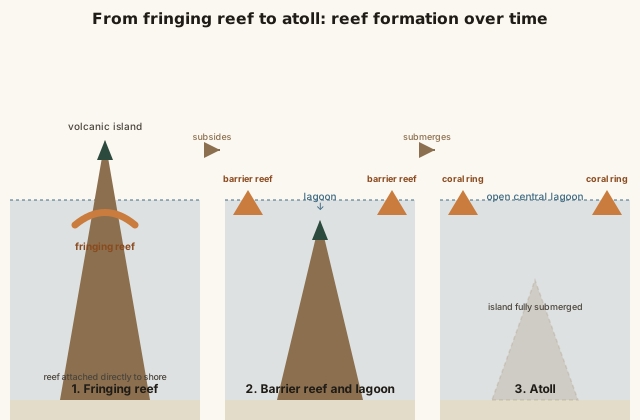
Read the three panels left to right as one continuous timeline spanning millions of years, not three separate reef types. The island in the middle panel is the same island as the left panel, just further along in its subsidence; by the right panel, it's gone entirely, and only the coral it hosted — which kept growing upward the whole time — remains visible at the surface.
Common mistakes
Common Mistakes
Referring to coral as a plant or a type of rock.
→ Coral is an animal — specifically a colonial cnidarian related to jellyfish and sea anemones. The hard structure is a skeleton the animals secrete, not a mineral formation or plant growth.
Assuming a white, bleached reef is already dead.
→ Bleached coral has lost its algae and its color, but it's still alive at that point — it can recover if water temperatures return to normal quickly enough, though prolonged bleaching does eventually lead to death by starvation.
Assuming all coral reefs form the same way, in warm shallow water near a coastline.
→ Most reef-building coral does need warm, shallow, sunlit water, but cold-water coral species like Lophelia pertusa build reef structures in cold, dark water at depths up to roughly 2,000 meters, using filter-feeding instead of photosynthetic algae.
Common misconception
“Coral reefs are made of rock or coral is a type of plant.”
Coral is an animal. Each individual coral polyp is a small, soft-bodied organism closely related to jellyfish and sea anemones — all part of the group called cnidarians. What looks like a solid rock structure is actually the accumulated calcium carbonate skeletons secreted by colonies of these living animals over hundreds to thousands of years, with a thin layer of living tissue covering the surface. The confusion is understandable, since a reef does look and feel rock-hard, and its color often comes from the microscopic algae living symbiotically inside the coral's tissue rather than from the animal itself — but underneath, it's built and maintained by living animals the entire time.
Someone says, 'Coral reefs are basically colorful rock formations, like an underwater version of a mineral deposit.' What's the most accurate correction?
Try it yourself
What to do next
What to do next
- Look at the calculator result above and compare it to the fact that reefs support roughly a quarter of marine species — a strong signal of how disproportionately biodiverse reef ecosystems are for their tiny footprint.
- Next time you hear about a bleaching event in the news, connect it to the specific mechanism: sustained warm water causing coral to expel its algae, not the coral simply 'dying from heat' directly.
- Look up NOAA's Coral Reef Watch to see real-time sea surface temperature and bleaching-risk monitoring for reefs worldwide.
- Read the related entry on Sea Levels & Coastlines to see how warming oceans connect to broader changes in marine geography.