Stars, Galaxies & the Universe: How Big, How Old, How Far
Stars are massive spheres of plasma powered by nuclear fusion, grouped into galaxies containing billions of them, all within a roughly 13.8-billion-year-old universe so vast that distance is measured in light-years, not kilometers.
Reading time
— 7 min
Updated
— Aug 19, 2026
Fact-reviewed
— Aug 19, 2026
Key Takeaways
Key Takeaways
1A light-year measures distance, not time — it's how far light travels in one year, about 9.46 trillion kilometers, used because ordinary units like kilometers become unwieldy at cosmic scale.
2The Milky Way alone contains an estimated 100-400 billion stars, and the observable universe contains hundreds of billions of galaxies — the Sun is one star among an almost incomprehensible number.
3Because light takes time to travel, looking at a distant star or galaxy means seeing it as it was in the past, not as it is right now — the farther away, the further back in time you're looking.
The concept
Stars are enormous, glowing balls of superheated gas that produce their own light and heat through nuclear fusion. Our Sun is one ordinary star among the 100 to 400 billion stars that make up the Milky Way, the galaxy we live in. And the Milky Way is just one of hundreds of billions of galaxies scattered across the observable universe. Because space is so vast, astronomers measure distance in light-years — how far light travels in one year — instead of kilometers or miles.
The scale of "far away" in space is genuinely hard to picture with everyday units, which is exactly why the light-year unit exists — and it only clicks once you run real distances through it.
Quick check
A star is described as being '4.24 light-years away.' What does that figure actually tell you?
Worked examples
Example 1: Converting light-years to kilometers (baseline case)
Proxima Centauri, part of the Alpha Centauri star system, is the closest known star to the Sun at about 4.24 light-years away. One light-year equals roughly 9.46 trillion kilometers (9,460,730,472,580.8 km, to be exact, based on light's speed and a standard year length). Multiplying: 4.24 × 9.46 trillion km ≈ 40.1 trillion kilometers. Even at that "closest star" distance, the number is so large that light-years remain far more practical to work with than kilometers for everyday astronomical description.
Example 2: Why Voyager 1 will never reach another star in a meaningful timeframe (edge case / variation)
Voyager 1, launched in 1977, is the most distant human-made object from Earth, traveling at about 17 kilometers per second — extremely fast by everyday standards, roughly 60,000 km/h. Yet after decades of travel it has covered only a tiny fraction of a single light-year (roughly 0.0025 light-years as of the mid-2020s). If Voyager 1 were somehow aimed at Proxima Centauri (it isn't — it's headed in a different direction and isn't targeting any star), covering that star's 4.24-light-year distance at 17 km/s would take on the order of 75,000 years. This is the edge case that makes interstellar distances click: even a spacecraft that's genuinely fast by human engineering standards is nowhere close to fast enough to make light-year-scale trips on human timescales.
Quick check
Voyager 1 travels at about 17 km/s, extremely fast for a spacecraft, yet would need roughly 75,000 years to cover the distance to the nearest star if it were headed that way. What does this reveal?
Example 3: Andromeda's light as a look back in time (real-world / applied case)
The Andromeda Galaxy, the nearest large spiral galaxy to the Milky Way, sits about 2.5 million light-years away. Any light reaching a telescope on Earth tonight from Andromeda left that galaxy roughly 2.5 million years ago — around the time early human ancestors were first using stone tools on Earth. Astronomers use this literally, not just poetically: to study how galaxies looked in the early universe, they simply look at galaxies far enough away that their light has taken billions of years to arrive, which is one reason powerful telescopes are built to see extremely faint, extremely distant objects — the fainter and farther, the further back in cosmic history they're revealing.
How we know the universe is 13.8 billion years old
The Big Bang wasn't an explosion that happened at one point inside a pre-existing empty space — it was the moment roughly 13.8 billion years ago when the entire observable universe began expanding from an extremely hot, dense state, and it has kept expanding ever since. Two independent lines of evidence pin down that age. First, in the 1920s Edwin Hubble found that nearly every galaxy's light is redshifted — stretched toward longer, redder wavelengths the same way a passing ambulance siren drops in pitch as it moves away — and that the farther away a galaxy is, the more its light is redshifted. That pattern only makes sense if space itself is expanding and carrying galaxies apart, and running that expansion backward points to a single starting moment. Second, in 1965 scientists detected the cosmic microwave background — faint microwave radiation filling all of space, left over from about 380,000 years after the Big Bang when the universe first cooled enough for light to travel freely instead of being scattered by hot, dense plasma. Its precise temperature pattern, mapped in extraordinary detail by later space telescopes, matches Big Bang models so closely that it's treated as close to direct confirmation, not just supporting evidence.
Quick check
Astronomers say almost every distant galaxy shows redshift — its light stretched toward longer wavelengths — and that more distant galaxies show more redshift. What does this pattern indicate?
Galaxies themselves come in a few broad shapes. Both the Milky Way and Andromeda are spiral galaxies — flat, rotating disks with curving arms of young, actively star-forming regions winding out from a dense central bulge. Elliptical galaxies, by contrast, are smoother and more rounded, made up mostly of older stars with little of the gas needed to form new ones — many are thought to form when two spiral galaxies collide and merge, which is itself the Milky Way and Andromeda's own long-term future: the two galaxies are approaching each other and are predicted to collide and merge in roughly 4-5 billion years, likely producing a single elliptical galaxy.
How it works (visual)
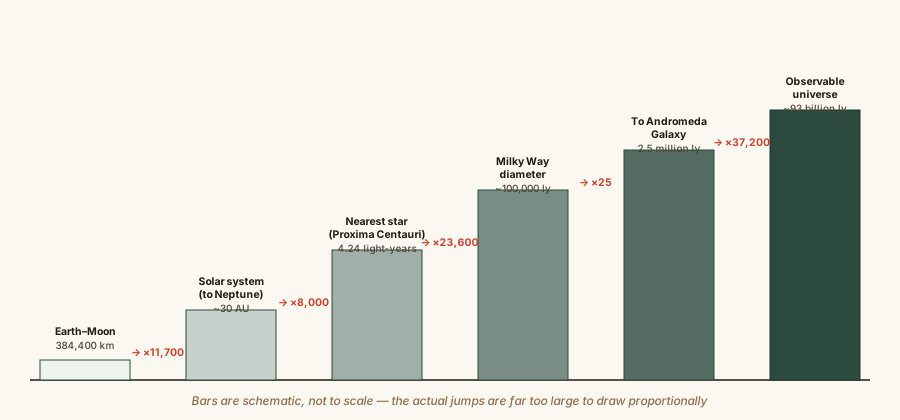
Scale comparison: Earth-Moon distance to the observable universe
Each step in the diagram jumps by a staggering multiple over the last — the leap from "width of the solar system" to "distance to the nearest star" alone is a jump of roughly 8,000 times. That's the core reason astronomers switch units as they zoom out: kilometers work fine for the Moon, astronomical units work for the solar system, and only light-years make interstellar and intergalactic distances describable without a wall of unmanageable zeros.
Common mistakes
Common Mistakes
✕
Assuming a light-year measures how long a trip would take, rather than how far away something is.
→ A light-year is purely a distance unit — how far light travels in one year. How long an actual trip takes depends entirely on the traveler's own speed, which is nowhere close to light speed for any human spacecraft.
✕
Picturing the Sun as literally yellow or orange in color.
→ The Sun's light is close to white when viewed from space; the yellow-orange tint seen from the ground comes from Earth's atmosphere scattering blue light more than red and yellow.
✕
Assuming that what we see when looking at a distant star or galaxy shows how it looks right now.
→ Because light takes time to travel, we're always seeing distant objects as they were when the light left — for very distant galaxies, that can mean seeing light billions of years old.
Common misconception
“A light-year measures time, the way it sounds like it might given the word 'year' in it.”
A light-year is a unit of distance, not time — specifically, the distance light travels in one year, about 9.46 trillion kilometers. The confusion comes from the name pairing a time unit (year) with a physical process (light traveling), but the resulting quantity is a fixed distance, the same way "a 3-minute walk" describes a distance covered, not a unit of time itself. Astronomers use it because kilometers and miles become unmanageably large numbers once you're talking about interstellar or intergalactic distances.
Quick check
Someone says, 'That star is 100 light-years away, so it must have taken 100 years for the light to reach us.' Is the reasoning here correct?
Try it yourself
Convert light-years to kilometers
Distance in kilometers40,113,497,203,742.59
What to do next
What to do next
Try the calculator above with the Milky Way's diameter (about 100,000 light-years) to see just how many kilometers wide our own galaxy is.
Next time you look up at a bright star at night, remember you may be seeing light that left it years, decades, or centuries ago.
Stop picturing the Sun as yellow — picture it as white, and the yellow-orange tones you actually see as an effect of Earth's atmosphere.
Read the related entry on the Solar System & Planets to see how astronomical units (AU) handle the smaller-scale distances inside our own solar system.
FAQ
FAQ
Related terms
Related terms
Light-year
A unit of distance, not time — the distance light travels in one year, about 9.46 trillion kilometers (5.88 trillion miles).
Galaxy
A massive, gravitationally bound system of stars, gas, dust, and dark matter — the Milky Way is one of an estimated hundreds of billions of galaxies in the observable universe.
Milky Way
The spiral galaxy that contains Earth's solar system, home to an estimated 100-400 billion stars.
Main-sequence star
A star, like the Sun, in the stable, hydrogen-fusing phase that makes up the majority of its lifetime.
Nebula
A giant cloud of gas and dust in space, often a site of star formation or the remnant of a star's death.
Supernova
The explosive death of a massive star, briefly outshining an entire galaxy and scattering heavy elements into space.
Black hole
A region of space where gravity is so strong that nothing, not even light, can escape once past its event horizon.
Observable universe
The portion of the universe close enough that its light has had time to reach us since the Big Bang — roughly 93 billion light-years in diameter.
Big Bang
The rapid expansion of an extremely hot, dense state that the entire observable universe expanded from roughly 13.8 billion years ago — the starting point of cosmic expansion, not an explosion happening at one point inside a pre-existing empty space.
Cosmic microwave background (CMB)
Faint microwave radiation that fills all of space, left over from about 380,000 years after the Big Bang when the universe first cooled enough for light to travel freely — its precise pattern is one of the strongest pieces of evidence for the Big Bang.
Redshift
The stretching of light toward longer, redder wavelengths as its source moves away from an observer; galaxies show more redshift the farther away they are, which is how astronomers know the universe is expanding.
Spiral galaxy
A galaxy with a flat, rotating disk and curving arms of stars and gas winding out from a dense central bulge — the Milky Way and Andromeda are both spiral galaxies.
Elliptical galaxy
A galaxy with a smooth, rounded shape and little of the gas needed for new star formation, typically made up of older stars — thought to often form when spiral galaxies collide and merge.
 KnowThis