Space Exploration & Technology: How Rockets, Orbits, and Space Travel Actually Work
Space exploration relies on rockets that use Newton's third law to accelerate to orbital or escape velocity, after which spacecraft either fall continuously around a planet in orbit or coast freely through deep space.
Reading time
— 7 min
Updated
— Aug 19, 2026
Fact-reviewed
— Aug 19, 2026
Key Takeaways
Key Takeaways
1Rockets work in the vacuum of space through Newton's third law — expelling exhaust mass backward at high speed pushes the rocket forward, with no need for air or anything else to 'push against.'
2Orbiting isn't escaping gravity — it's continuous free-fall. A spacecraft in low Earth orbit still experiences roughly 90% of Earth's surface gravity; it stays up by moving sideways fast enough to keep missing the ground as it falls.
3The speed of light creates a real, unavoidable communication delay in space — a signal to the Moon takes about 1.3 seconds one-way, and a signal to Mars takes anywhere from about 3 to 22 minutes depending on the planets' positions.
The concept
A rocket reaches space by burning fuel and shooting the resulting exhaust out the back at extremely high speed — the rocket gets pushed forward in reaction, the same way a released balloon zips around a room as air rushes out of it. Once a spacecraft is going fast enough, it can settle into an orbit, circling a planet instead of falling back down or flying off into space. Astronauts aboard an orbiting spacecraft like the International Space Station appear to float because they, the station, and everything inside it are all falling together at the same rate — not because gravity has disappeared.
Getting a spacecraft off the ground and into a stable orbit is only half the engineering problem — the other half is staying in contact with it once it's gone, and that's where the finite speed of light becomes an unavoidable, physical constraint on space missions.
Quick check
A common intuition is that rockets need air to push against, the way a swimmer pushes against water. Why do rockets actually work even in the vacuum of space?
Worked examples
Example 1: Radio signal delay to the Moon (baseline case)
The Moon sits an average of about 384,400 km from Earth. Radio signals travel at the speed of light, about 299,792 km/s. Travel time = distance ÷ speed = 384,400 ÷ 299,792 ≈ 1.28 seconds one-way. This is why Apollo-era mission control had to build in a brief pause after speaking before an astronaut's reply could arrive — a small but very real communication lag baked into the physics of the situation, not a technical fault.
Example 2: Why Mars rover communication delay isn't a fixed number (edge case / variation)
Unlike the Moon, Mars's distance from Earth changes dramatically because both planets orbit the Sun at different speeds. At closest approach (opposition), Earth and Mars can be as near as roughly 55-60 million km apart, giving a one-way signal delay of around 3 minutes. At their farthest (on opposite sides of the Sun, called conjunction), the distance can stretch past 400 million km, pushing the one-way delay to roughly 22 minutes. This variable, unavoidable delay — with no way to speed it up, since nothing travels faster than light — is exactly why Mars rovers like Perseverance and Curiosity are built with autonomous navigation software: mission control can't joystick a rover in real time when a single command-and-confirmation round trip can take up to 44 minutes.
Quick check
Mission engineers can't drive a Mars rover in real time the way you'd drive a remote-control car. What is the direct physical reason for this?
Example 3: Why the Apollo lunar module's ascent stage could be so small (real-world / applied case)
Earth's escape velocity is about 11.2 km/s, which is why leaving Earth requires a massive multi-stage rocket like the Saturn V. The Moon, with far less mass, has an escape velocity of only about 2.38 km/s — less than a quarter of Earth's. This real difference is exactly why the Apollo lunar module's ascent stage, the small craft that carried astronauts off the Moon's surface back to lunar orbit, could get away with a single modest engine and a fraction of the fuel a comparable Earth launch vehicle would need. The same underlying physics — thrust from Newton's third law overcoming a specific escape velocity threshold — scales dramatically differently depending on which body you're launching from.
How it works (visual)
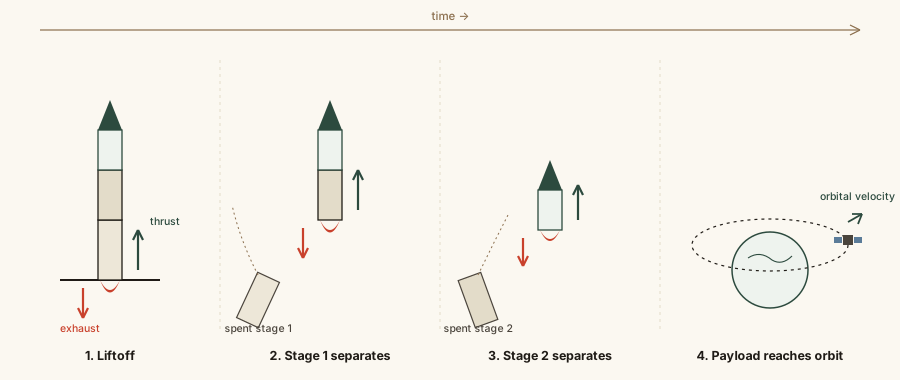
How a multi-stage rocket reaches orbit
Notice that the rocket doesn't fly straight up the whole way — after clearing the thickest part of the atmosphere, it pitches over and builds up horizontal (sideways) speed, because reaching orbit is really about going fast enough sideways to keep missing the ground, not about climbing to a certain height. Each stage separation sheds the mass of an empty fuel tank and spent engine, so the remaining stages don't waste thrust accelerating parts that are no longer useful — this is why multi-stage designs can reach orbital velocities that a single-stage rocket of the same total size generally cannot.
A short history of getting to space
Human spaceflight moved from theory to reality in a specific, fast sequence. The Soviet Union launched Sputnik 1 in 1957, the first artificial satellite, proving an object could reach orbital velocity at all. Just four years later, in 1961, Soviet cosmonaut Yuri Gagarin became the first human in space, completing one full orbit of Earth. The United States answered with the Apollo program, and in 1969 Apollo 11 landed the first humans on the Moon — an achievement made possible by exactly the escape-velocity and multi-stage rocket physics covered above, scaled up to the enormous Saturn V. Since 2000, the International Space Station has been continuously crewed without a single gap, making it humanity's longest-running foothold in space.
The most significant recent shift is the rise of the reusable rocket. Historically, every rocket stage was discarded after a single use — burned out, dropped into the ocean, and never flown again — which made the rocket itself one of the largest costs of any launch. Starting with the first successful landing of a Falcon 9 first stage in 2015, SpaceX demonstrated that a rocket stage could fly back down, reignite its engines to slow its descent, and land upright to be inspected, refueled, and reflown, cutting the cost of that stage across many missions instead of building a new one every time. This is a direct application of the same thrust-and-fuel physics covered earlier, just aimed downward for a controlled landing instead of only upward for launch.
Not every mission carries people. Space probes — uncrewed spacecraft like Voyager 1 and 2, or the Perseverance and Curiosity Mars rovers — explore far beyond where sending humans would be practical or safe, often over missions lasting decades. Orbiting telescopes like Hubble (launched 1990) and the James Webb Space Telescope (launched 2021) sidestep the way Earth's atmosphere blurs and blocks starlight, capturing sharper images and wavelengths (like infrared, for James Webb) that ground-based telescopes can't. Communications and weather satellites are usually placed in geostationary orbit specifically because that orbit keeps them fixed over one point on Earth, letting a satellite dish or weather station stay pointed at the same spot in the sky permanently rather than having to track a moving target.
Common mistakes
Common Mistakes
✕
Thinking rockets need air or something solid to push against, like an oar pushing against water.
→ Thrust comes from Newton's third law — expelling exhaust mass backward generates a forward reaction force with no external medium required, which is why rockets work in the vacuum of space.
✕
Assuming astronauts on the ISS float because they've left Earth's gravity behind.
→ At the ISS's altitude, Earth's gravity is still about 90% as strong as at the surface. Astronauts float because the station and everyone in it are in continuous free-fall together, not because gravity has switched off.
✕
Treating the Earth-Mars communication delay as a fixed number, like 'it always takes X minutes to talk to Mars.'
→ The delay changes constantly as both planets move in their orbits — anywhere from about 3 minutes at closest approach to about 22 minutes one-way at farthest separation.
Common misconception
“There's no gravity in space, which is why astronauts on the International Space Station float around.”
Gravity doesn't switch off in orbit — at the ISS's altitude of roughly 400 km, Earth's gravitational pull is still about 90% as strong as it is on the ground. What astronauts experience is continuous free-fall: the ISS is constantly falling toward Earth under gravity, but it's also moving sideways so fast (about 7.66 km/s) that the curve of the Earth falls away beneath it at the same rate it's falling — so it never actually gets closer to the ground. Everything and everyone inside the station is falling at that exact same rate, which is what produces the sensation of weightlessness, correctly called microgravity rather than "zero gravity."
Quick check
If Earth's gravity at the International Space Station's altitude is still about 90% as strong as on the ground, why do astronauts aboard appear weightless?
Try it yourself
Radio signal one-way travel time (distance ÷ speed of light)
One-way signal travel time (seconds)1.28
What to do next
What to do next
Try the calculator above with Mars's farthest distance from Earth (about 401,000,000 km) to see how the one-way delay stretches to roughly 22 minutes.
Next time you see footage of the ISS, remember astronauts are floating because they're in continuous free-fall, not because gravity has vanished.
Look up which stage separation altitude a rocket you're curious about (like Falcon 9 or Saturn V) uses, and connect it to the multi-stage mass-shedding idea above.
Read the related entry on Forces & Motion to see Newton's third law explained in full, outside the specific case of rocket propulsion.
FAQ
FAQ
Related terms
Related terms
Escape velocity
The minimum speed an object needs to break free of a planet's gravity without further propulsion — about 11.2 km/s from Earth's surface.
Orbit
A continuous free-fall path around a body, maintained because the object's sideways speed keeps it falling around the body rather than into it.
Low Earth orbit (LEO)
An orbit roughly 160 to 2,000 kilometers above Earth's surface, home to the International Space Station and most satellites, including crewed missions.
Geostationary orbit
A circular orbit about 35,786 kilometers above the equator where a satellite's orbital period matches Earth's rotation, so it appears fixed over one point on the ground.
Microgravity
The condition of apparent weightlessness experienced in orbit, caused by continuous free-fall rather than an absence of gravity.
Free-fall
The state of falling under gravity alone with no other forces acting — orbiting spacecraft are technically in continuous free-fall around the planet.
Multi-stage rocket
A rocket built from separate sections that burn out and detach in sequence, shedding dead weight so the remaining stages accelerate more efficiently.
Thrust
The forward force produced by a rocket engine, generated by expelling exhaust mass backward at high speed.
Reusable rocket
A rocket designed to land intact and fly again, rather than being discarded after one launch — the core innovation behind the sharp drop in launch costs since the mid-2010s.
Space probe
An uncrewed spacecraft sent to explore beyond Earth orbit — flying past, orbiting, landing on, or roving across another body — without carrying humans or returning to Earth.
 KnowThis