 KnowThis
Key Takeaways
Key Takeaways
- 1The adult human skeleton has 206 bones, and skeletal muscles move the body by pulling on those bones — muscles can only contract and pull, never push, which is why opposing movements need paired muscles.
- 2Most bones and joints work as levers, with the joint acting as the fulcrum, the muscle providing effort force, and the body part or object being moved acting as the load.
- 3Bone is living tissue that is constantly being broken down and rebuilt by dedicated cells, and both bone and muscle respond directly to how much they're used — this is why exercise strengthens them and inactivity weakens them.
The concept
That pulling-only mechanism is easy to state but easy to underestimate — it explains not just how a single joint bends, but why the body needs so many muscles working in coordinated pairs and groups just to move at all.
You bend your elbow to lift a cup, then straighten it again to set the cup down. What is happening with your biceps and triceps muscles?
Worked examples
Example 1: The forearm as a lever (baseline case)
Example 2: A calf raise as a different class of lever (edge case / variation)
A forearm curling a weight has a mechanical advantage of about 0.14 (less than 1). What does this actually tell you about the biceps?
Example 3: How resistance training rebuilds both muscle and bone (real-world / applied case)
When a muscle is repeatedly loaded beyond its accustomed level — as in resistance training — microscopic tears form in muscle fibers. The body responds during rest by repairing that tissue and adding new contractile proteins, making the fiber slightly thicker and stronger than before; repeated over weeks, this is how muscle mass and strength increase. Bone responds to the same kind of mechanical stress through its own remodeling cycle: osteoblasts increase bone deposition at the specific sites carrying the new load, gradually increasing bone density where it's needed most. This is why weight-bearing and resistance exercise are specifically recommended for maintaining bone strength — a swimmer, despite excellent cardiovascular fitness, gets far less bone-density benefit than a runner or weightlifter, because buoyancy removes most of the mechanical loading that triggers bone-building.
How it works (visual)
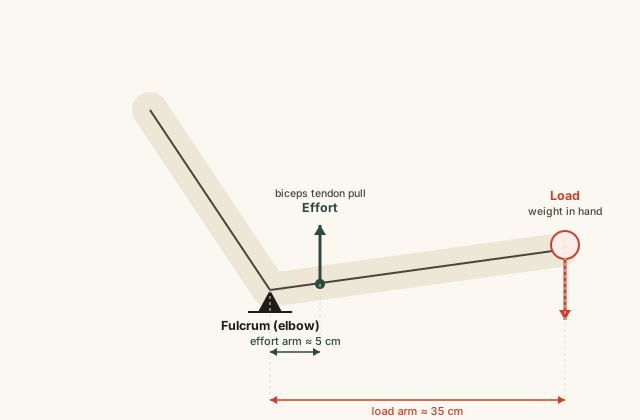
Trace the three points along the forearm: the fulcrum (elbow) stays fixed, the effort (biceps pull) is applied close to the fulcrum, and the load (the hand and whatever it's holding) sits much farther away. Because the effort arm is short and the load arm is long, this class of lever always trades force for speed — the same layout, at different scales, shows up at the knee, shoulder, and ankle throughout the body.
Common mistakes
Common Mistakes
Thinking a single muscle can both push and pull.
→ Muscles only generate force by contracting (pulling). Any 'push' motion you make — like straightening your arm — is actually a different muscle on the opposite side of the joint contracting and pulling in that direction.
Assuming bones are inert, unchanging structural material, like the steel frame of a building.
→ Bone is living tissue in constant turnover — osteoclasts break it down and osteoblasts rebuild it continuously, which is why bone density responds to exercise, diet, hormones, and age.
Believing more muscle mass automatically means proportionally more strength in every movement.
→ Strength in a specific movement also depends on lever geometry — where tendons attach relative to the joint — which varies between individuals and affects how much force translates into movement, independent of raw muscle size.
Common misconception
“Muscles can push as well as pull, the same way you'd push or pull a door.”
A muscle fiber generates force only one way: by contracting and shortening, which pulls its two attachment points closer together. It cannot actively lengthen and push. Every "pushing" motion the body performs — straightening a bent knee, extending a bent elbow — is actually a different muscle, on the opposite side of the joint, contracting and pulling in that direction. This is exactly why muscles are arranged in antagonistic pairs around nearly every joint in the body: one muscle group handles each direction of movement, because no single muscle can handle both.
Why does the body need paired muscles like the biceps and triceps, rather than one muscle that handles both bending and straightening the elbow?
Try it yourself
What to do next
What to do next
- Next time you bend and straighten a joint, notice which muscle you can feel contracting for each direction — that's the antagonistic pair in action.
- Try the lever calculator above with your own rough arm measurements to see your personal forearm mechanical advantage.
- If you lift weights or run, connect the muscle soreness afterward to the same repair-and-rebuild cycle that also strengthens bone density over time.
- Read the related entry on Forces & Motion to see how lever mechanics and force apply outside the body as well.