 KnowThis
Key Takeaways
Key Takeaways
- 1Aging is the buildup of specific biological changes at the cellular and tissue level, not just the passage of time — a person's chronological age (years lived) and biological age (physiological condition) can genuinely differ.
- 2Most human cells can only divide a limited number of times because their telomeres — protective caps on chromosome ends — shorten with each division, eventually triggering cellular senescence.
- 3Lifespan (the biological maximum) and life expectancy (a population-level statistical average) measure different things — global average life expectancy has risen dramatically over the past century even though the maximum human lifespan has changed far less.
The concept
That gap between chronological and biological age isn't just an abstract distinction — it shows up in concrete, countable terms once you look at how many times a given cell can actually divide before its telomeres run out.
Two people are both exactly 60 years old on paper. Why might one show significantly more age-related physical decline than the other?
Worked examples
Example 1: Telomere shortening and the limit on cell division (baseline case)
Example 2: Cells that don't follow the standard limit (edge case / variation)
Cancer cells are often able to divide far beyond the normal Hayflick limit that constrains most human cells. What's the most likely explanation?
Example 3: Chronological age versus biological age in real life (real-world / applied case)
Consider two people, both chronologically 60 years old. One has exercised regularly for decades, never smoked, and maintains a healthy diet; the other has been sedentary, smoked for many years, and eats a diet high in processed food. Research tracked by institutions like the NIH's National Institute on Aging has repeatedly linked these lifestyle factors to measurable differences in biological aging markers — including cardiovascular condition, muscle mass retention, and bone density — independent of the shared chronological age. The two people are the same age in years, but plausibly not the same age in the condition of their arteries, lungs, muscles, and bones. This is also the basis for the distinction between lifespan and healthspan: the goal of much current aging research isn't only to extend total years lived, but to extend the years lived in good health before serious age-related decline sets in.
How it works (visual)
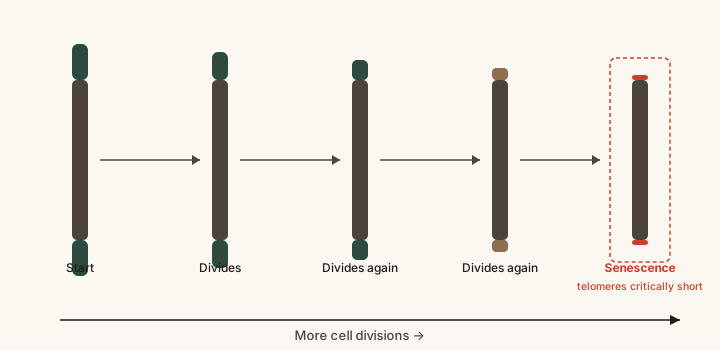
Read the diagram left to right as a timeline of divisions for a single cell lineage: each step shortens the telomere cap slightly, and the process is one-directional under normal conditions — telomeres don't grow back between divisions in most cell types. The final state, cellular senescence, isn't cell death; the cell survives and stays active but permanently stops dividing, which is a very different outcome from simply dying off.
Common mistakes
Common Mistakes
Treating chronological age as a complete measure of a person's physical condition.
→ Chronological age only counts years lived. Biological age — shaped by genetics, lifestyle, and cellular wear — is a separate and often more medically meaningful measure of physical condition.
Confusing lifespan (the biological maximum for a species) with life expectancy (a statistical population average).
→ Life expectancy rises mainly by reducing early and preventable deaths across a population; it doesn't mean the biological maximum lifespan itself has extended by the same amount.
Assuming cellular senescence means a cell has died.
→ A senescent cell is still alive and metabolically active — it has simply and permanently stopped dividing. Death and senescence are two different cellular outcomes.
Common misconception
“Aging is purely about the number of years a person has lived — it's just a count, not a biological process.”
Aging is a real, physical process happening continuously inside cells and tissues — including telomere shortening, accumulating cellular senescence, and gradual changes in organ function — not merely a number that increases on a birthday. This is exactly why chronological age and biological age can diverge: genetics and, importantly, modifiable factors like exercise, diet, sleep, and smoking history have all been linked by aging research to measurable differences in how quickly a person's biological markers of aging progress, independent of the number of birthdays they've had. Two people born on the same day can arrive at 60 with meaningfully different biological conditions.
If aging were purely about counting years lived, what observation from real aging biology would contradict that idea?
Try it yourself
What to do next
What to do next
- Try the calculator above with your own age and a life expectancy figure from your country's national statistics agency, and remember it's a population average, not a personal prediction.
- Next time aging comes up in conversation, distinguish chronological age (years lived) from biological age (physiological condition) — they aren't the same thing.
- Note that lifestyle factors linked to slower biological aging — regular exercise, not smoking, balanced diet — are the same factors covered throughout this body-systems series (muscles, bones, blood, hormones).
- Read the related entry on Hormones & the Endocrine System to see how hormonal changes with age, like declining estrogen or testosterone, connect to broader physical aging.